

An in-service 401(k) to gold rollover moves part of your vested 401(k) balance into a self-directed IRA that holds physical precious metals, while you still work for the employer that sponsors the plan. Whether you can do it is decided by your plan document, not by the gold dealer. If the plan allows it, the process is a direct transfer to an IRA custodian, followed by a metals purchase inside that IRA. Our in-house IRA department at GoldRock Metal Exchange walks you through each of those steps.
TL;DR
- An in-service rollover is a transfer from an active employer 401(k) to an IRA before you leave the job. It only exists if your plan permits it.
- For salary deferrals, federal law generally ties in-service distributions to age 59½, and only when the plan includes that option. Employer match money can follow different rules.
- A direct rollover, where the plan sends funds straight to the IRA custodian, avoids the 20% mandatory withholding that applies when a check is made out to you.
- The IRA can hold only approved metals, and they must be kept with an approved custodian arrangement, not at home.
- Metals carry costs and price risk. Nothing here is a promise of returns, safety or tax results.
Table of Contents
- What an in-service rollover actually is
- Can you move your 401(k) to gold while still employed?
- The in-service rollover to gold, step by step
- Request a Free Precious Metals Consultation
- Direct or indirect rollover: why the difference matters
- Which metals can an IRA hold?
- Storage and custody: the rule that surprises people
- Costs, risks and trade-offs to understand
- Moving IRA or TSP money instead of a 401(k)
- Where GoldRock fits in
- Our perspective
- FAQ
- Sources
What an in-service rollover actually is
Most people think of a 401(k) rollover as something that happens after you quit or retire. An in-service rollover is the same transfer, made while you are still an active employee. Professional guidance on the topic describes it as moving vested balances from an active employer plan into an IRA before you separate from employment, and notes that the plan document must permit distributions to current employees.
Three terms are worth defining before going further:
- Vested balance: the part of your account that belongs to you. Your own salary deferrals are always yours. Employer contributions may vest over time.
- Plan document: the legal rulebook for your employer’s 401(k). It decides which withdrawals, transfers and loans are allowed.
- Self-directed IRA: an individual retirement account whose custodian lets you hold assets beyond mutual funds and stocks, including approved physical metals.
An in-service rollover is not a loan and not a hardship withdrawal. A 401(k) loan is borrowed money you repay into the plan. A rollover is a transfer of retirement money from one retirement account to another. Under IRS rules, an eligible rollover distribution generally excludes hardship distributions, required minimum distributions and loans treated as distributions, so those cannot be rolled into gold at all.
Can you move your 401(k) to gold while still employed?
The honest answer is: it depends on your plan. Two layers decide it.
Layer one: federal law. For elective deferrals (the money you chose to contribute from your paycheck), the Internal Revenue Code generally ties in-service distributions to reaching age 59½. The in-service guidance citing IRC 401(k)(2)(B)(i)(III) describes this as the general rule, applicable only if the plan includes the option.
Layer two: your plan. Even where federal law allows a distribution, your employer’s plan has to offer it. Some plans allow in-service rollovers of certain sources only, such as after-tax contributions or rollover money you brought in from a prior employer. Employer match money may not be distributable in-service until later, depending on how the plan is written.
To find out where you stand:
- Ask your plan administrator or HR department for the summary plan description, the plain-language version of the plan document.
- Look for the headings “in-service distributions,” “in-service withdrawals” or “rollovers out.”
- Check which contribution sources are covered (deferrals, match, after-tax, prior-employer rollovers) and any minimum age or service requirement.
- Ask the administrator how many in-service distributions per year are allowed and whether they charge a processing fee.
If you want a second set of eyes on what the plan language means for the metals side of the move, call us at (888) 859-0978. Questions about the legal or tax effect of a specific withdrawal belong with your plan administrator, a tax professional or an attorney.
For a broader view of who qualifies for a metals IRA, see our guide to gold IRA eligibility and what the IRS requires.
The in-service rollover to gold, step by step
The sequence below is the general process. Each step has a place where delays tend to happen, and in several of them our IRA department takes the paperwork off your hands.
Step 1: Confirm your plan allows it
Start with the plan check above. Nothing else matters until the plan administrator confirms in writing that an in-service rollover is available to you and for which money sources. The most common delay is asking for the wrong source, for example requesting the whole balance when only part of it is eligible.
Step 2: Open a self-directed precious metals IRA
Your 401(k) cannot buy metals directly. You need an IRA with a custodian that handles precious metals. We provide personalized guidance on self-directed IRAs, and our in-house IRA department handles the setup so you are not passing forms between several parties. You can start from our Precious Metals IRA page or go straight to opening an IRA.
Step 3: Request a direct rollover from the plan
You submit the plan’s distribution form and choose a direct rollover to the new IRA. The money moves from the plan to the IRA custodian, either by wire or by a check payable to the custodian for your benefit, not to you personally. Forms vary by plan. Common errors are a misspelled custodian name, a missing account number and checking the wrong box for the distribution type.
Our IRA department helps you complete the receiving-side details so the instructions match what the custodian expects.
Step 4: Wait for funds to arrive and settle
Plans take different amounts of time to process distributions, so we do not quote a fixed timeline. Funds must be received and show as available in the IRA before a purchase can be placed. Keep your plan administrator’s confirmation until the transfer shows in the new account.
Step 5: Choose approved metals
With funds in the IRA, you select the metals. We carry gold, silver, platinum and palladium, and your consultation covers which products fit IRA rules and your goals. More on this in the next section.
Step 6: Complete the purchase and arrange storage
The IRA buys the metals, and they are held under the custodian arrangement. IRA metals are not shipped to your house. If you also want metals outside a retirement account, Private Delivery is how we get physical purchases to you with insured delivery.
Step 7: Keep records and stay in touch
Keep the plan confirmation, the rollover paperwork, the purchase confirmation and each year’s account statements. We offer ongoing consultations after the purchase, so questions about your holdings do not end at checkout.
Request a Free Precious Metals Consultation
If your plan permits in-service rollovers and you want to see how the process would work for your account, Request a Free Precious Metals Consultation or call (888) 859-0978. A GoldRock IRA specialist can explain each step and answer questions about the metals before you commit to anything.
Direct or indirect rollover: why the difference matters
There are two ways to move the money, and the choice changes what happens with withholding.
| Direct rollover | Indirect (60-day) rollover | |
|---|---|---|
| Who receives the money | The IRA custodian | You |
| Federal withholding | Generally none on the rollover | Plan generally must withhold 20% |
| Your deadline | Plan and custodian processing | 60 calendar days to redeposit |
| Risk of paperwork error | Lower | Higher |
The IRS explains that when an eligible rollover distribution is paid to you, the payer generally must withhold 20% for federal income tax, and a direct rollover avoids that. With an indirect rollover, you must redeposit the full amount, including the withheld portion, within 60 calendar days for the rollover to be completed without tax consequences. That means you would need to cover the withheld 20% from other funds until the IRS refunds it.
Because a direct rollover keeps the money out of your hands, it is the route we set up for in-service moves. Our guide to the 60-day rollover and the 20% withholding goes deeper. How any of this applies to your tax return is a question for a qualified tax professional.
Which metals can an IRA hold?
Not every coin or bar qualifies. The IRS treats most collectibles as off-limits for IRAs, with an exception for certain bullion that meets purity standards under Section 408(m) of the Internal Revenue Code. In practice:
- Gold, silver, platinum and palladium can all be IRA-eligible when the product meets the required fineness (purity) and is produced to the required standard.
- Rare or numismatic coins are generally treated differently from bullion. Collectible value is the reason they can fall outside IRA rules.
- Purity alone is not enough. A product can have high purity and still fail eligibility, which is why we check each item before it goes into an IRA.
We cover the rules in detail in Gold IRA Rules, Section 408(m) and gold and our IRA-safe guide to coins. For platinum specifically, see the Platinum IRA guide.
You can browse the full range by metal: gold, silver, platinum and palladium. Eligibility for IRA purposes is confirmed with your IRA specialist before purchase.
Storage and custody: the rule that surprises people
In an IRA, the metals are owned by the retirement account, not by you personally. That is why IRA metals are kept with an approved custodian arrangement instead of in a home safe. Taking personal possession of IRA metals can be treated as a distribution, with consequences your tax professional can explain.
This is the main difference between buying metals inside an IRA and buying them outright. Outside an IRA, you own the metals directly and can take insured private delivery. Inside an IRA, the structure comes first. Many investors do both: a retirement allocation held under the IRA arrangement and a separate purchase delivered to them.
Costs, risks and trade-offs to understand
Moving retirement savings into physical metals is a decision about allocation, not a guarantee of anything. Calm, informed investors look at these points:
- Price movement. Metal prices rise and fall. Past performance does not predict future results, and we make no promise of appreciation.
- Costs. A metals IRA typically involves a setup fee, annual custodian and storage fees, and the difference between a dealer’s buy and sell prices. Ask for every fee in writing during your consultation.
- No income. Physical metals do not pay interest or dividends the way bonds and many stocks do.
- Allocation size. Most investors move a portion of their savings rather than everything. Our article on 5 to 15% gold for U.S. retirement explains how allocation questions are usually framed. The right percentage for you is a conversation with your financial adviser.
- Plan trade-offs. Money you leave in the 401(k) keeps whatever features the plan has, such as employer matching on new contributions. Check how an in-service move affects your ongoing contributions before you request it.
- Other ways to diversify. Some retirement savers also look at assets like real estate, and a short overview of investing in property for retirement shows how that thinking works. Physical metals are one tool among several.
If withdrawals are your concern, our guide to gold IRA distribution rules covers required minimum distributions and age 59½.
Moving IRA or TSP money instead of a 401(k)
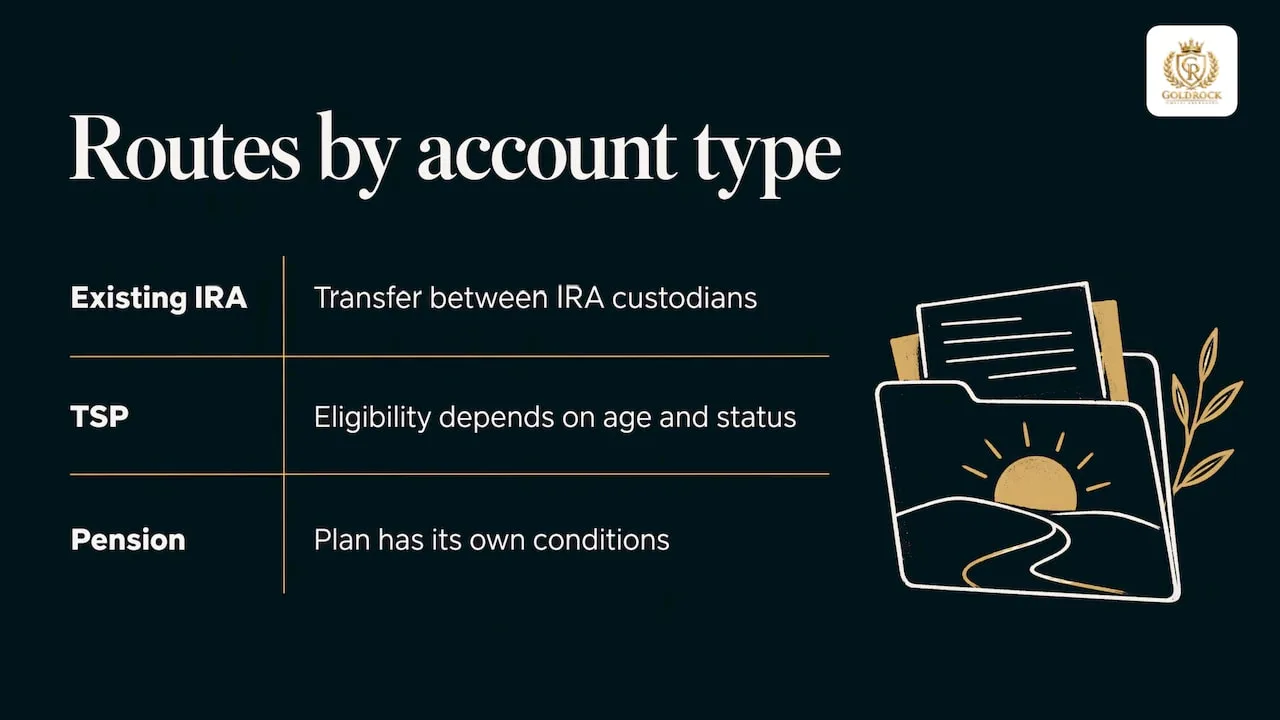
The route depends on where the money sits.
Existing IRA (traditional, Roth, SEP, SIMPLE). There is no employer plan to ask. You open the self-directed IRA and request a transfer or rollover between IRA custodians. Because no plan document is involved, in-service rules do not come into it. Our IRA department coordinates the receiving side.
Thrift Savings Plan (TSP). The TSP is the federal employee retirement plan, and it has its own withdrawal rules for people still in service. Check the TSP’s current rules for in-service withdrawals and transfers to an IRA before you plan anything, since eligibility depends on your age and status. Once the TSP releases funds to your IRA, the metals steps are the same as above.
Pensions. Pension plans have their own conditions. See how to move a pension to a gold IRA.
If you are comparing in-service rollovers with moving money after you leave a job, our page on paperwork for a 401(k) to gold move walks through that version.
Where GoldRock fits in
A rollover touches three parties: your plan administrator, the IRA custodian and the metals dealer. Delays usually come from the handoffs between them. We keep the handoffs short with a dedicated in-house IRA department that supports the transfer from your plan into a Precious Metals IRA, plus personal guidance on the metals themselves. If you also want metals delivered to you outside the IRA, we offer insured private delivery. Start with our Precious Metals IRA page or call (888) 859-0978.
Our perspective
Most people who ask us about moving a 401(k) to gold while still working are not chasing a trend. They are watching market swings and inflation and want some of their retirement savings in something tangible.
What we tell them first is that the plan comes first. Your plan document decides whether an in-service rollover is possible, and a direct rollover keeps the transfer clean. We would rather spend the first conversation on those details than rush you to a purchase.
We built an in-house IRA department because the transfer is where people get stuck. One team that handles the IRA paperwork and the metals, with personal service and ongoing consultations afterward, is how we think a rollover should feel: organized and unhurried.
Physical metals are a portion of a plan, not the whole plan. We never promise returns, and we encourage you to work through allocation with your financial adviser and tax questions with a tax professional.
Blake
FAQ
Can I roll over my 401(k) to gold while I’m still working?
Only if your plan document allows in-service distributions. For salary deferrals, federal law generally ties them to age 59½, and the plan must include the option. Ask your plan administrator for the summary plan description to confirm.
Is an in-service rollover the same as a 401(k) loan?
No. A loan is borrowed money you repay into the plan, and a loan treated as a distribution is not an eligible rollover distribution. A rollover moves retirement money from the plan into an IRA, where the metals are purchased.
Why do people choose a direct rollover?
In a direct rollover the plan sends funds straight to the IRA custodian. When a distribution is paid to you instead, the plan generally must withhold 20% for federal income tax, and you have 60 days to redeposit the full amount. Your tax professional can explain how that applies to you.
Can I keep IRA gold at home?
IRA metals are held under an approved custodian arrangement, not at home. Metals you buy outside an IRA can be delivered to you with insured private delivery.
Can I move an IRA or TSP balance to silver or platinum too?
Eligible IRA funds can be moved to a self-directed IRA and used to buy approved gold, silver, platinum or palladium. TSP withdrawals follow the TSP’s own rules, so check your eligibility first. Our IRA specialists can walk you through the metals side.
If you are ready to talk it through, Request a Free Precious Metals Consultation or call (888) 859-0978.
Educational disclaimer: This article is for general education only. It is not investment, tax or legal advice, and it does not promise returns, safety, appreciation or tax benefits. Rules change and depend on your plan and circumstances. Consult your plan administrator, a qualified tax professional and a licensed financial adviser before moving retirement funds.
Sources
- In-Service 401(k) Rollover: 2026 Rules and Tax Guide
- IRS Publication 575 (2017), Pension and Annuity Income
- Advanced Markets guide to rollovers and IRA planning
- Why Investing in Property Is Crucial for Your Retirement