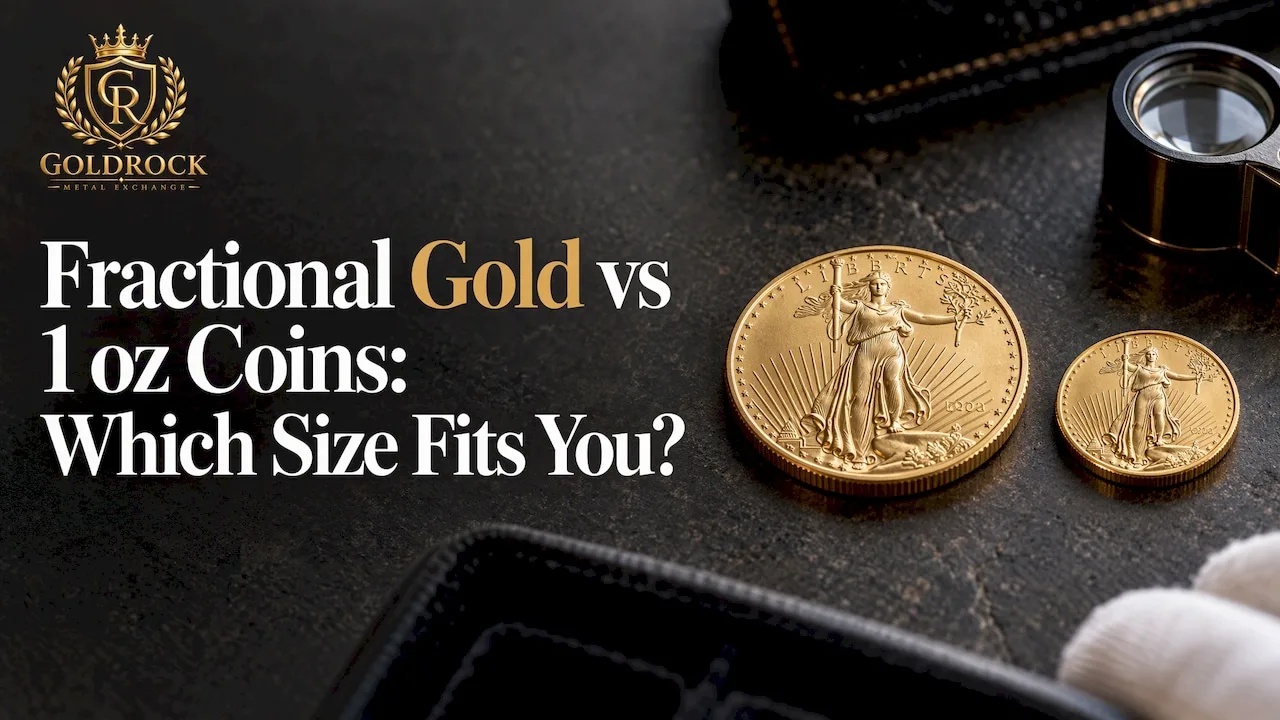
Fractional gold (1/10, 1/4 and 1/2 oz coins) usually costs more per ounce of gold than a 1 oz coin, because the percentage premium over spot is typically higher on smaller sizes. In return, you get a lower entry price and more flexibility when you buy, gift or sell in pieces. A 1 oz coin is usually the more efficient way to accumulate gold. Fractionals are usually the more flexible way to hold it. The right mix depends on your budget, how you plan to sell, and whether the metal will sit in a retirement account. If you want to talk it through, our team at GoldRock Metal Exchange can walk you through the sizes at (888) 859-0978.
This article is educational only. It is not investment, tax or legal advice, and it does not predict or promise returns.
TL;DR
- Fractional gold means coins under one troy ounce, most often 1/10, 1/4 and 1/2 oz.
- Smaller coins normally carry a higher percentage over melt value than one-ounce pieces, so each ounce of gold costs more.
- A 1 oz coin favors cost efficiency. Fractionals favor a smaller starting budget, buying in steps and selling in portions.
- Many buyers hold both: a core of 1 oz coins and a smaller layer of fractionals.
- Compare the all-in price per ounce of gold, not the sticker price of the coin.
Table of Contents
- What counts as fractional gold
- Fractional gold vs 1 oz: side-by-side
- Why fractional gold costs more per ounce
- When a 1 oz coin makes sense
- When fractional gold makes sense
- A practical way to choose
- Request a free consultation
- What GoldRock offers
- Fractional gold, 1 oz coins and retirement accounts
- Our perspective
- Frequently asked questions
- Ready to compare sizes?
- Sources
What counts as fractional gold
A fractional gold coin holds less than one troy ounce of gold. The American Numismatic Association identifies fractional gold pieces as 1/10, 1/4 and 1/2 ounce. The U.S. Mint shows the same ladder in its flagship product: American Eagle gold bullion coins come in one-ounce, half-ounce, quarter-ounce and tenth-ounce weights.
Two details trip up new buyers.
The ounce is a troy ounce. Precious metals are weighed in troy ounces, not the ounces on a kitchen scale. NIST lists 1 troy ounce as 31.1034768 grams, while an ordinary avoirdupois ounce is about 28.35 grams. So a 1/10 oz coin holds roughly 3.11 grams of gold.
Coin weight and gold content are not the same. American Gold Eagles contain 1.0000, 0.5000, 0.2500 and 0.1000 troy ounce of fine gold respectively. The coins themselves weigh slightly more because the 22-karat alloy includes silver and copper. Always compare fine gold content, not gross coin weight.
Fractional gold vs 1 oz: side-by-side
| Factor | 1 oz coin | Fractional (1/10, 1/4, 1/2 oz) |
|---|---|---|
| Entry cost | Highest per coin | Lower per coin |
| Premium over spot (percentage) | Typically lower | Typically higher |
| Cost per ounce of gold | Usually lower | Usually higher |
| Selling flexibility | One piece, all or nothing | Sell a little at a time |
| Gifting or dividing | Hard to split | Easy to divide among people |
| Storage and handling | Fewer pieces to track | More pieces to count, store and insure |
| Best fit | Efficient accumulation | Small budgets, stepwise buying, partial sales |
Why fractional gold costs more per ounce
The ANA advises that 1/10, 1/4 and 1/2 ounce gold pieces normally carry a higher percentage over melt value than one-ounce pieces. The reason is structural. Striking, packaging, shipping and handling a coin costs much the same whether it holds a tenth of an ounce or a full one, so those costs weigh more heavily on a small coin.
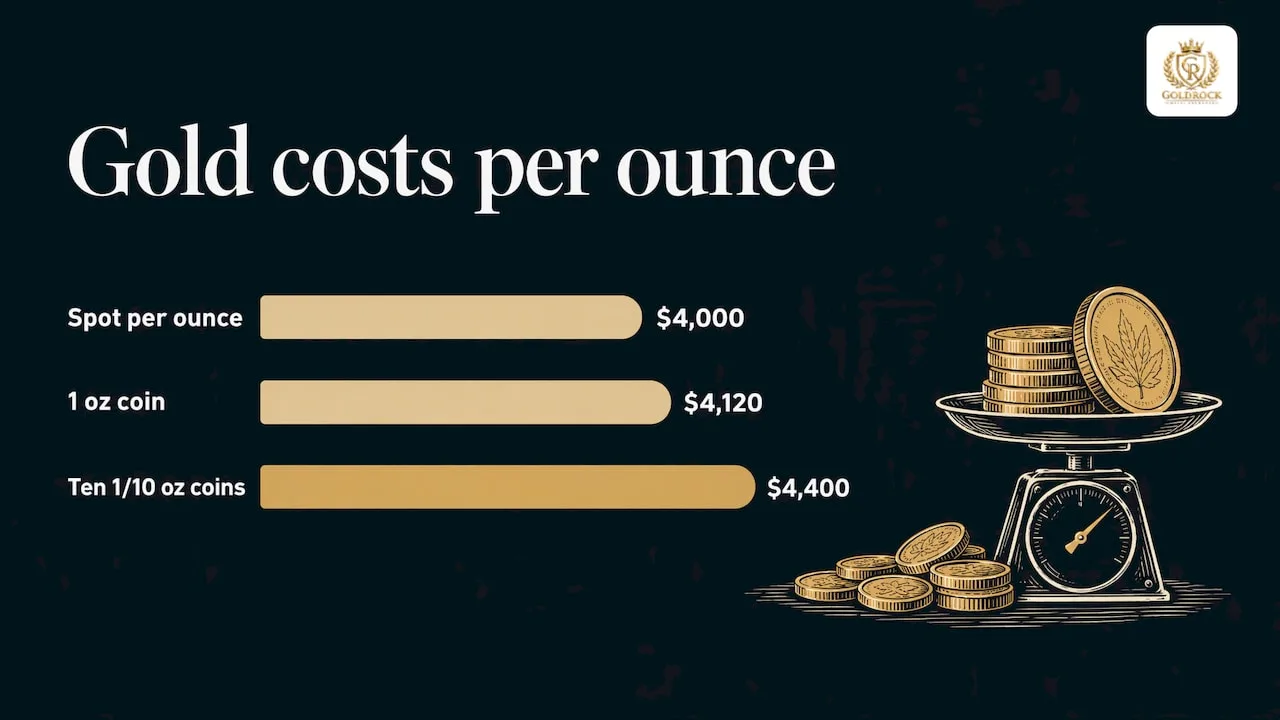
Here is a hypothetical example with round numbers, not a quote. Assume gold is $4,000 per ounce.
- A 1 oz coin at a 3% premium costs $4,120.
- A 1/10 oz coin at a 10% premium costs $440. That is the equivalent of $4,400 per ounce.
- Buying ten of those 1/10 oz coins would cost $4,400 for the same one ounce of gold, or $280 more than the single coin.
Premiums change with market conditions, product and dealer, so the real percentages will differ. The pattern holds: the smaller the piece, the more of your payment goes to something other than gold. Our guide on gold premium over spot shows how to read a quote line by line.
Premium is also a real cost when you sell. What a buyer pays you depends on market demand, inventory and the coin’s condition, so a higher purchase premium is not something to count on getting back. Price moves can matter too. Coverage of gold’s sustained rally and record trading volume is a reminder that spot can move quickly between the day you buy and the day you sell. We never predict where it will go.
When a 1 oz coin makes sense
A one-ounce coin tends to suit you when:
- Efficiency is the goal. You are building a position over time and want as much of each dollar as possible to buy gold rather than fabrication.
- You buy in larger amounts. The premium gap compounds as the dollar amount grows.
- You want simplicity. One coin is one line on your records, one item to store and one item to sell.
- You plan to hold for the long term. Fewer transactions means fewer premiums paid.
The U.S. Mint notes that Gold Eagles use a 22-karat alloy that makes the coins harder and more resistant to scratching and marring. Surface condition can affect resale value, so keep coins in their protective packaging whatever the size.
When fractional gold makes sense
Fractionals earn their place in specific situations:
- A smaller starting budget. A 1/10 oz coin lets you own physical gold without committing the price of a full ounce.
- Buying in steps. You can add a coin each month or quarter instead of waiting to save for an ounce.
- Selling in portions. If you might need part of your holdings, you can sell one small coin instead of your whole ounce.
- Gifts and family transfers. Small coins divide cleanly among several people.
- Flexible rebalancing. Smaller pieces let you trim a position by a precise amount.
These are reasons of convenience and control. The higher premium is the price of that flexibility, and for many buyers it is a fair price.
A practical way to choose
Use these criteria in order.
- Set your goal. Efficient accumulation points toward 1 oz. Flexibility and divisibility point toward fractionals.
- Set your budget. Decide how much you want to put in gold in total, then see how many pieces that buys in each size.
- Compare all-in cost per ounce. Divide the total price, including shipping and any fees, by the fine gold content. The live prices page gives you the spot reference.
- Think about the exit. If you may sell in parts, price what a mix of sizes would look like. Our guide to selling gold in the U.S. explains how to compare quotes after fees.
- Decide on a split. A common approach is a core of one-ounce coins plus a smaller reserve of fractionals. It is a way to balance cost and flexibility, not a rule.
A worked example
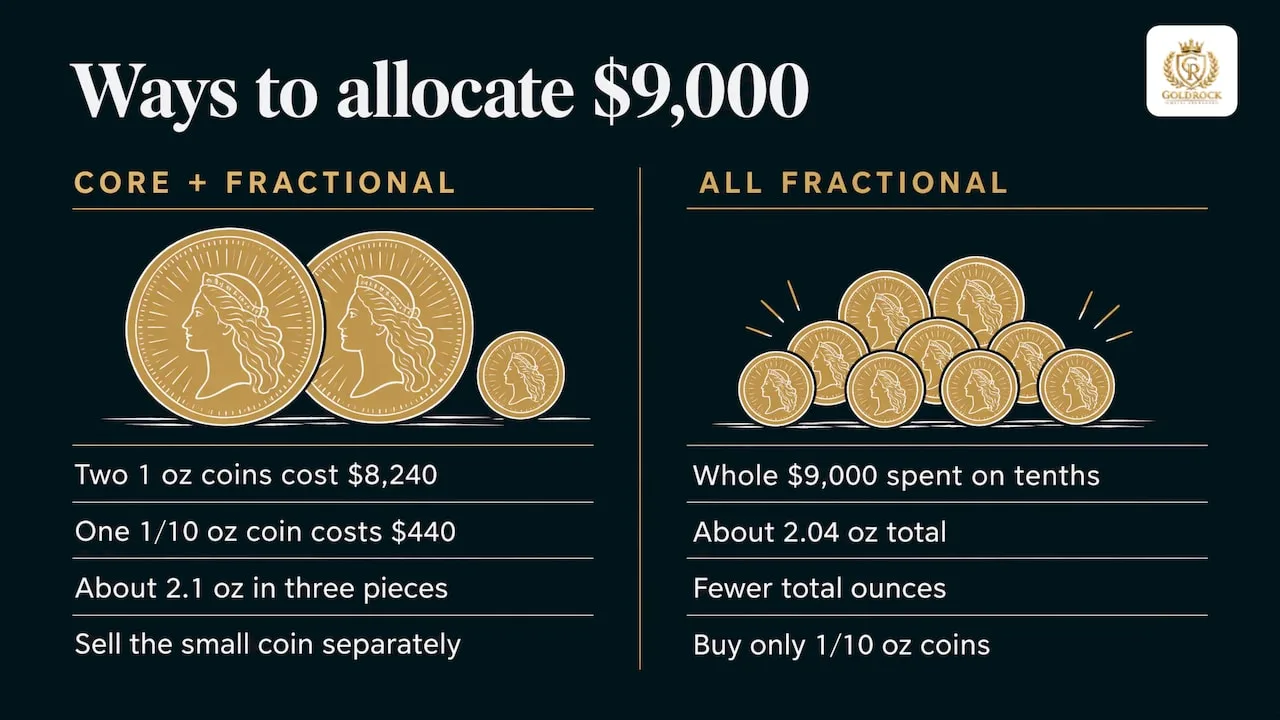
Suppose you have $9,000 to put into gold, using the hypothetical prices above. You could buy two 1 oz coins for $8,240 and use the remaining $760 on one 1/10 oz coin at $440, leaving a little for shipping. You would hold about 2.1 ounces in three pieces and could sell the small coin on its own. Spending the whole amount on 1/10 oz coins would buy fewer total ounces, around 2.04. The one-ounce core buys more gold for the same money. The fractional layer buys the ability to sell in smaller pieces.
Request a free consultation
Choosing sizes is easier with someone who can price the options side by side. If you would like to compare sizes against your budget, Request a Free Precious Metals Consultation or call (888) 859-0978.
What GoldRock offers
GoldRock Metal Exchange is a full-service precious metals dealer. You can browse gold in the sizes we carry, along with silver, platinum and palladium, and order online or by phone.

We also offer insured private delivery of purchased metals, so your order reaches you with the shipment protected. For retirement accounts, our in-house IRA department provides personalized guidance on self-directed Precious Metals IRAs. For examples of which coins investors commonly consider, see our gold coin examples guide.
Fractional gold, 1 oz coins and retirement accounts
If you are thinking about holding gold in a self-directed IRA, coin choice has extra rules about which products qualify and how they are held. Those rules differ from buying metal for your own safe or private delivery. Our guide to investing in coins for retirement covers what to look at, and our IRA department can answer product-eligibility questions before you commit. For questions about taxes or your personal situation, speak with a qualified tax professional or financial adviser.
Our perspective
Most people who ask us about fractional gold are really asking two questions: how much do I want to own, and how do I want to be able to sell it. The first is a budget question. The second is a flexibility question. Neither has one right answer.
Our view is that cost per ounce should be the starting point, because it is the number that shows what you are paying for the gold itself. From there, size is a tool. Larger coins keep the cost of each ounce down. Smaller coins let you buy and sell in steps.
We built our service around personal guidance for that reason. You can talk with us about sizes, metals and delivery, and if you are working with a retirement account, our in-house IRA department handles the transfer process with you. We would rather you understand the trade-offs clearly than buy a size you did not choose on purpose.
Blake
Frequently asked questions
Is fractional gold a worse deal than a 1 oz coin?
It costs more per ounce of gold because premiums are normally higher as a percentage on smaller coins. That is a cost of flexibility, not a flaw. If you want to buy in steps or sell in portions, the extra premium can be worth paying.
What is the difference between an ounce and a gram of gold?
Gold is priced by the troy ounce, which equals about 31.1 grams according to NIST. A gram is therefore roughly 1/31 of a troy ounce. A regular ounce is lighter, at about 28.35 grams.
How much gold is in a 1/10 oz coin?
A 1/10 oz American Gold Eagle contains 0.1000 troy ounce of fine gold, about 3.11 grams, per the U.S. Mint. The coin itself weighs a little more because of the silver and copper in its alloy.
Can I mix fractional and 1 oz coins?
Yes. Many buyers hold one-ounce coins for efficiency and a few fractionals for flexibility. A consultation can help you set a mix that fits your budget and how you plan to sell.
Should I choose sizes differently for an IRA?
Possibly. Retirement accounts have product and storage rules that a personal purchase does not. Ask our IRA department which products qualify before you buy, and consult a tax professional for tax questions.
Ready to compare sizes?
If you want help matching coin sizes to your goals, Request a Free Precious Metals Consultation or call GoldRock Metal Exchange at (888) 859-0978.
Disclaimer: This content is for educational purposes only. It is not personalized investment, tax or legal advice. Precious metals prices can rise or fall, and nothing here promises returns, safety, tax benefits or appreciation.
Sources
- American Eagle Gold Bullion Coins, U.S. Mint
- Tips for Buying and Selling Bullion, American Numismatic Association
- Precious Metals Conversion Information, NIST