

If you take money or metal out of a gold IRA before age 59½, the IRS generally treats it as an early distribution. That means the amount is typically included in your income, and a 10% additional tax can apply on top of it, unless an exception fits. Moving an account to a new custodian through a proper rollover or direct transfer is a different event from a withdrawal. This guide explains the difference, the exceptions, and the steps people take to keep a retirement move from becoming an accidental distribution.
This article is educational. It is not tax, legal or investment advice, and it does not describe your personal situation.
TL;DR
- The IRS generally adds a 10% tax to IRA distributions taken before age 59½, on top of regular income tax, unless an exception applies.
- A rollover or transfer into another IRA or qualified plan is not an early withdrawal when it is done correctly.
- Gold IRAs follow the same early distribution rules as other IRAs, because the metal is simply the asset inside the account.
- Required minimum distributions are a separate rule with their own penalty, starting at age 73.
- A tax professional should confirm how any of this applies to you before you act.
Table of Contents
- What counts as an early withdrawal from a gold IRA
- What the 10% additional tax actually costs
- Exceptions to the 10% additional tax
- Rollover or transfer: why moving an account is not a withdrawal
- Buying metals inside the IRA versus taking possession
- Traditional versus Roth: how withdrawals differ
- Early withdrawal versus required minimum distributions
- A practical order of operations
- How GoldRock can help
- FAQ
- Sources
What counts as an early withdrawal from a gold IRA
A gold IRA is an individual retirement arrangement that holds approved physical metals instead of, or alongside, stocks and funds. The IRS does not create a separate penalty for it. The same rules that apply to any traditional or Roth IRA apply here.
The IRS defines amounts taken from an IRA or retirement plan before age 59½ as early or premature distributions. People generally owe the additional 10% tax on them unless an exception applies. The IRS says the 10% tax is meant to discourage using IRA money for purposes other than retirement.
Three situations commonly fall into this category for metals owners:
- Cashing out. You sell metals inside the account and take the cash.
- Taking metals out in kind. You ask the custodian to distribute coins or bars to you rather than sell them.
- A rollover that goes wrong. Funds are paid to you and not redeposited into a retirement account in time.
The third case catches people off guard. Our guide on the 60-day rollover trap walks through how a move that was meant to be tax-neutral can turn into a distribution.
What the 10% additional tax actually costs
The 10% additional tax applies to the part of the early distribution that you must include in gross income, and it is in addition to regular income tax. Two separate charges can therefore apply to the same withdrawal.
Here is a simple illustration of the arithmetic only. Suppose a traditional gold IRA distribution of $20,000 is fully includable in income and no exception applies. The additional tax is $2,000. Ordinary income tax comes on top, and its amount depends on your income, filing status and other facts that we cannot know. We do not estimate that figure here.
A few related points that readers often miss:
- Form 1099-R. After a traditional IRA distribution you generally receive a Form 1099-R. Box 7 carries a code: code 1 for an early distribution with no known exception, and code 2 for an early distribution where an exception applies.
- Form 5329. The IRS instructions say you generally file Form 5329 to report an exception to the 10% additional tax.
- Metals prices matter. A distribution in kind is measured by the value of the metal when distributed, so the same coins can represent different taxable amounts at different times. Nobody can promise what a given metal will be worth.
Because the details turn on your own return, this is a question for a qualified tax professional.
Exceptions to the 10% additional tax
The IRS lists a number of situations where the additional tax does not apply to an early IRA distribution. The IRS page on early distribution exceptions includes, among others:
- Distributions after the owner’s death, paid to a beneficiary or estate
- Total and permanent disability
- Terminal illness
- Unreimbursed medical expenses above the IRS threshold (7.5% of adjusted gross income, per the IRS retirement topics page)
- Health insurance premiums paid while receiving unemployment compensation
- Substantially equal periodic payments, often called SEPP
- Qualified higher education expenses
- Up to $10,000 for a qualified first-time home purchase
- Qualified birth or adoption distributions, up to $5,000
- Qualified reservist distributions, IRS levy payments, domestic abuse victim distributions and certain disaster-related distributions
Each exception carries its own conditions, and some apply to IRAs but not to employer plans, or the other way round. An exception removes the additional 10% tax only. The distribution itself can still be includable in income. Read the IRS wording for the exception you think fits, and confirm with a tax professional before relying on it.
Rollover or transfer: why moving an account is not a withdrawal
Most people who ask about early withdrawal penalties on a gold IRA are really asking about funding one from a 401(k), a 403(b), a TSP account or an existing IRA. That is where the distinction between a transfer and a rollover matters.
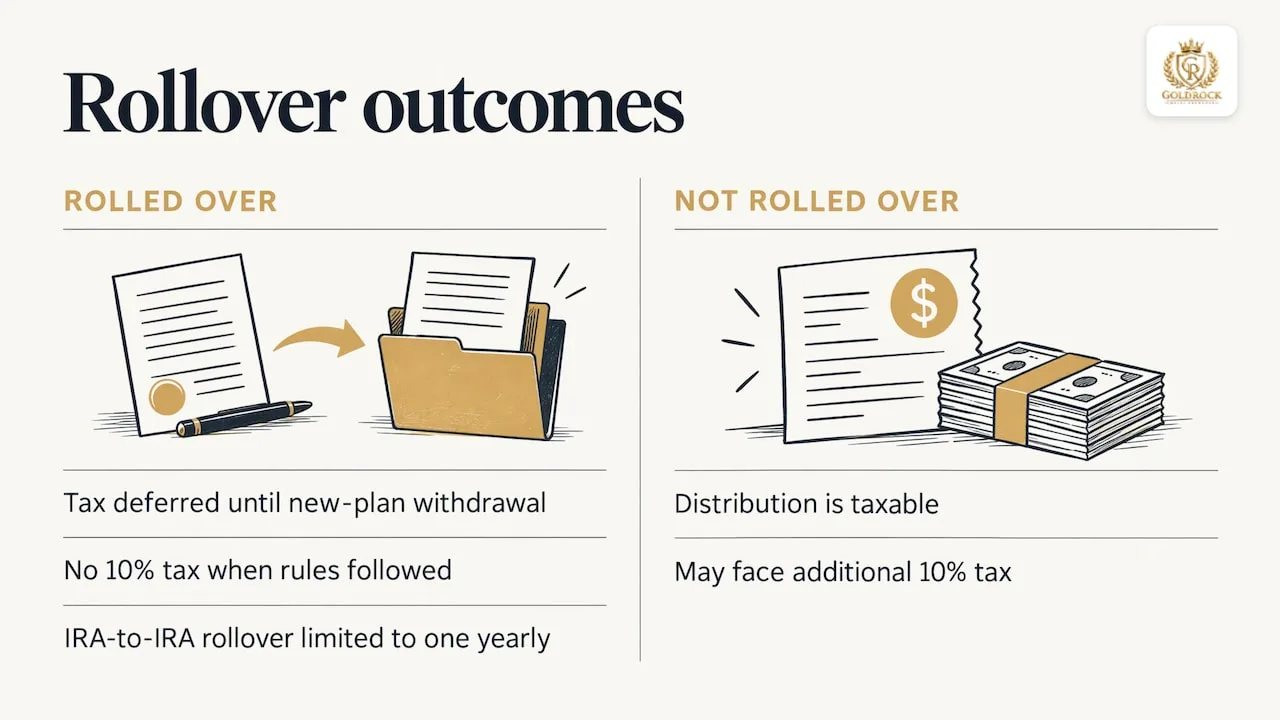
The IRS explains that when you roll over a retirement plan distribution, you generally do not pay tax until you withdraw it from the new plan. If you do not roll it over, it is taxable and may also face the additional 10% tax unless an exception applies. Distributions rolled over to another IRA or qualified plan are not subject to the 10% additional tax when the rules are followed, including the one IRA-to-IRA rollover per year limit.
Direct transfer
In a direct transfer, the money moves from one custodian to another and you never receive it. There is no 60-day clock, and the one-rollover-per-year limit does not come into play for a custodian-to-custodian IRA transfer. Many people prefer this route for that reason. Our article on avoiding rollover mistakes with direct transfers covers the common errors.
60-day rollover
In a 60-day rollover, a check is made out to you and you redeposit it into a qualifying retirement account within the IRS time limit. The IRS says that after January 1, 2015 you can make only one rollover from an IRA to another IRA in any 12-month period, counting all your IRAs as one. Rollovers from an employer plan can also involve mandatory tax withholding that you would need to make up from other funds to roll over the full amount. We explain this in how 20% withholding works on a 60-day rollover.
Rollovers between IRAs also raise their own tax questions depending on what the account holds, such as UBTI filing on IRAs for certain alternative investments. For metals held directly, a custodian can explain which of those rules are relevant.
How long a move takes
Paperwork, signatures and the sending institution’s own processing all affect timing. We cover what to expect in our gold IRA rollover timeline. If you are working with a 401(k) specifically, see moving a 401(k) to gold without penalty. Pension holders can read about moving a pension to a gold IRA.
| Direct transfer | 60-day rollover | |
|---|---|---|
| Who receives the funds | The new custodian | You, temporarily |
| Time limit for you | None | 60 days to redeposit |
| Withholding risk | Not applicable | Possible on employer plan distributions |
| Early withdrawal exposure | Not a distribution when done correctly | Can become a distribution if the deadline or rules are missed |
Buying metals inside the IRA versus taking possession
The IRS treats the metals in your IRA differently from the metals you own personally. For an individually directed account, acquiring a collectible is treated as a distribution equal to its cost, generally taxed as ordinary income, and the 10% additional tax may apply if the participant is under 59½.
Certain gold, silver and platinum coins, and certain bullion held by a bank or approved non-bank trustee that keeps physical possession, are not included in the Internal Revenue Code section 408(m) definition of a collectible. That is why eligibility and custody both matter. Two separate things have to be right: the metal itself and who holds it. Our guide to the two Section 408(m) rules explains how each can trigger tax, and our gold IRA rules overview summarizes the basics.
What if you want the metal in your own hands? Because the IRA framework centers on a trustee keeping possession, asking for metals to be delivered to you is generally a distribution request, not a storage change. If you are under 59½ and no exception fits, the early distribution rules above can then apply. Ask your custodian how they handle in-kind distributions, and ask a tax professional what it would mean for you.

Separately, buying metals with money outside a retirement account is a different path. Those purchases are not IRA distributions, and our private delivery service is designed for insured delivery of metals you buy directly.
Traditional versus Roth: how withdrawals differ
The type of IRA changes what is taxed and when.
- Traditional. Contributions may be deductible, and the IRS says deductible contributions and earnings withdrawn are taxable. Distributions are taxed as ordinary income, so the 28% collectibles rate does not apply to a traditional gold IRA, according to CBS News.
- Roth. Contributions are made with after-tax money. The IRS says qualified Roth distributions are not included in gross income. A qualified distribution is one made after the 5-year period beginning with the first tax year of a Roth contribution, and on or after age 59½, because of disability, to a beneficiary after death, or for a first home up to a $10,000 lifetime limit.
Other Roth ordering and conversion rules can apply, and they are beyond what a general article can settle. If you are weighing a conversion, see our overview of tax traps in Roth conversions with gold IRAs and speak with a tax professional.
Early withdrawal versus required minimum distributions
These two rules are often mixed up. They sit at opposite ends of retirement.
| Early withdrawal | Required minimum distribution | |
|---|---|---|
| When | Before age 59½ | Generally starting at age 73 |
| Consequence | 10% additional tax unless an exception applies | 25% excise tax on the amount not taken, reduced to 10% if corrected within 2 years |
| Roth IRA | Qualified distributions are not taxed | Owners are not required to take withdrawals while alive |
Between 59½ and 73, there is generally no additional 10% tax on IRA distributions, although traditional IRA withdrawals can still be taxable income. Our article on gold IRA distribution rules covers custodian steps for taking distributions at those ages, including metal held in kind.
Our perspective
Most of the early withdrawal problems we hear about do not start with someone deciding to cash out. They start with a paperwork gap: a check made out to the wrong party, a missed deadline, or a rollover that was never meant to pass through the owner’s hands.
That is why we built a dedicated in-house IRA department. One team handles the transfer of your retirement account into precious metals, so you are not left to coordinate between institutions alone. We prefer to walk through the process by phone, explain which steps your plan administrator and custodian will take, and leave the tax questions to your tax professional.
We also think the calm approach is the right one. Physical gold, silver, platinum and palladium can diversify a retirement portfolio, but no metal comes with a promise of returns, and we do not offer one. What we can offer is personal guidance and insured private delivery for the metals you buy, so the process is clear at each step.
Blake
A practical order of operations
These steps describe the general flow of a metals IRA move. They are not personalized advice.
- Identify the source account. A 401(k), 403(b), TSP, pension or existing IRA each have different distribution rules.
- Ask the source plan what it allows. Some plans restrict rollovers while you are still employed.
- Choose a transfer method with your tax professional. A direct transfer avoids having the funds pass through your hands.
- Open the new self-directed IRA. The account should exist before funds are sent.
- Confirm the metals are eligible. Check the IRS criteria and confirm what the custodian will hold.
- Keep records. Statements, Form 1099-R and any Form 5329 are part of your tax file.
You can review how we handle this on our Precious Metals IRA page and the account opening page.
Talk to a person before you move funds
If you want the process walked through in plain terms before you decide anything, call us at (888) 859-0978. Our team can explain how a metals IRA is set up, how transfers are typically handled, and what delivery options exist for metals bought outside an IRA.
Request a Free Precious Metals Consultation
How GoldRock can help
GoldRock Metal Exchange is a full service precious metals dealer. We help investors acquire physical gold, silver, platinum and palladium, with self-directed IRA guidance from an in-house IRA department and insured private delivery for purchases made outside an IRA.

You can browse gold, silver, platinum and palladium, or learn more through GoldRock Education. For coins in a retirement account, our guide to investing in coins for retirement explains what to look for.
FAQ
Is there a special penalty for withdrawing from a gold IRA?
No. A gold IRA follows the same IRS early distribution rules as other IRAs. Generally, an early IRA withdrawal before age 59½ is included in gross income and can carry a 10% additional tax, subject to exceptions. The metal inside the account does not change that.
Does moving a 401(k) into a gold IRA trigger the 10% penalty?
A properly completed rollover or direct transfer is generally not an early withdrawal, and the IRS says tax is generally due only when you withdraw from the new plan. Problems arise when funds are paid to you and not rolled over in time. Confirm the method with your plan administrator and a tax professional.
Can I take my gold out of my IRA and keep it at home?
IRS rules on metals in IRAs center on a trustee keeping physical possession. Taking metal out of the account is generally a distribution, so the early withdrawal rules can apply if you are under 59½. Ask your custodian and a tax professional before requesting an in-kind distribution.
Do I owe the penalty at 59½ or later?
The 10% additional tax is aimed at distributions before age 59½. After that age, traditional IRA distributions can still be taxable income, and required minimum distributions generally begin at age 73. Roth IRA owners are not required to take withdrawals during their lifetime.
Where can I get help setting up a metals IRA?
Call GoldRock Metal Exchange at (888) 859-0978 or request a consultation through our IRA page. Our in-house IRA department can explain the setup process. We do not provide tax or legal advice.
Request a Free Precious Metals Consultation
Educational disclaimer: this article is for general information only. It is not personalized investment, tax or legal advice, and it promises no returns, safety, tax benefits or price appreciation. Precious metals prices can rise and fall. Consult a qualified tax professional or attorney about your situation.
Sources
- IRS Topic no. 557, Additional tax on early distributions
- IRS: What if I withdraw money from my IRA?
- IRS: Exceptions to tax on early distributions
- IRS: Investments in collectibles in individually directed qualified plan accounts
- IRS: Rollovers of retirement plan and IRA distributions
- IRS: Instructions for Form 5329
- IRS Publication 590-B (2020), Distributions from IRAs
- IRS Publication 590-B (2023), Distributions from IRAs
- IRS: Traditional and Roth IRAs
- IRS: Required minimum distributions
- CBS News: Can you avoid paying capital gains tax on gold?