
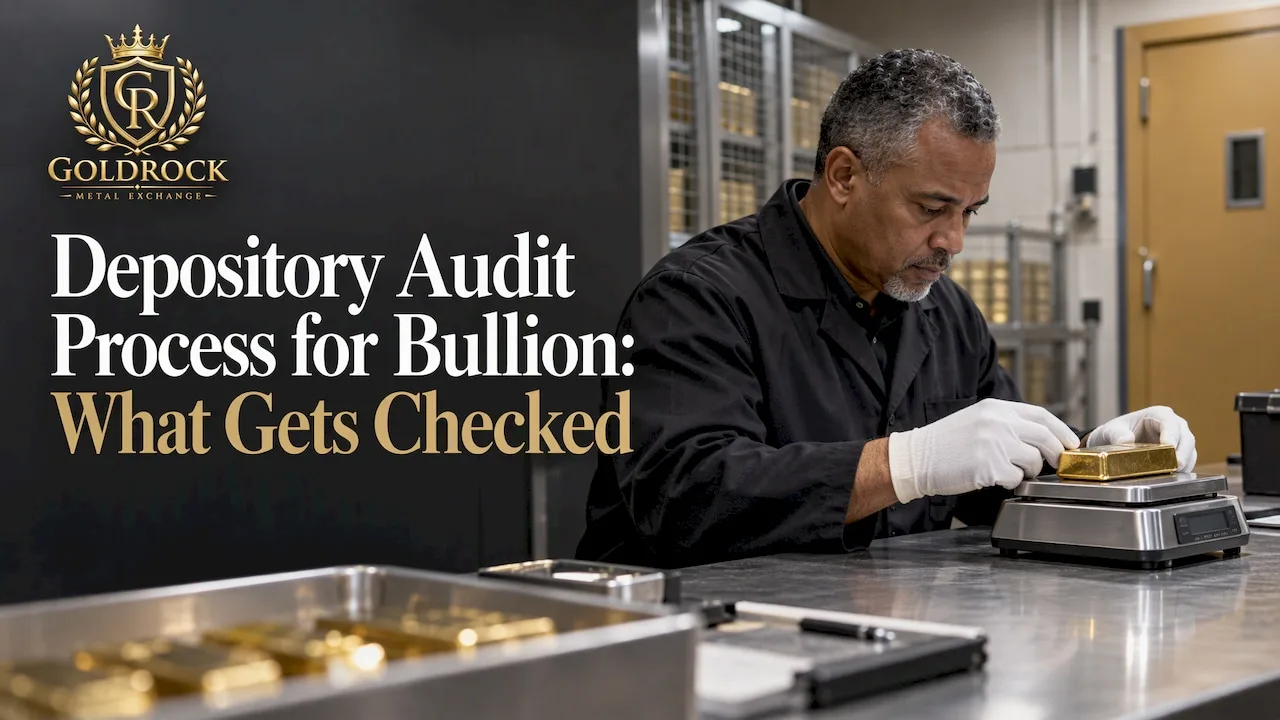
A bullion depository audit is an independent count and inspection of the metal a vault holds, matched against the records of who owns it. Auditors reconcile total weight, inspect each bar’s serial number and markings, confirm the bars sit in the right account, and check-weigh a sample. For you, it is the main way the vault’s records get tied back to real metal on the shelf. If you hold physical gold, silver, platinum or palladium in a self-directed IRA, this is the process behind the statement you receive.
This guide walks through each step, shows who audits and how often, explains what an audit does and does not tell you, and covers why delivery from a depository takes the time it does.
TL;DR
- A typical bar-level audit reconciles total weight, inspects every bar’s number, year, refiner and purity, confirms bar counts by batch, and check-weighs a random sample, per a published audit report.
- Audit frequency and the auditor depend on the depository. Public programs, such as the one in Texas, describe regular third-party audits and government oversight.
- An audit confirms that metal exists and matches records at a point in time. Ownership structure, storage type and insurance are separate questions.
- Delivery timing from a vault depends on paperwork, account type, shipping and verification, so no single number fits every order.
- We help IRA clients through the transfer and storage setup. Request a Free Precious Metals Consultation or call (888) 859-0978.
Table of Contents
- What a bullion depository audit actually is
- The audit process, step by step
- Who audits, and how often
- What an audit tells you, and what it leaves to other documents
- Reading an audit report as an account holder
- A worked example: what a reconciliation looks like
- Request a Free Precious Metals Consultation
- How we approach it
- Depository delivery times for bullion
- Where private delivery fits
- A short checklist before you fund an IRA with metals
- FAQ
- Educational disclaimer
- Sources
What a bullion depository audit actually is
A depository is a secure vault that stores metal on behalf of its owners. When you hold bullion in a self-directed IRA, the metal sits with the custodian’s chosen depository, not in your home. Your statement says you own a certain quantity. The audit is how someone other than the vault itself checks that the number is true.
There are two broad kinds of check:
- Internal counts and reconciliations. The depository’s own staff compare physical inventory to its ledger on a routine basis.
- Independent audits. An outside firm or an official body inspects the metal and the records, then reports findings to the depository, its clients or a regulator.
Both matter. Routine internal checks catch small discrepancies early. Independent audits add a second set of eyes with no stake in the result.
The audit process, step by step
The clearest public example of a bar-level audit procedure is a report prepared by an inspection firm for the custodian of a gold fund, covering the close of business on October 15, 2024. It is a useful model because it spells out each step. Individual depositories may vary the details, but the logic is the same.
1. Reconcile total recorded weight
The auditor starts with the client’s recorded total bullion weight and compares it to the custodian’s records. If the two ledgers disagree before anyone opens a vault door, that is the first flag. In the published report, the audited holding was 1,101 bars totaling 439,236.591 troy ounces, and the advised and found figures matched with zero variance.
2. Visually inspect every bar
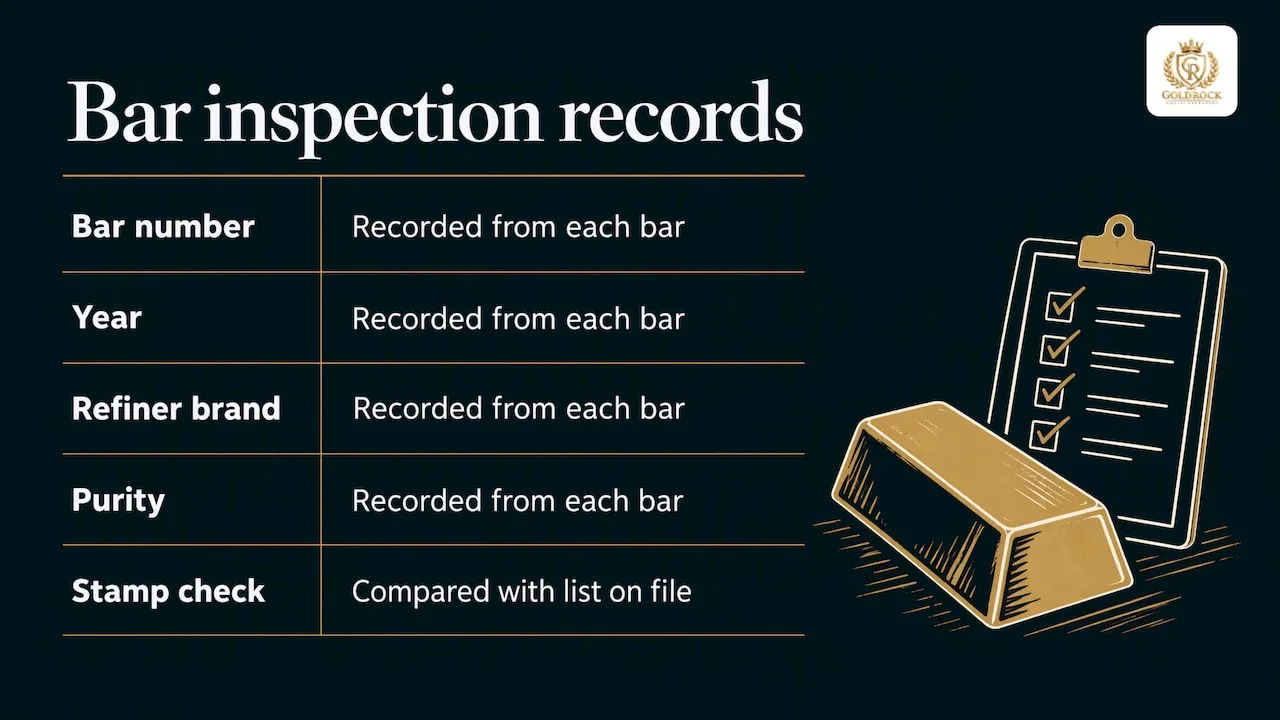
The auditor physically looks at each bar and records its bar number, year, refiner brand and purity. This is why serial numbers and hallmarks matter. A bar is identified by what is stamped on it, and each stamp is compared to the list on file. If you want to understand what those markings mean, our guide to how to verify gold bars explains the details, and LBMA Good Delivery standards explains why refiner marks carry weight in the market.
3. Verify bar counts by batch or pallet
Bars are normally stored in batches or on pallets. The auditor counts the bars in each and checks the count against both the custodian’s and the client’s records. A count mismatch shows up here even if every individual bar looks right.
4. Confirm the account name
The auditor compares records to confirm the bars are held in the name of the applicable account. This step addresses a simple question: is this metal assigned to the account that claims it? It is where the difference between segregated and commingled storage becomes concrete, and our segregated vs. commingled storage checks show what to look for in your own account terms.
5. Check-weigh a random sample
The auditor weighs a random selection of the bar list. In the report above, the sample was about 2.5% of the bars, measured against the Good Delivery Rules, the specifications for large gold bars. Weighing every bar would be slow and would mean handling metal more than needed, so sampling gives statistical confidence while limiting movement.
6. Reconcile movements during the period
Vaults are not static. Metal comes in and goes out. The auditor reconciles reported weights and the physical bar movements that happened during the inspection period, so deposits and withdrawals are accounted for, not just the final snapshot.
7. Report non-conformities
Any difference between records and reality, physical or administrative, is reported to the client. The October 2024 report found no physical or administrative non-conformities. A clean report is the normal goal, and the reporting step is what gives the process teeth.
Who audits, and how often
The answer depends on the depository, and the rules for private vaults differ from those for public programs.
The Texas Comptroller’s Texas Bullion Depository FAQ gives a public example. It says the appointed Depository Administrator has direct oversight and audit privileges over account-holder accounts, that a Texas-based accounting firm audits the depository on a regular schedule and submits reports to the Comptroller, and that the depository is also subject to audits from the State of Texas.
Legislatures elsewhere are moving toward formal audit schedules too. A fiscal note from the Indiana Legislative Services Agency on House Bill 1227 describes a proposal requiring each designated bullion depository to be audited by an independent third-party auditor every year, with an annual report to the General Assembly. The bill is a proposal, so check the state legislature’s site for its current status.
These state programs are separate from the depositories that hold most IRA metals. For an IRA depository, the audit schedule, the auditor and who receives the report are usually set by the depository’s own agreements. Those details are worth reading in your account paperwork, and we can walk you through them.
| Audit type | Who performs it | What it usually covers |
|---|---|---|
| Internal count | Depository staff | Ledger vs. physical inventory, routine reconciliations |
| Independent third-party audit | Outside accounting or inspection firm | Bar-level inspection, weight reconciliation, account records |
| Government audit | State or federal body, where a public program applies | Oversight of operations and account-holder records |
What an audit tells you, and what it leaves to other documents
An audit is a snapshot with a specific scope. It is strong evidence on one question: does the metal the records describe physically exist, in the stated quantity and form, at the time of inspection? That is valuable, and it is the reason independent audits are the backbone of confidence in vaulted metal.
Several other questions are answered by other documents:
- Ownership and structure. Whether your metal is allocated to your account or pooled with others is a feature of your storage agreement. See our explainer on precious metal storage options.
- Insurance. Coverage terms are set in the depository’s policy. As one public example, the Texas Comptroller’s FAQ says the full metal content value of account-holder assets is insured through the Lloyd’s of London marketplace, covers 100% of assets in account-holder accounts, and was reviewed and approved by the Depository Administrator. Our 8-step depository insurance checklist shows which terms to read in any policy.
- Physical security. The same FAQ describes storage in a Class III vault within a purpose-built 10-acre facility in Leander, Texas. Vault ratings and facility features are described by the operator, not by the audit.
- IRA rules. Whether a depository qualifies for IRA holdings is a compliance matter. Our guide on verifying an IRS-approved depository covers the three steps to confirm it.
No audit promises a price, a return, or a tax outcome. It is a tool for confirming custody, and it works best alongside clear account paperwork.
Reading an audit report as an account holder
You do not need to be an auditor to read the summary page. Look for these items:
- The as-of date. An audit describes one moment. Note when the inventory was counted.
- The scope. Did it cover all metals and all accounts, or a defined portion?
- The method. Bar-by-bar inspection, sampling rate and the standard applied for weighing.
- The result. Advised versus found quantities, and any variance.
- Non-conformities. Whether any physical or administrative exceptions were noted and how they were resolved.
- The auditor. An independent firm or official body, and who receives the report.
If any of these are unclear in your own paperwork, that is a normal question to raise with your IRA team. At GoldRock Metal Exchange, our dedicated in-house IRA department handles the transfer of retirement accounts into precious metals and keeps consultations going after the account is open, so you have a person to ask.
A worked example: what a reconciliation looks like
Take a simple illustration, not a real account. Suppose a depository’s ledger shows 100 bars in a batch and the client’s records show the same 100. The auditor counts 100 bars on the pallet, reads each serial number against the list, and weighs a random handful. The sampled weights fall within the tolerance the weighing standard allows, and the account name on the records matches the account that holds the bars. Result: advised equals found, no exceptions.
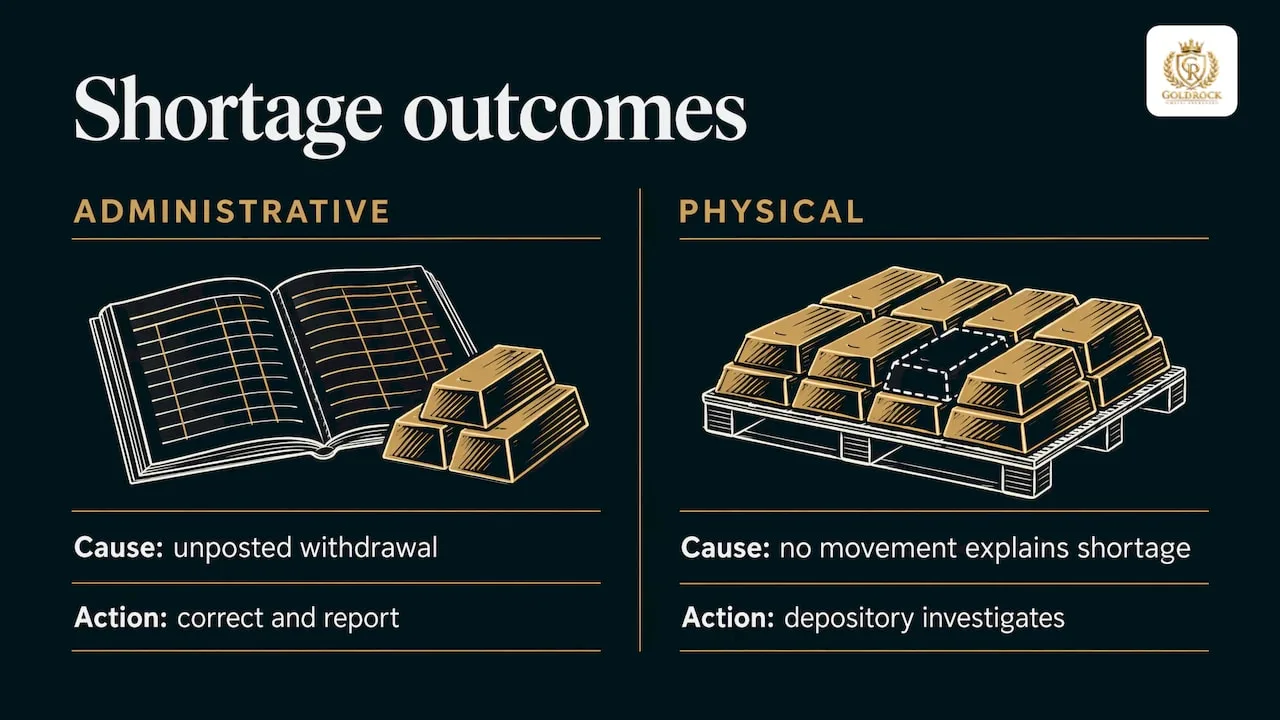
Now suppose the auditor counts 99 bars. The count step flags it at once. The auditor then checks the movement records for the period, which might show a withdrawal that was not yet posted to the client ledger. If so, it is an administrative non-conformity that gets corrected and reported. If no movement explains it, it is a physical discrepancy that the depository must investigate. The process is built so each type of difference surfaces at a specific step.
Request a Free Precious Metals Consultation
If you are weighing a rollover or a new purchase and want to understand the storage and audit side before you commit, talk to us. We can explain how a Precious Metals IRA is set up, how metals move to storage, and what paperwork you will receive. Request a Free Precious Metals Consultation or call (888) 859-0978.
How we approach it
Most people ask about price first. The ones who sleep best ask about custody first: where is the metal, in whose name, and who checks.
We built our IRA department in-house so that the person who helps you with the rollover is the person you can call when you have a question about the account. You should understand your storage terms and your insurance terms in plain words, and we take the time to go through them with you. Our guidance is educational and personal. We do not make promises about returns or outcomes.
For clients who prefer to take delivery of metals outside a retirement account, we offer insured private delivery. Whichever route you choose, the goal is the same: metal you can account for.
Blake
Depository delivery times for bullion
The second question readers raise is how long it takes to get metal out of, or into, a depository. There is no single figure, because several steps sit between your request and the vault door. The factors that usually shape the timeline are:
- Account type. Metal held inside an IRA is owned by the IRA, so a distribution or transfer follows retirement-account procedures, not a simple pick-up. Our guide on IRA depository vs. home storage explains why removal is not the same as taking delivery of a purchase.
- Paperwork and approvals. Written instructions, signatures and custodian review come before any metal moves.
- Inventory preparation. Bars and coins are pulled, verified against records and packed. Allocated metal tied to specific serial numbers follows an additional matching step.
- Shipping and insurance. Insured, tracked shipping adds transit time and requires someone to receive the package.
- Holidays and volume. Busy periods and bank or vault closures stretch schedules.
Because timing differs by depository and account, ask for the expected processing window in writing at the start. Our team can lay out the sequence for a Precious Metals IRA so you know each step before you begin. Taxes can apply to certain IRA distributions and metal sales, so speak with a tax professional about your own situation. Our article on Section 408(m) rules gives general educational background.
Where private delivery fits
Not every buyer wants vault storage. Some choose to purchase metals outside an IRA and receive them directly. For these buyers we offer insured private delivery, so the shipment is covered while it travels. If you hold metals at home, home insurance for gold bullion explains what a standard policy may and may not cover. Metals bought for an IRA are a different matter, because IRS rules expect them to stay with an eligible trustee, which is why the account type should be settled before you place an order.
If you are ready to look at metals themselves, you can browse gold, silver, platinum and palladium. To begin a retirement account, see our Precious Metals IRA page or open a precious metal IRA.

A short checklist before you fund an IRA with metals
- Confirm the depository is approved for IRA holdings.
- Read the storage agreement: segregated or commingled, and what that means for your bars.
- Read the insurance terms, including what is covered and the coverage limit.
- Find out how often the depository is audited and who performs the audit.
- Ask for the expected timeline for funding, purchase, storage and any later distribution.
- Keep your account statements and compare them to what you expect.
FAQ
How often are bullion depositories audited?
It depends on the depository. Public programs describe regular schedules: the Texas Comptroller says a Texas-based accounting firm audits its depository on a regular schedule, and Indiana’s proposed HB 1227 would require annual independent audits. For IRA depositories, the frequency is set in the depository’s own agreements, so we can help you read those terms.
Does an audit check every bar?
A bar-level audit typically inspects every bar visually, recording its number, year, refiner and purity. Weighing is usually done on a random sample. In the October 2024 report cited above, the sample was about 2.5% of the bar list.
Does an audit prove I own the metal in my account?
An audit confirms that the metal is physically present and matches records, including that bars are held in the applicable account’s name. Your ownership terms live in your storage agreement and account documents. Our team can explain how those documents work together.
Is audited metal the same as insured metal?
No. An audit verifies inventory, and insurance is a separate contract covering loss or damage. Each should be understood on its own terms, and our depository insurance checklist lists the points to read.
How long does delivery from a depository take?
It varies with account type, paperwork, shipping method and volume. IRA-held metals follow retirement-account procedures, which add steps. Ask for the expected window at the start of the process.
Educational disclaimer
This article is for general education only. It is not investment, tax or legal advice, and nothing here promises returns, safety, tax benefits or price appreciation. Precious metals prices can fall as well as rise. Speak with a qualified financial, tax or legal professional about your own situation. For a free consultation about a Precious Metals IRA or private delivery, Request a Free Precious Metals Consultation or call (888) 859-0978.
Sources
- Audit report for a gold fund custodian, as of October 15, 2024
- Texas Bullion Depository FAQ, Texas Comptroller of Public Accounts
- Indiana Legislative Services Agency fiscal note, HB 1227 (2026)