

A phone order for gold bullion is a purchase you complete by speaking with a representative: you choose the product, the quantity and the delivery method, agree on a price, and pay. The call itself is simple. What protects you is knowing what to settle before any money moves: the exact product, the price over spot, every fee, the delivery terms and the paperwork you will receive. At GoldRock Metal Exchange, you can place that call yourself at (888) 859-0978 and talk through gold, silver, platinum or palladium with a person, including insured private delivery.
This article is educational. It is not investment, tax or legal advice, and it does not promise returns, safety or appreciation of any metal.
TL;DR
- Call the dealer yourself. Federal regulators advise buyers never to respond to cold calls or unsolicited offers.
- Settle product, weight, price over spot, fees and delivery terms in writing before you pay.
- Your cost is the spot price plus a premium, and the dealer’s buy-back price sits below spot. That gap is the spread.
- Delivery is part of the purchase: ask about insurance, signature requirements and receipts before you order.
- Buying with retirement money works differently from a direct purchase, because an IRA’s metal must be held by a trustee.
Table of Contents
- Why order by phone at all
- Before you dial: five decisions to make
- How spot price and premium shape what you pay
- The phone order checklist
- Delivery: what makes a phone order feel secure
- Retirement money is a different kind of order
- Request a consultation
- Our approach to phone orders
- Promo: gold, silver, platinum and palladium, with insured delivery
- Costs and risks to weigh before any purchase
- FAQ
- Sources
Why order by phone at all
Many buyers like an online storefront for browsing. A phone call is better when you want to talk through a first purchase, a larger order, or a mix of metals. You can describe what you want to accomplish, hear the options, and ask about delivery in the same conversation. It also suits readers who are moving retirement savings and have questions about the process, since a person can walk you through each stage.
The trade-off is that a call moves quickly, and a quick pace is where mistakes happen. The rest of this guide gives you a routine to keep the conversation orderly.
Before you dial: five decisions to make
A clear plan keeps you from being led by a script. Decide these first.
- Which metal. Gold, silver, platinum and palladium behave differently and cost differently per ounce. You can browse gold, silver, platinum and palladium offerings before you call, so you arrive with names and sizes in mind.
- Which form. Coins and bars both count as bullion. Coins are often easier to divide into smaller amounts. Bars can carry lower premiums per ounce at larger sizes. Our guide to investing in coins for retirement explains the form question in more depth.
- How much. Set a dollar budget and let the representative convert it into a quantity at the quoted price. A budget of $1,000 buys less metal than $1,000 divided by spot, because of the premium.
- Where the money comes from. Direct purchases use your own funds. Retirement purchases use a self-directed IRA, which has its own rules.
- How it arrives. Home delivery, private delivery, or a trustee’s storage for an IRA.
How spot price and premium shape what you pay
The spot price is the cash price for immediate delivery of physical metal, quoted in dollars per troy ounce. The Commodity Futures Trading Commission (CFTC), the federal agency that polices commodity markets, explains the arithmetic in its advisory on buying physical metals: if spot is $2,000 per ounce, a half-ounce coin is worth $1,000 in metal, and the dealer adds a markup, or premium, on top.
Dealers sell above spot and buy back below it. That difference is called the spread. The same CFTC advisory notes that some fraudulent sellers have charged spreads above 300%, while others charge less than 20%. You do not need to memorize those numbers. You need to know that the spread is the single most useful number to ask about.
A worked example
Say spot is $2,000 per ounce, which is a round number used only to show the math. You want a one-ounce coin.
- Metal value: 1 oz x $2,000 = $2,000.
- If the quoted price is $2,100, the premium is $100, or 5% over spot.
- Your $1,000 budget buys a little under half an ounce at that premium, not exactly 0.5 oz.
The CFTC suggests doing this check yourself: multiply the weight by the current spot price, then compare the result to the retail price you were quoted. Keep a calculator and a live spot quote open during the call. Spot moves during the trading day, so a quote is only good for the moment and terms the representative gives you.
Why smaller pieces cost more per ounce
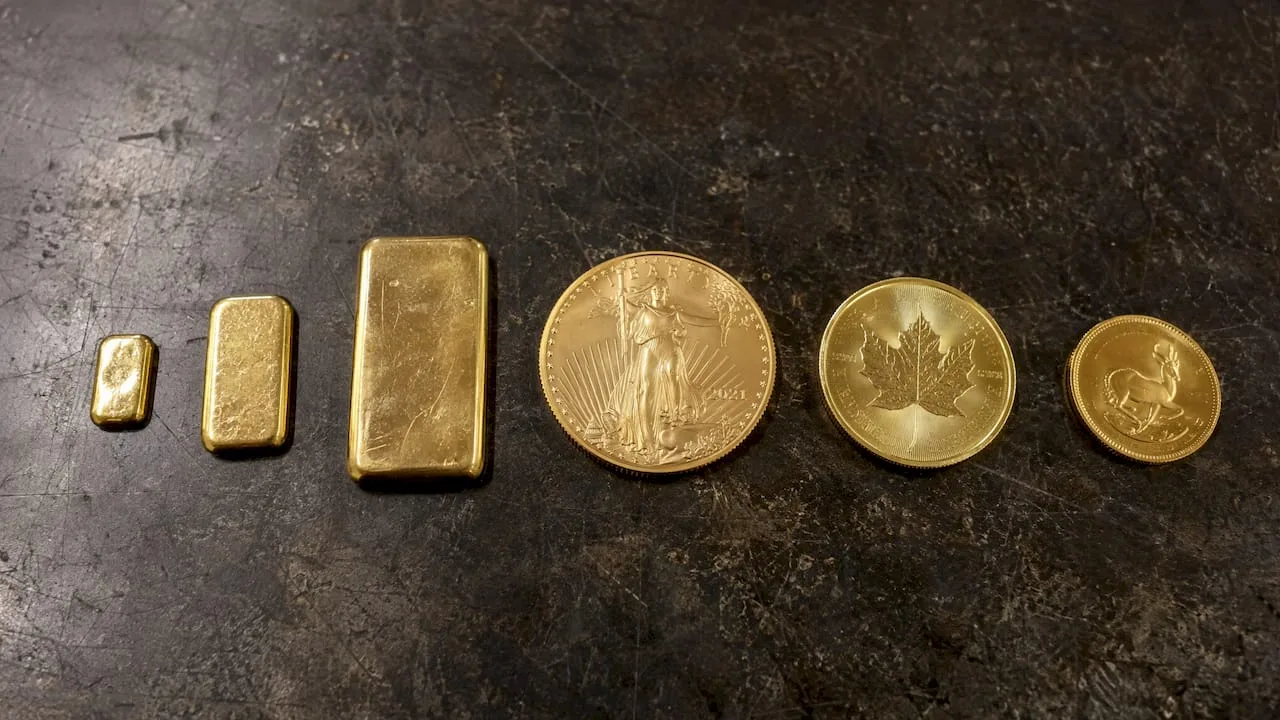
Small gold bars and coins typically carry higher premiums per ounce than large ones, because fabricating and handling costs do not shrink in proportion to weight. This is one reason people asking how much a small gold bar costs get different answers. The metal value is weight times spot, and the rest is premium that depends on size, product and demand. Ask for the premium per piece and the total for your quantity.
The phone order checklist
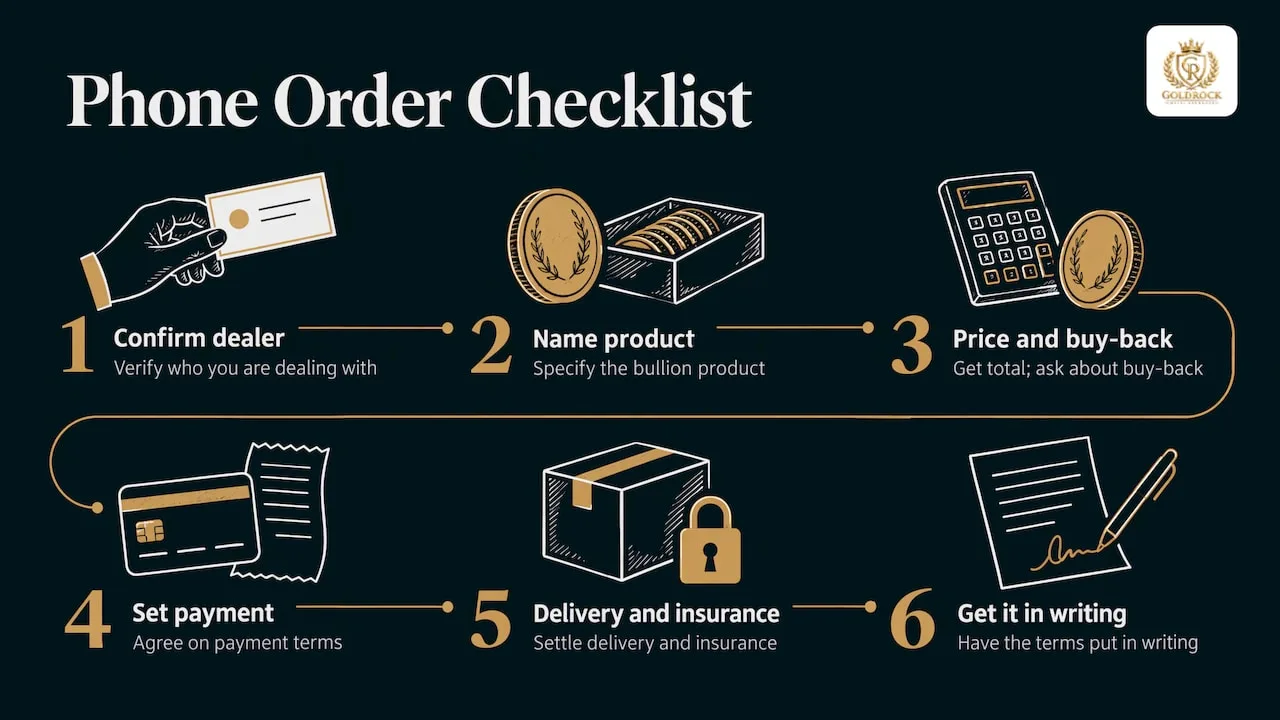
Use this sequence on any bullion call. It follows the questions the CFTC and the Federal Trade Commission (FTC) recommend buyers ask.
Step 1: Confirm who you are dealing with
You should be the one who placed the call. The CFTC advises buyers to ignore cold calls, unsolicited emails and pop-up sellers. Retail metal dealers are not federally regulated, so the agency suggests checking the state attorney general or securities regulator for complaint histories, and searching the names of owners and salespeople. If a salesperson gives investment advice, you can also check their registration and disciplinary record.
Step 2: Name the exact product
Say the product aloud and have it repeated back: the metal, the mint or refiner, the weight, the year if it matters, and the quantity. Ambiguity about whether something is a government-minted coin, a private-mint round or a bar can change the price and, for IRAs, eligibility.
Step 3: Get the total price, with every fee
Ask for the price per piece, the premium over spot, and the total including any shipping, handling, insurance or processing charges. The CFTC advises asking for all fees, costs and commissions and the agreed retail price in writing before you sign anything or hand over money. A fee that cannot be put in writing beforehand is, in its words, a red flag.
Step 4: Ask about buy-back
Ask what the dealer would pay to buy the same item back. The CFTC recommends this because the buy-back price tells you the real size of the spread.
Step 5: Settle payment terms
Ask which payment methods are accepted, when payment is due, when the price is locked, and what happens to your price if payment arrives after the market has moved. Get the answers in an order confirmation rather than relying on memory. Payment methods and timing vary by dealer, so confirm them for your own order rather than assuming.
Step 6: Settle delivery and insurance
Ask who carries the metal during shipping, whether it is insured and for what amount, whether a signature is required, what the timeline is, and what to do if a package is damaged or late. The FTC advises budgeting for insurance and storage and getting a receipt. Our pages on signature-required gold delivery and home insurance for gold bullion cover what to expect once the metal reaches you.
Step 7: Get everything in writing
Before paying, ask for a written confirmation listing the product, quantity, price, fees and delivery terms. Keep it with your receipt. If a representative pushes you to decide right now, slow down. The FTC’s guidance on gold investing lists “act now” pitches among the signs to walk away from, along with representatives who treat risk disclosures as a formality.
Delivery: what makes a phone order feel secure
With a phone order, the metal travels after you have agreed to pay. That makes delivery terms as important as price. A few points to understand:
- Who has custody in transit. You want the carrier, the insurance and the signature process described before you buy.
- Visibility. Packages containing valuables are best handled discreetly. Our article on discreet gold shipping in the U.S. explains why private delivery can suit larger shipments.
- Records. Keep the invoice, tracking details and delivery confirmation together.
GoldRock offers insured private delivery for purchased metals. If you want to understand the service before calling, read what a private metals delivery service is and our overview of delivery options for buyers.
Storage after delivery
Once the metal is yours, storage and insurance become your responsibility. The CFTC points out that storage costs and insurance add to the cost of holding metal, and that precious metals pay no dividends and do not compound. Plan for a secure location and for coverage. These ongoing costs are simply part of owning physical metal, and knowing them upfront lets you set a sensible budget.
Retirement money is a different kind of order
If you intend to buy metal with a 401(k), IRA or Thrift Savings Plan balance, the phone order works differently. You do not receive the metal at home. The Internal Revenue Service (IRS) states that bullion held by an IRA must be in the physical possession of a bank or IRS-approved nonbank trustee. The same page explains that certain coins and highly refined bullion are the exceptions to the rules that otherwise treat collectibles purchased with IRA money as distributions. In other words, product eligibility and custody matter from the first call.
Two more points from the official sources:
- A rollover has a clock. The IRS gives you 60 days from receipt of a distribution to complete a rollover, with limited waivers for circumstances beyond your control. Our guide to IRA rollover versus transfer explains the difference in mechanics.
- Fees deserve the same scrutiny as in any bullion order. The CFTC describes a case where a customer rolled over a $300,000 IRA and the dealer allegedly took $150,000 in fees and commissions. Ask for every fee, in writing, before you sign.
GoldRock has a dedicated in-house IRA department that handles the transfer of retirement accounts into precious metals, and you can read more on our Precious Metals IRA page. For rules and eligibility questions, our guides on gold IRA rules and gold IRA eligibility go deeper. For questions about taxes on any rollover or purchase, speak with a qualified tax professional.
Request a consultation
If you want to talk through a purchase with a person, GoldRock offers personal guidance by phone, covering metals, retirement accounts and delivery.
Request a Free Precious Metals Consultation
Or call (888) 859-0978.
Our approach to phone orders
Most people who call us about their first purchase already know what they want to protect: a retirement, a family’s savings, a sense of stability. What they need from the call is clarity, not pressure.
That is why we think of a phone order as a conversation, not a transaction. You should leave it knowing the product, the quantity, the price over spot and how the metal will reach you. Our in-house IRA department handles retirement account transfers, and we offer insured private delivery for purchased metals, so the questions about paperwork and shipping have a single place to go.
We stand behind personal service and transparent dealing without paid endorsements. If you are weighing coins against bars, or a direct purchase against a self-directed IRA, we will talk through the decision criteria with you. We do not promise returns, because no one can.
Blake
Promo: gold, silver, platinum and palladium, with insured delivery
GoldRock sells physical gold, silver, platinum and palladium to investors, with insured private delivery and ongoing consultations. If you are ready to move from reading to ordering, start with the Gold category or call (888) 859-0978 to place an order with a representative.

If the money comes from a retirement account, our Precious Metals IRA service is the place to begin, and you can start the process on our open an IRA page.
Costs and risks to weigh before any purchase
Physical metal is a long-term holding with real costs, and a calm look at them helps you set expectations.
- Transaction costs. Premiums and fees apply when you buy, and the spread applies when you sell.
- No income. The CFTC notes that precious metals pay no dividends and do not compound, so any change in value comes from the price of the metal itself.
- Holding costs. Storage and insurance add to the cost of ownership.
- Financing rules. The same CFTC page says it is illegal for dealers to offer leveraged or financed metal purchases unless the metal is delivered within 28 days. A phone order should be a straightforward purchase of metal you actually receive or that a trustee holds.
- Price movement. Metal prices rise and fall, and nothing in this article suggests a particular outcome.
Some investors hold a modest share of their portfolio in metals to diversify beyond stocks and bonds. How much, if any, is a question for you and a licensed financial professional.
FAQ
How much gold can I buy for $1,000?
Divide your budget by the all-in price per ounce, not by spot alone. Because dealers add a premium over spot, $1,000 buys somewhat less than $1,000 divided by the spot price, and the shortfall is larger on small coins and bars. Ask the representative for the total price including fees before you commit.
Is it safe to give card or payment details over the phone?
Only share payment details when you placed the call yourself and have confirmed the terms of the order. Federal regulators advise against responding to unsolicited calls. Ask for a written confirmation of the order, and keep your receipt and delivery records.
Can I order gold bullion by phone and have it delivered privately?
Yes. GoldRock offers insured private delivery for purchased metals. Ask about the carrier, the insured amount, whether a signature is required and the expected timeline when you place the order.
Can I buy gold by phone with my 401(k) or IRA?
Retirement purchases are handled through a self-directed IRA, and the metal is held by a trustee rather than shipped to you. Our in-house IRA department guides the transfer of retirement accounts into precious metals. For tax questions on a rollover, consult a qualified tax professional.
What is the difference between spot price and the price I pay?
Spot is the market price per troy ounce of the metal. The price you pay adds a dealer premium, and shipping or other fees may apply. Multiply the weight by spot and compare it with the quote to see the premium in dollars.
Sources
- CFTC Customer Advisory: 10 Things to Ask Before Buying Physical Gold, Silver, or Other Metals
- CFTC: Precious metals fraud
- FTC: Investing in Gold? What’s the Rush? (May 2011)
- IRS: Retirement plans FAQs regarding IRAs
- IRS: Rollovers of retirement plan and IRA distributions
Educational disclaimer: This content is for general education only. It is not personalized investment, tax or legal advice and does not promise returns, safety, tax benefits or appreciation. Consult a qualified professional about your own situation.
Request a Free Precious Metals Consultation