

Palladium is defined as an industrial precious metal whose price behavior during market stress diverges sharply from gold’s traditional safe-haven role. The role of palladium during market stress is driven primarily by automotive demand, supply constraints, and financial market mechanics rather than monetary value. Between 2020 and early 2026, palladium experienced extreme price swings from above $3,400 to near $1,000, a range no classic safe-haven asset would tolerate. Investors who understand this distinction can use palladium tactically, not as a crisis shield, but as a diversification tool that behaves differently from both equities and gold across market cycles.
How does palladium’s price behave during market stress?
Palladium drops fast and hard when financial markets panic. During the march 2026 selloff, palladium prices corrected nearly 26% within weeks due to forced liquidations that had nothing to do with changes in physical demand. That distinction matters. The metal’s price fell not because automotive factories stopped buying, but because leveraged investors needed cash and sold whatever was liquid.

Gold behaved very differently during the same period. Gold’s hedging benefits manifest more strongly over prolonged crises, while palladium is often sold in early panic phases with limited downside protection. Gold’s monetary history gives it a floor during fear-driven markets. Palladium has no equivalent anchor.
The table below shows how the two metals have responded during recent stress periods:
| Stress Event | Palladium Price Movement | Gold Price Movement |
|---|---|---|
| COVID-19 panic (march 2020) | Sharp initial drop, then recovery | Brief dip, then strong rally |
| 2022 rate hike cycle | Significant decline on demand fears | Moderate decline, faster recovery |
| March 2026 dislocation | Nearly 26% correction in weeks | Held relatively stable |
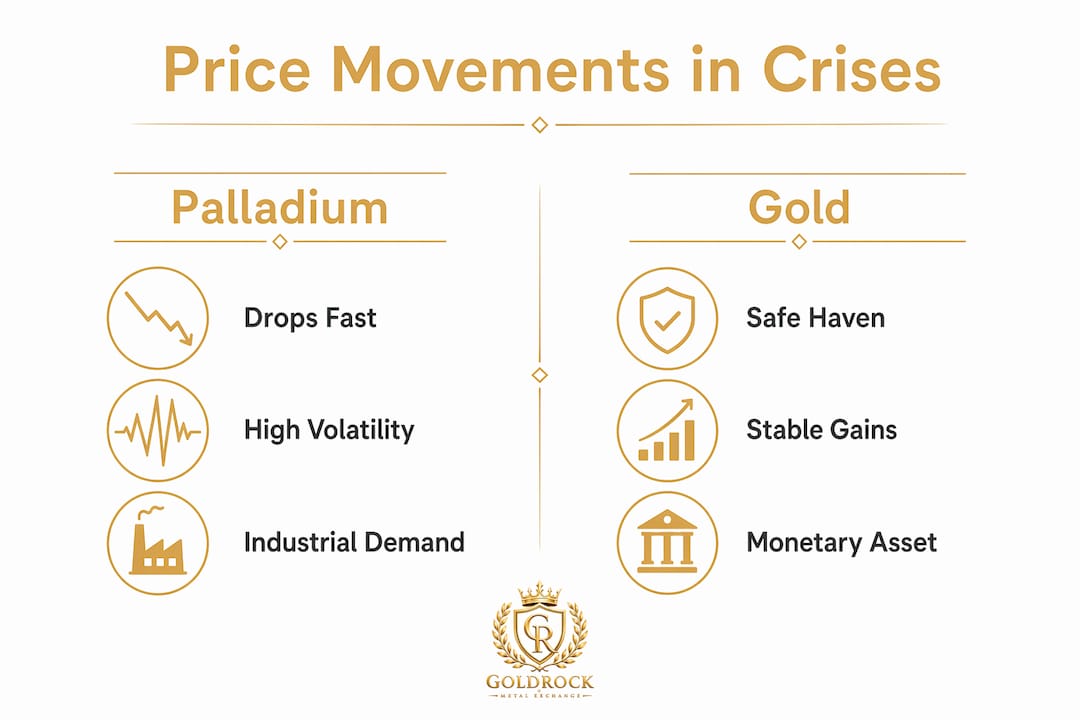
Palladium’s high volatility results from supply constraints and its non-monetary industrial use, causing rapid price corrections that clear out speculative excess. These corrections can be severe, but they also reset the metal to levels where physical buyers re-enter the market.
Pro Tip: Track the spread between palladium and platinum prices. When palladium trades at a significant premium to platinum, automakers have a financial incentive to substitute platinum in catalytic converters, which adds downward pressure on palladium prices during already stressed markets.
Why is palladium an industrial metal rather than a safe haven?
Palladium’s primary function is industrial, not monetary. Over 80% of global palladium demand comes from catalytic converters in gasoline and hybrid vehicles, which strip harmful emissions from exhaust gases. That single use case makes palladium’s price deeply tied to auto production cycles, emission regulations, and fuel technology trends.
The transition to electric vehicles initially spooked palladium investors, but the picture is more nuanced. Hybrid vehicles demand higher palladium loadings to meet tightening emission standards, creating a durable industrial demand floor even as pure EV adoption grows. Hybrids are not a bridge to a palladium-free future. They are a sustained source of demand.
Several structural factors shape palladium’s price outside of crisis periods:
- Supply concentration: Russia and South Africa account for the vast majority of global palladium supply, making geopolitical disruptions a persistent price risk.
- Platinum substitution: Automakers can substitute platinum for palladium in catalytic converters, but the switch takes years of engineering and capital investment.
- No monetary reserve role: Central banks do not hold palladium. No government treats it as a reserve asset, so there is no institutional floor during financial panics.
- Recycling supply: Secondary supply from recycled catalytic converters grows as the global vehicle fleet ages, adding a countercyclical supply source.
Palladium’s price is driven by physical demand and supply dislocations, not by investor fear or confidence in monetary systems. That is what separates it from gold and silver, and why the role of precious metals in crisis looks so different depending on which metal you hold.
What misconceptions do investors have about palladium during financial crises?
The most damaging misconception is that all precious metals rise during market downturns. Palladium carries the “precious metal” label, but it does not behave like one during acute stress. Institutional panic selling during acute crises often pushes palladium prices down alongside equities, contradicting the expectation that precious metals always rise during downturns.
Three historical episodes illustrate this pattern clearly:
- 2008 financial crisis: Palladium fell sharply as auto production collapsed and credit markets froze. Gold dropped initially too, but recovered far faster as the Federal Reserve flooded markets with liquidity.
- March 2020 COVID panic: Palladium dropped alongside equities in the initial selloff before recovering. The recovery was driven by supply disruptions in South Africa, not by safe-haven buying.
- March 2026 dislocation: Palladium’s price decline was driven by financial deleveraging, independent of physical demand or inventory changes. Investors who expected a safe-haven response were caught off guard.
The pattern is consistent. During the first phase of any acute crisis, investors sell liquid assets to meet margin calls and redemptions. Palladium, traded on futures markets with significant speculative positioning, gets caught in that wave. The physical market fundamentals reassert themselves only after the financial panic subsides.
Patience separates successful palladium investors from those who panic sell at the bottom. Understanding market phases matters more than reacting to price headlines. The effects of market stress on palladium are temporary at the financial level, but they feel permanent when you are watching your position drop 26% in a matter of weeks.
Pro Tip: Distinguish between financial-driven selling and fundamental deterioration. If palladium drops because of margin calls and deleveraging, the physical demand story has not changed. If it drops because automakers are switching to platinum or EVs are displacing hybrids faster than expected, that is a structural shift requiring a different response.
How can palladium complement a diversified precious metals portfolio?
Palladium is best used as a tactical, small allocation within a broader precious metals strategy. Gold is widely recognized as a defensive core asset with a recommended allocation of 5–15%, whereas palladium is considered a strategic diversification asset rather than a direct safe haven. That framing is the right starting point for any portfolio construction conversation.
The logic behind including palladium is correlation, not crisis protection. Palladium’s price drivers, automotive production, emission regulation, and South African mining output, are largely independent of the factors that move gold, silver, or equities. Allocations to platinum and palladium should be small but can noticeably enhance portfolio diversification due to unique price drivers distinct from gold and equities.
The table below compares the roles of gold, platinum, and palladium in a diversified portfolio:
| Metal | Primary Role | Key Price Driver | Crisis Behavior | Suggested Allocation |
|---|---|---|---|---|
| Gold | Defensive core | Monetary demand, fear | Holds or rises | 5–15% |
| Platinum | Industrial diversifier | Auto and industrial demand | Mixed, often falls | 2–5% |
| Palladium | Tactical diversifier | Gasoline auto demand | Often falls initially | 1–3% |
A small palladium position does not protect you during the first wave of a crisis. What it does is expose your portfolio to a recovery dynamic that is independent of equity markets or central bank policy. When auto production rebounds and supply constraints tighten again, palladium can recover sharply, adding a return stream that gold alone cannot provide.
Goldrockmetalexchange works with investors to build multi-metal portfolios that reflect this logic, pairing gold’s defensive stability with palladium’s industrial recovery potential. The goal is not to replace gold with palladium. The goal is to hold both for different reasons and different time horizons. Investors can also explore self-directed IRA options to hold physical palladium in a tax-advantaged retirement account, which changes the holding cost calculation significantly.
Palladium’s place in a stress-tested portfolio: Blake’s view
Palladium is one of the most misunderstood assets in the precious metals space, and I say that after watching investors repeatedly make the same mistake. They buy palladium expecting it to behave like gold during a crisis, and then sell it in a panic when it does the opposite.
The 2026 correction was a perfect case study. The physical market was not broken. Hybrid demand was intact. South African supply had not suddenly recovered. What happened was purely financial: leveraged positions unwound, and palladium got sold because it was liquid and profitable to sell. Investors who understood that held through the correction. Those who did not locked in losses at the worst possible moment.
My view is that palladium belongs in a portfolio as a tactical position, sized at 1–3% of total holdings, and held with a multi-year time horizon. It is not a crisis hedge. It is an industrial recovery play with precious metal characteristics. The distinction sounds academic until you are watching your position drop 26% in a month and trying to decide whether to hold or fold.
The right framework is simple: gold defends, palladium diversifies. Hold gold for the panic phase. Hold palladium for the recovery phase. If you try to use palladium as a safe haven, you will be disappointed every time.
— Blake
Physical palladium and precious metals at Goldrockmetalexchange
Goldrockmetalexchange offers physical palladium, gold, platinum, and silver for investors who want to hold real assets outside the financial system.
Whether you are building a crisis-resilient core with gold or adding palladium as a tactical industrial play, Goldrockmetalexchange provides personalized guidance to match your allocation to your actual risk tolerance and time horizon. The in-house IRA department simplifies moving retirement funds into physical metals, including palladium, with insured delivery on every order. Visit the Goldrockmetalexchange shop to view current palladium and gold products, or explore the education resources to deepen your understanding of how each metal behaves across market cycles before you commit capital.
Key takeaways
Palladium is a tactical diversification asset, not a safe haven, and investors who treat it as one will consistently be surprised during acute market stress.
| Point | Details |
|---|---|
| Palladium drops during panics | Financial deleveraging pushes palladium down alongside equities, regardless of physical demand. |
| Industrial demand is the price floor | Hybrid vehicle emission requirements sustain palladium demand even as EV adoption grows. |
| Gold and palladium serve different roles | Gold defends during crises; palladium diversifies and recovers during industrial rebounds. |
| Small allocations work best | A 1–3% palladium position adds diversification without exposing the portfolio to excessive volatility. |
| Patience is the key variable | Palladium’s financial-driven selloffs are temporary; physical fundamentals reassert after panic subsides. |
FAQ
What is palladium’s role during market stress?
Palladium typically falls during acute market stress because leveraged investors sell it to meet margin calls, not because physical demand weakens. Its role is industrial diversification, not crisis protection.
Does palladium act as a safe haven like gold?
Palladium is not a classic safe haven. Unlike gold, it has no monetary reserve role, so it does not benefit from the fear-driven buying that supports gold prices during financial crises.
Why did palladium drop nearly 26% in march 2026?
The march 2026 correction was driven by financial deleveraging and forced liquidations, not by any change in automotive demand or physical supply. The physical market fundamentals remained intact throughout the selloff.
How much palladium should an investor hold?
A 1–3% allocation is appropriate for most investors seeking industrial diversification. Larger positions amplify volatility without proportionally increasing the diversification benefit.
Is palladium a good investment during economic downturns?
Palladium is a poor short-term hedge during economic downturns but can deliver strong returns during the recovery phase when auto production rebounds and supply constraints tighten. Timing and patience are critical.