There is no single palladium forecast for 2026. Published estimates run from roughly $1,100 to $2,900 per ounce, and most of the cluster sits between about $1,100 and $1,750. The spread comes from one disagreement: whether tight mine supply or rising recycling and weaker auto demand will matter more. This guide lays out who forecasts what, what drives the gap, and how to think about the numbers if you are considering physical palladium.
This article is educational. It does not predict prices, promise returns and is not personalized investment, tax or legal advice.
TL;DR
- A survey of analysts published by the LBMA showed an average 2026 palladium forecast of $1,740.25/oz, within a range of $1,090 to $2,900/oz.
- Forecasts published later in the year are generally lower. Several cluster near $1,100 to $1,500/oz.
- The main swing factors are auto demand (battery electric vehicles, hybrids), recycling, Russian and South African output, the Stillwater mine in the U.S., and trade policy.
- Treat any forecast as one scenario, not a promise. Your own time horizon, budget and goals matter more than a target price.
Table of Contents
- Where the forecasts stand
- Why the forecasts disagree
- Risks that could move the numbers
- What the outlook means for a physical buyer
- Our perspective
- How GoldRock can help
- A note on capital gains
- Frequently asked questions
- Ready to talk it through?
- Sources
Where the forecasts stand
The table below collects the forecasts that were published for 2026, with the date or period each applies to. Forecasts are revised often, so read each as a snapshot.
| Source | Forecast | Notes |
|---|---|---|
| LBMA survey of analysts | $1,740.25/oz average; $1,090 to $2,900/oz range | Early 2026 survey; wide dispersion |
| Bank of America | $1,725/oz 2026 average (up from $1,525) | January 2026; cites deficits, tariff risk, Chinese demand |
| OCBC | $1,511/oz at end-2026 | May 29, 2026; mixed-to-downside bias |
| SFA Oxford | $1,455/oz average; $1,100 to $1,600/oz range | September 2026 |
| BMI | $1,400/oz 2026 average (cut from $1,500) | Reported September 10, 2026 |
| UBS | Around $1,100/oz over the next 12 months | October 27, 2026 |
A few things stand out. The survey high of $2,900 and low of $1,090 show how far apart informed analysts can be. Within the LBMA survey, the most bearish named forecaster averaged $1,400 and the most bullish $2,300, according to the same survey write-up. And the direction of revisions during 2026 has mostly been downward, though not in a straight line.
How one forecaster changed its mind
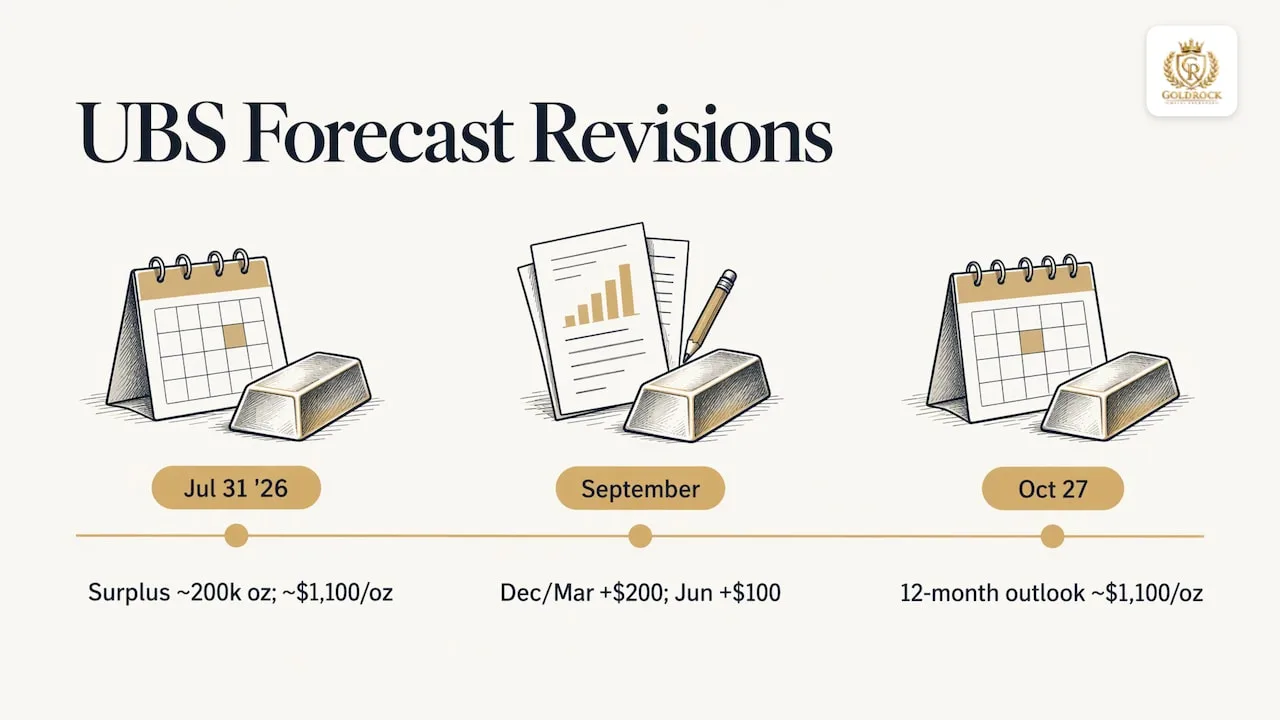
UBS is a useful example of why a single number should never anchor a decision. On July 31, 2026, it was reported as expecting a surplus of roughly 200,000 ounces and a price near $1,100/oz, because more recycling would outweigh lower mine output and weaker demand. In September it raised its targets by $200/oz for December 2026 and March 2027 and by $100/oz for June 2027, citing tighter physical conditions, hybrid demand and falling mine output. Then on October 27 it cut its outlook again to around $1,100/oz over 12 months, pointing to weaker investor positioning, bearish options sentiment and China’s imports falling from 8.6 tonnes in April to 3.4 tonnes in September.
Three views in four months, each reasoned. That is normal for a small, thinly traded market like palladium.
Why the forecasts disagree
Palladium is mostly an industrial metal. Most of its demand comes from catalytic converters in gasoline vehicles, and its supply is concentrated in a few countries. Small shifts on either side move the balance, and analysts weigh those shifts differently.
Supply and recycling
SFA Oxford’s 2026 outlook projects primary supply down 4% to 5.91 million ounces and recycling up 7% to 3.01 million ounces. It also expects total demand down 2% to 9.27 million ounces, with automotive demand down 3% to 7.19 million ounces, and a market deficit of 345,000 ounces. It attributes the more supportive balance to a temporary 260,000-ounce reduction in Russian production.
BMI sees things differently over a longer horizon. It expects palladium to move into a 182,000-ounce surplus in 2027 and approach a surplus of 1 million ounces a year by 2030 as older vehicles are scrapped and recycling rises. It also expects Russian output to fall 7% to 2.9 million ounces, and it cited faster South African supply recovery when cutting its 2026 average.
The auto transition cuts both ways
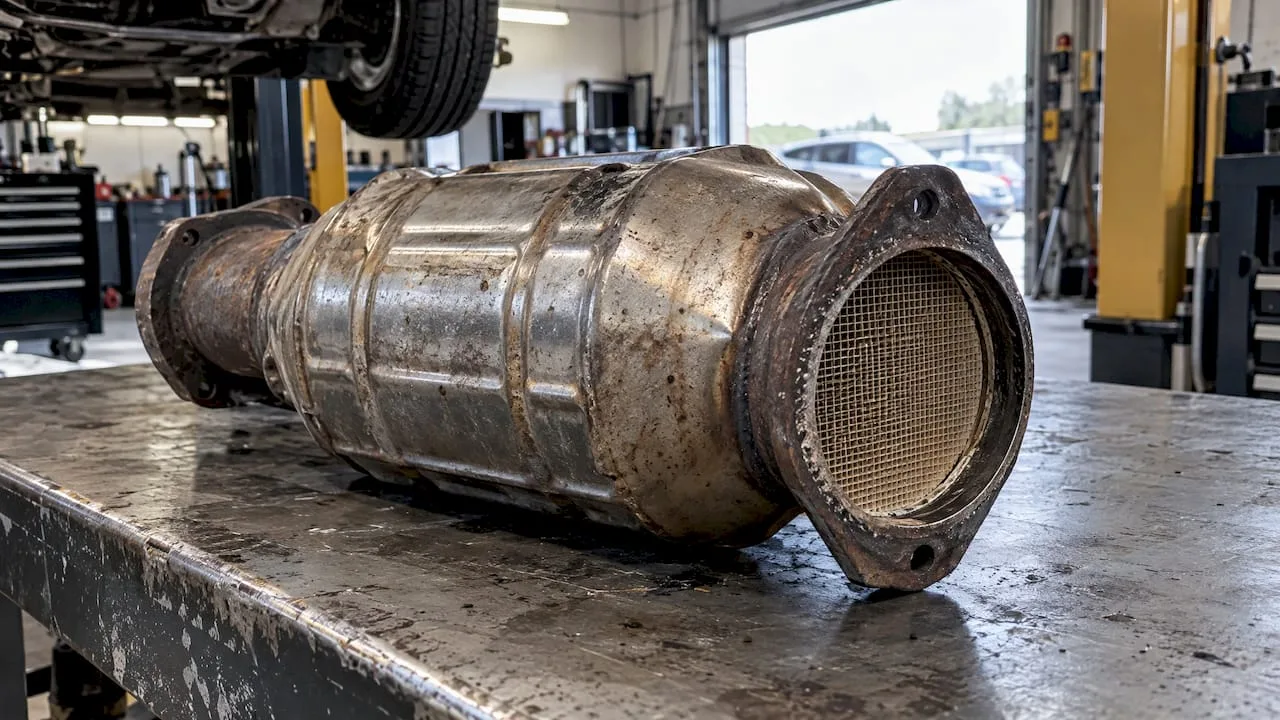
Battery electric vehicles need no catalytic converter, so their growth weighs on long-run palladium demand. In the near term, though, hybrids and slower-than-expected EV adoption still use palladium. UBS has pointed to hybrid adoption and palladium’s widening discount to platinum as supports for demand. That discount can encourage automakers to substitute palladium back into gasoline catalysts, although UBS still describes the long-term demand outlook as negative because of electrification.
OCBC’s outlook adds substitution, thrifted catalyst loadings and the auto cycle to the list of challenges for demand. If you want to see how palladium sits next to its sister metal, our guide to platinum versus palladium covers the structural differences.
Trade policy
In the United States, the Department of Commerce estimated a dumping margin of about 828% for unwrought Russian palladium. Bank of America said potential duties could push domestic prices higher. Tariff decisions are one reason U.S. and global prices can diverge from what a supply-and-demand model alone would suggest.
Risks that could move the numbers
SFA Oxford’s September report lists several risks to its own range of $1,100 to $1,600/oz:
- Faster EV gains and falling internal combustion and hybrid production, which reduce autocatalyst demand.
- Lower Russian output, which would tighten supply.
- A prolonged Stillwater strike, which would cut North American production.
- Higher energy or commodity prices that slow the broader economy and car sales.
The same report notes that ETF outflows and futures positioning shifted during the year, a reminder that investor sentiment can move price independently of fundamentals.
None of this means palladium will rise or fall. It means the plausible range is wide, and anyone buying physical metal should be comfortable with that range before they act.
What the outlook means for a physical buyer
Forecasts answer “where might the price go?” A buyer’s real questions are different. Here are decision criteria that hold regardless of which analyst proves right.
- Purpose. Are you adding a small industrial-metal position to a diversified mix, or looking for something to hold through market stress? Palladium behaves differently from gold. Our guides on palladium in a retirement plan and palladium during market stress walk through that role.
- Position size. Because the forecast range is wide, many investors keep any single-metal allocation modest. What is right for you depends on your situation, so discuss it with a licensed financial professional.
- Time horizon. A forecast for the end of 2026 says little about a ten-year holding period. Long-term views depend on the auto transition, recycling growth and mine supply.
- Ownership method. Metal can be held directly, with private delivery, or inside a self-directed IRA if it meets IRS requirements. Eligibility rules for palladium are specific, which we explain in our 99.95% rule for palladium IRAs.
- Entry approach. Some buyers spread purchases over several months rather than trying to pick a single moment. That is one common approach, not a recommendation for your circumstances.
- Comparing metals. If you are weighing palladium against another metal, see gold versus palladium for the trade-offs. For the other metals’ outlooks, we also publish a gold price outlook and a silver price outlook.
To see where palladium trades today, check our live prices page.
Our perspective
We read forecasts as a map of scenarios, not a schedule. When analysts at respected institutions land anywhere from $1,090 to $2,900, the honest takeaway is that palladium is a volatile, specialized market.
That is why we focus on process rather than prediction. Our clients get personal guidance on what palladium can and cannot do inside a portfolio, whether the metal is eligible for a self-directed IRA, and how delivery will work. Our in-house IRA department handles the paperwork of a rollover, and private delivery is insured.
We would rather you make an informed, unhurried decision than chase a headline target. If palladium fits your plan, we will help you buy it properly. If you have questions first, we are glad to talk them through.
Blake
How GoldRock can help
If you are considering physical palladium, you can browse our palladium products or speak with our team about how metals fit your retirement planning through a Precious Metals IRA. Our in-house IRA department supports the transfer process, and purchased metal can be sent by insured private delivery.
Request a Free Precious Metals Consultation or call (888) 859-0978.
A note on capital gains
Many readers ask about palladium capital gains tax. We do not give tax advice, and your situation is yours alone, so a CPA or tax attorney is the right person to ask. As general background only: for U.S. federal purposes, physical palladium bullion is generally treated as a collectible. A gain on metal held more than one year faces a maximum 28% collectibles rate, while a gain on metal held one year or less is short-term and taxed at ordinary income rates. The 28% figure is a ceiling, not necessarily your effective rate, and net investment income tax and state or local taxes can add to the total.
How gains are treated inside a retirement account can differ from direct ownership. Ask a tax professional how it applies to you before you act.
Frequently asked questions
Is palladium expected to rise in 2026?
Forecasts disagree. The LBMA survey average was $1,740.25/oz, but later forecasts from SFA Oxford, BMI and UBS sit mostly between $1,100 and $1,500/oz. Nobody can know the outcome, so treat these as scenarios.
What is the palladium price prediction for the end of 2026?
OCBC forecast $1,511/oz at the end of 2026 in its May outlook. SFA Oxford expects a trading range of $1,100 to $1,600/oz, and UBS expects around $1,100/oz over the next 12 months. These are third-party estimates, not guarantees.
Why do palladium forecasts vary so much?
Palladium is a small market tied to gasoline vehicle production. Analysts weigh falling mine supply, rising recycling, hybrid demand, EV adoption and tariffs differently, so modest changes in assumptions produce large differences in price targets.
Can I hold palladium in an IRA?
Sometimes. Palladium must meet IRS requirements, including fineness standards, and be held through an approved custodian. Our palladium IRA guide explains the rules, and our team can walk you through setup.
How is palladium taxed in the U.S.?
General background is in the capital gains section above. Because tax treatment depends on your holding period, account type and income, please consult a qualified tax professional.
Ready to talk it through?
If you want to discuss palladium, a rollover or insured delivery with a person rather than a price chart, Request a Free Precious Metals Consultation or call (888) 859-0978.
Educational disclaimer: This content is for general education only. It is not investment, tax or legal advice, and it does not promise returns, safety, tax benefits or price appreciation. Precious metals prices can fall as well as rise. Consult a licensed professional about your own situation.
Sources
- LBMA: Precious Metals Set for Volatile 2026
- SFA Oxford: The Palladium Standard 2026
- OCBC: ESG-FX, Platinum and Palladium, May 29, 2026
- Investing.com: BofA lifts platinum and palladium forecasts
- Metal.com: UBS forecasts palladium market surplus
- Investing.com: UBS raises palladium price target
- Investing.com: UBS cuts palladium forecast
- Mining.com: BMI cuts platinum and palladium forecasts
- Kiplinger: How collectibles are taxed