
A gold order price lock means the dealer confirms a specific price per item when you place the order, and holds it while you complete payment within an agreed window. The price is built from the spot price plus a premium. Spot can move after you lock, but your quoted price should not, as long as you pay on time and the order terms stay the same. The details, such as the length of the window, the accepted payment methods and the consequences of missing the deadline, are set by the dealer and should be confirmed in writing before you pay.
This guide explains what is being locked, how long a lock typically lasts, what happens when the market moves, and how a lock works when the metal is bought through a self-directed IRA. It is educational, not personal advice.
TL;DR
- A price lock fixes your order price (spot plus premium) at the time the dealer confirms your order, so later market moves do not change that quote.
- The lock only holds if you meet the dealer’s payment deadline and pay by an accepted method. Ask for the deadline in writing.
- The locked price covers the metal and premium. Confirm separately whether shipping, insurance and any account fees are included.
- IRA purchases add steps: funds move between custodians, so ask how the price is confirmed when the money arrives.
- Call GoldRock at (888) 859-0978 to review the specific terms of any order before you commit.
Table of Contents
- What a price lock actually locks
- When the price gets locked
- How long a locked price stays valid
- What happens if the market moves after you lock
- Missing the payment deadline or changing the order
- What else to confirm before you pay
- How a price lock works with an IRA purchase
- A step-by-step way to lock a gold order with confidence
- Our perspective on price locks
- Talk to a specialist about your order
- Common mistakes to avoid
- FAQ
- Educational disclaimer
- Sources
What a price lock actually locks
Gold trades all day on global markets, and the benchmark price you see on a screen is the spot price. When you buy physical bullion or coins, you do not pay spot alone. The Commodity Futures Trading Commission (CFTC) explains that buyers pay the spot price plus a markup, or premium, and that premiums, fees and commissions can eat into what you end up with.
A price lock freezes that combined number for your order. In practice, it covers three things:
- The spot reference. The spot value used on the moment your order is confirmed.
- The premium. The dealer’s markup for that specific product, which depends on the coin or bar, its size and its availability.
- The quantity. The exact number of ounces, coins or bars on the order.
If you want the groundwork first, our guide to how spot price works when buying physical metals and our explainer on what gold premium over spot means cover each piece in detail.
Why the premium differs by product
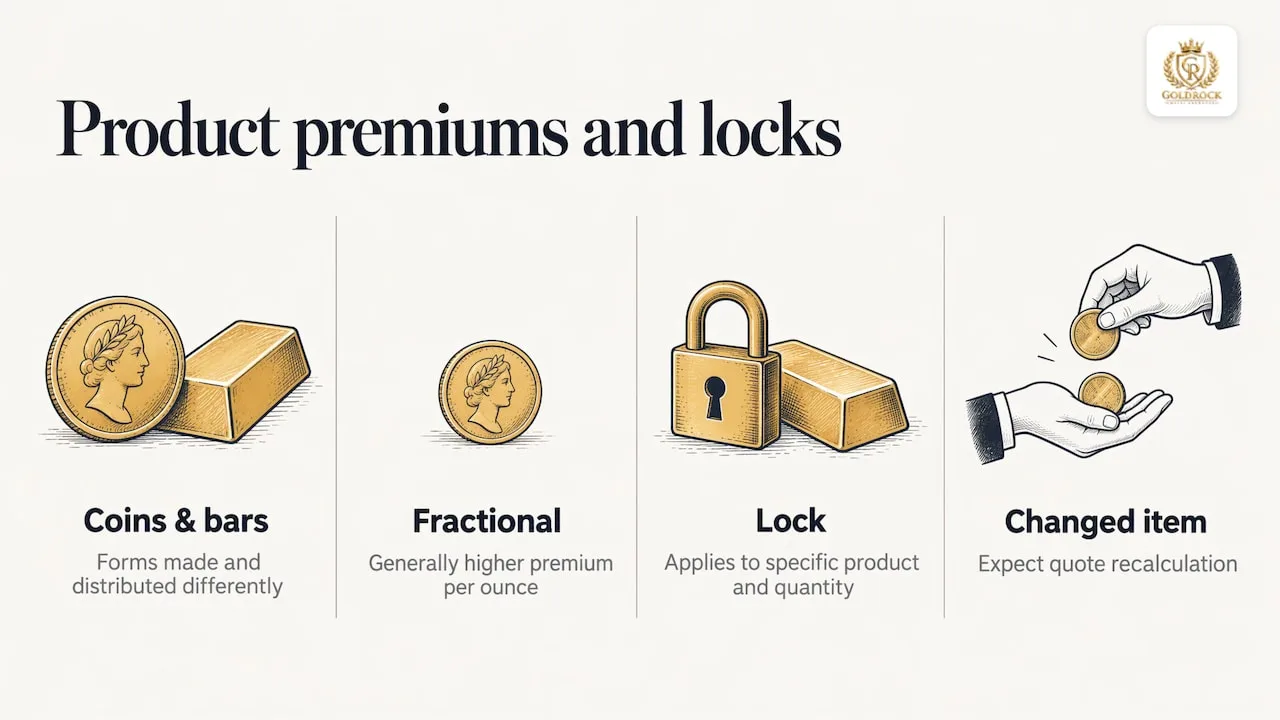
Two items with the same gold content can carry different premiums. Government-minted coins, large bars and small fractional pieces are made and distributed differently, and smaller pieces generally carry a higher premium per ounce because fabrication costs are spread over less metal. That is why a lock is attached to a specific product and quantity, not to “gold” in general. If you change the item after locking, expect the quote to be recalculated.
When the price gets locked
There are three moments at which a price can become firm, and it pays to know which one applies to your order:
| Moment | What it means | What to ask |
|---|---|---|
| Quote only | A price shown on a website or given as an estimate. It may change before you confirm. | Is this a quote or a confirmed order price? |
| Order confirmed | The dealer agrees to the price and quantity with you, by phone or in writing. | Can I get the confirmed price, quantity and deadline in writing? |
| Payment received | Funds have cleared and the order is settled. | Does the price depend on when funds arrive or when the order is confirmed? |
On a phone order, the price is usually agreed while you are speaking with a representative. On an online order, it is typically tied to the moment the order is placed or confirmed. Because practices vary from one dealer to another, the safest habit is to ask the same short question every time: “At what moment is my price final?” Then ask for the answer in an email or order confirmation.
You can follow the market while you decide on our live prices page, but treat any figure there as a reference until a representative confirms an order price with you.
How long a locked price stays valid
There is no single industry-wide window. Dealers set their own, and it usually depends on how you pay. The reasoning is simple: the dealer commits to a price while carrying the risk that the market moves before your money arrives. The longer funds take to arrive, the more risk the dealer holds, so the window tends to be shorter for slower payment methods and tied to a clear deadline.
What matters for you is the deadline attached to your specific order. Confirm:
- The exact date and time by which payment must be received, not just sent.
- Which payment methods are accepted for that order, and whether the window differs between them.
- Whether the time zone is specified.
- What happens if a bank holiday or weekend falls inside the window.
Write the deadline down. Most disputes about locked prices come from two people remembering a window differently.
What happens if the market moves after you lock
This is the reason people lock a price in the first place. Once the price is confirmed, the order is priced at the locked figure whether spot rises or falls afterward, provided you meet the terms.
That cuts both ways, and it is worth saying plainly and calmly:
- If spot rises after you lock, your order stays at the earlier, lower price.
- If spot falls after you lock, your order stays at the earlier, higher price.
A lock gives certainty about what you will pay. It is not a forecast, and nothing about it promises that the metal will gain or hold value. Precious metals prices can move in either direction, and the CFTC reminds buyers that gold is not always a safe investment. The value of a lock is clarity, so you can budget a purchase and not watch a screen between a phone call and a payment.
If you are weighing whether to buy at all, our gold price outlook lays out the factors investors commonly consider. It is general education, not a recommendation about timing.
Missing the payment deadline or changing the order
Because the dealer holds the price at its own risk, a missed deadline usually releases that commitment. Typical outcomes include:
- The order is re-priced at the current spot plus premium.
- The order is cancelled and must be placed again.
- A cancellation or restocking charge applies, in some cases, when a lock is cancelled after the market has moved.
Which of these applies depends on the dealer’s written terms. Before you pay, ask three questions:
- If my payment arrives late, is the order re-priced or cancelled?
- If I cancel after locking, is any fee charged?
- If I want to change the product or quantity, does the lock carry over?
Our guide to return policies for bullion explains why precious metals orders are treated differently from ordinary retail purchases, and why reading the terms before payment is the right order of operations.
What else to confirm before you pay
The locked price is the headline number, but the total cost of an order includes more than that. Run through this checklist with the representative before you confirm:
Items inside or outside the locked price
- Shipping and handling. Is it included in the price, or added after?
- Insurance. Is the shipment insured, and for what value?
- Sales tax. Whether tax applies can depend on your state and on the product, so ask the dealer and, where needed, a qualified tax professional. We do not give tax advice.
- Payment method terms. Whether any method changes the price or the window.
- Product availability. Is the item in stock, or is it being sourced after you order?
Delivery and verification
A price lock secures the price, not the logistics. Ask how the order will be packed and shipped, whether a signature is required, and how you should inspect the package on arrival. GoldRock offers insured private delivery of purchased metals, and our team can walk you through how that works for your order.
Paperwork
Keep the order confirmation, the written price, the deadline, the invoice and the shipping record together. If a question comes up later, a clear paper trail resolves it quickly.
How a price lock works with an IRA purchase
Buying physical metals through a self-directed IRA adds parties and steps. Your retirement funds are held by a custodian, the metals must meet IRS requirements, and the dealer and custodian coordinate payment and storage. Because money moves between institutions, timing is less immediate than a card or wire from your own bank.
What that means for a price lock:
- Funding comes first or runs in parallel. If you are rolling over from a 401(k) or another IRA, the transfer must arrive at the new custodian before the custodian can pay for the metals. Ask whether the price is confirmed when you place the order or when funds are available.
- The window has to fit the transfer. Ask how a lock interacts with the expected transfer time so the deadline is realistic.
- Eligibility matters. Federal rules limit which metals an IRA can hold. IRS guidance on investments in collectibles explains that IRAs generally cannot hold collectibles, with exceptions for certain gold, silver, platinum and palladium bullion and coins that meet specified standards. Confirm that the exact product qualifies before you lock it.
- Fees are separate. Custodian and storage fees are not part of the metal’s price. Our breakdown of gold IRA fees shows the categories to ask about.
Tax consequences of a rollover are specific to your situation, so speak with a qualified tax professional. Our in-house IRA department handles the process side: paperwork, coordination and communication between the parties. If you are starting out, our Precious Metals IRA page and the steps to open a precious metal IRA explain how the process begins.
A step-by-step way to lock a gold order with confidence
- Decide what you want. Pick the metal, product type and quantity. Browse gold or silver to see what is offered, and read about coin types if you are unsure.
- Ask for the full quote. Request spot reference, premium, quantity, and any shipping or insurance charges.
- Ask when the price becomes final. Phone or online, confirm the exact moment.
- Get the deadline in writing. Include time zone and accepted payment methods.
- Pay by the deadline. Allow margin for bank processing time.
- Keep records. Save the confirmation, invoice and tracking information.
- Inspect on delivery. Compare the contents with the invoice right away.
Our perspective on price locks
At GoldRock Metal Exchange, we believe a price lock should make a purchase calmer, not more confusing. The people who talk with us are often retirees or savers who want to understand exactly what they are paying before any money moves.
That is why we focus on personal service. Our representatives explain spot, premium, and timing in plain language, and we encourage every buyer to get the terms of an order clearly before committing. We do not pay for endorsements, and we do not pressure anyone to act quickly.
For retirement accounts, our dedicated in-house IRA department coordinates the rollover so you are not left chasing paperwork between institutions. Together with insured private delivery and ongoing consultations, we aim to make physical metals ownership straightforward from the first call to the day the metal is secured.
Blake
Talk to a specialist about your order
If you want to buy physical gold, silver, platinum or palladium, or fund a Precious Metals IRA, our team can explain the price, the timing and the delivery terms on your specific order before you decide anything. We also provide ongoing consultations, so questions after the purchase are welcome.

Request a Free Precious Metals Consultation or call (888) 859-0978.
Common mistakes to avoid
- Treating a website figure as a locked price. Only a confirmed order price is firm.
- Ignoring the premium. Comparing orders by spot alone leaves out part of the cost. Our silver premium guide shows how it works for that metal too.
- Skipping the deadline. Pay by the date and time stated, with time to spare.
- Forgetting fees outside the price. Shipping, insurance and IRA fees are separate line items to confirm.
- Choosing on urgency. A calm, documented order beats a rushed one. Our dealer selection practices cover the questions worth asking any seller.
FAQ
What does a price lock mean when I place a gold order?
It means the dealer confirms a price for specific products and quantities, usually spot plus premium, and holds it while you pay within an agreed window. Later market moves do not change that quote if you follow the terms. Ask for the price, quantity and deadline in writing.
How long does a locked price last?
The length is set by the dealer and often depends on how you pay. Your order confirmation should state the exact date, time and accepted payment methods. If it does not, ask before you send funds.
What if the gold price drops after I lock?
Your order stays at the locked price, which can be higher than the new market price. A lock provides certainty about cost, not a prediction of future value. If you are unsure about timing, discuss your questions with a representative and your own financial adviser.
Can I lock a price for an IRA purchase?
Sometimes, but timing differs because funds move through a custodian. Ask how the price is confirmed relative to the arrival of your rollover funds, and verify that the product meets IRS requirements for IRAs. Our in-house IRA department can walk you through the sequence.
Educational disclaimer
This article is for general education only. It is not personalized investment, tax or legal advice, and it does not promise returns, safety, tax benefits or appreciation. Precious metals prices can rise or fall. Consult a qualified professional about your own situation, and read all order and account terms before you commit.
Sources
- CFTC: Gold Isn’t Always a Safe Investment
- IRS Publication 590-A: Contributions to Individual Retirement Arrangements