
The safest way to move retirement funds is a trustee-to-trustee (direct) transfer. Avoid indirect 60-day rollovers unless you have a documented reason and enough outside cash to cover mandatory withholding. Most costly IRA rollover mistakes trace back to one decision: choosing to take receipt of the money instead of moving it custodian to custodian. If you’re rolling into a self-directed precious metals IRA, confirm the receiving custodian accepts the assets before you initiate anything.
TL;DR:
- The most effective way to move retirement funds involves a direct, trustee-to-trustee transfer, avoiding the risks and penalties associated with 60-day rollovers.
- Avoid multiple IRA rollovers within a 12-month window, as the IRS allows only one such rollover per year across all your IRAs, but trustee-to-trustee transfers are exempt.
- Never rollover a required minimum distribution or attempt to roll over inherited IRA assets, as these are either not eligible or strictly regulated and can trigger penalties.
- Confirm in writing that the receiving custodian accepts specific asset types, especially for self-directed precious metals IRAs, before initiating any transfer.
- Ensuring proper documentation at each step prevents costly errors, with the IRS guidance emphasizing the importance of clear communication and timely transfers.
Table of Contents
- Top IRA Rollover Mistakes to Avoid
- The IRS Rules Behind These Rollover Traps
- A Step-by-Step Checklist for a Clean Rollover
- Special Cases: Inherited IRAs, RMDs, Roth Conversions, and Cash-Outs
- How a Self-Directed Precious Metals IRA Handles Rollovers Correctly
- Why Documentation Matters More Than People Think
- Request a Free Precious Metals Consultation
- Where to Verify These Rules Directly
- Sources
Top IRA Rollover Mistakes to Avoid
Rollover mistakes rarely feel like mistakes in the moment. Someone changes jobs, gets a check instead of a transfer, and assumes they have plenty of time to deposit it. Then life happens. Here are the errors that cause the most damage, along with the fix for each.
1. Missing the 60-day rollover deadline. You have exactly 60 days from the date you receive a distribution to deposit it into another retirement account. Miss it, and the entire amount becomes taxable income for that year. If you’re under 59½, add a 10% early-withdrawal penalty on top. The IRS does grant waivers in narrow circumstances, such as a bank error or a serious illness, but you generally have to request that relief through a formal procedure, not just an apology letter.
How to avoid it: Skip the 60-day window entirely by requesting a direct transfer. There’s no clock to watch when the money never touches your hands.
2. Taking an indirect rollover that includes withholding. When a 401(k) or similar employer plan cuts you a distribution check, the plan administrator typically must withhold a mandatory portion for federal taxes. To roll over the full amount tax-free, you have to deposit 100% of the original balance, including the withheld 20%, using other funds to make up the difference. Miss that step and the withheld portion counts as a taxable distribution.

How to avoid it: If a direct transfer isn’t possible, plan to have cash on hand equal to the withheld amount, and file for the withholding credit when you file taxes.
3. Doing more than one IRA-to-IRA rollover in a rolling 12-month period. The IRS allows only one 60-day rollover per 12-month period across all your IRAs combined. It’s not a calendar-year reset. It’s a rolling 365-day window measured from the date of each rollover, a distinction that has tripped up plenty of taxpayers who assumed January 1 wiped the slate clean. Trustee-to-trustee transfers are not counted against this limit at all, which is one more reason direct transfers are the default recommendation.
How to avoid it: Track every rollover by date, not by calendar year, or better yet, use direct transfers so the limit never applies.
4. Rolling over a required minimum distribution. RMDs are not eligible for rollover, full stop. If you’re required to take one and mistakenly try to roll it into another account, the IRS treats it as an excess contribution, which can trigger additional excise taxes until corrected.
How to avoid it: Take your RMD first, separately, before initiating any rollover from that account.
5. Violating the same-property rule. Whatever you take out of a retirement account has to go back in as the same property. If you receive cash, you must deposit cash. You can’t cash out mutual fund shares and later deposit crypto or physical metal into the new account as part of that same rollover. Attempts to “swap” assets mid-rollover create a taxable event on the original distribution.
How to avoid it: If your goal is to end up holding a different asset type, like physical gold or silver, complete the transfer first, then purchase the new asset inside the account.
6. Leaving rolled-over funds sitting in cash. Once funds land in the new account, uninvested cash doesn’t grow. That’s lost time in the market, sometimes called cash drag, and it can meaningfully affect long-term account value if the funds sit idle for months.
How to avoid it: Have your investment decision ready before the transfer completes, so funds go to work almost immediately.
7. Misjudging the tax bill on a Roth conversion. Converting a traditional IRA or 401(k) to a Roth account is a taxable event in the year of conversion. People frequently underestimate the bill, especially when a large pretax balance gets converted all at once and pushes them into a higher bracket. Withholding rules here work differently than standard rollovers, and getting the mechanics wrong can compound the surprise.
How to avoid it: Estimate the tax impact before converting, and consider spreading conversions across multiple years.
8. Treating an inherited IRA like your own. Non-spouse beneficiaries generally cannot use a 60-day rollover with inherited IRA assets. Taking a distribution and trying to redeposit it later doesn’t work the way it does for your own account, and the mistake usually cannot be undone once the money has been withdrawn.
How to avoid it: Inherited accounts move only through direct, trustee-to-trustee transfers between properly titled inherited accounts.
9. Letting a small balance get automatically cashed out. Some employer plans automatically cash out or force-transfer small balances (often under a few thousand dollars) when an employee leaves. If that check isn’t handled within the 60-day window, it becomes a taxable distribution without you ever deciding to cash out.
How to avoid it: When you leave a job, deal with the old 401(k) balance immediately rather than letting the plan decide for you.
10. Assuming any custodian will accept any asset. Not every IRA custodian accepts every type of property, and this matters enormously for anyone rolling into a self-directed precious metals IRA. Confirm acceptance and documentation requirements before you initiate a transfer, not after the funds are already in motion.
How to avoid it: Call the receiving custodian first and get written confirmation of what they accept and how in-kind transfers are processed.
Practitioner coverage consistently identifies mishandling the 60-day rule as the single most expensive and common rollover error, more so than any other item on this list.
The IRS Rules Behind These Rollover Traps
Every mistake above traces back to a specific IRS rule. Understanding the rule itself, not just the symptom, is what lets you avoid the next mistake nobody warned you about.
The 60-day rule. The IRS gives you 60 calendar days from the date you receive a distribution to deposit it into an eligible retirement account. This rule is described directly on the IRS rollover page, which also outlines when the agency may grant a waiver, generally for reasons like a financial institution’s error, a death or serious illness in the family, or postal delays. Waivers are not automatic, and taxpayers typically have to submit a private letter ruling request or use a self-certification procedure with the receiving custodian.
The one-rollover-per-12-months rule. This limit applies across all of a taxpayer’s IRAs treated in aggregate, not per account. Case law, including Tax Court analysis referenced in Morningstar’s review of costly IRA mistakes, clarified that the rule applies on a rolling 365-day basis measured from each rollover date, a stricter reading than many taxpayers expected based on earlier IRS publications. That mismatch between informal guidance and how the rule actually gets enforced is exactly why direct transfers matter so much.
The lesson from that case history is blunt: IRS publications are a helpful starting point, but they are not the final word when a rollover decision carries real financial stakes. When the dollar amount is large or the situation is unusual, verify against the underlying statute or get professional guidance before you act.
Withholding requirements. Employer plan distributions paid directly to an employee are subject to mandatory 20% federal withholding in most cases. IRA-to-IRA indirect rollovers don’t automatically trigger the same withholding, but taxpayers can elect withholding voluntarily, and either way, the full gross amount has to be replaced within 60 days for the rollover to be tax-free.
RMD rules and SECURE 2.0. Required minimum distributions cannot be rolled over under any circumstance. Recent legislative changes have adjusted the age at which RMDs begin and introduced correction windows for missed distributions, but they haven’t changed the underlying prohibition on rolling RMD amounts into another account.
Reporting forms. Every rollover generates paperwork. The distributing custodian issues Form 1099-R reporting the distribution, and the receiving custodian issues Form 5498 reporting the contribution or rollover received. Reconciling these two forms is how the IRS confirms a rollover was completed correctly, and it’s also how you catch a custodian error before it becomes your problem at tax time.
A quick rundown of who bears responsibility for what:
- The distributing plan or IRA custodian: issues the check or transfer, applies withholding if required, and files Form 1099-R.
- The receiving custodian: accepts the funds or in-kind assets and files Form 5498.
- You: track the 60-day clock, replace withheld amounts if applicable, and confirm both forms match at tax time.
A Step-by-Step Checklist for a Clean Rollover
Follow this sequence whether you’re consolidating old 401(k)s, moving an IRA between custodians, or funding a self-directed account.
-
Gather account details before you call anyone. Get your current account number, the custodian’s rollover department phone number, and confirmation of what account type you’re moving into (traditional IRA, Roth IRA, self-directed IRA). If you’re transferring in-kind assets rather than cash, get the receiving custodian’s documentation requirements in writing first.
-
Request a trustee-to-trustee transfer explicitly. Call the receiving custodian and ask them to initiate the transfer directly with your current custodian. Use the phrase “direct trustee-to-trustee transfer,” not just “rollover,” since the two terms get used loosely and you want the money to move without ever being made payable to you.
-
If a direct transfer isn’t available, manage the indirect rollover carefully. Confirm how much will be withheld, and have replacement funds ready so you can deposit the full original amount, not just the check you received. Deposit it well before day 60, not on the deadline itself.
-
Verify receipt after the transfer completes. Check your new account statement to confirm the amount matches what was sent. Keep the confirmation from both custodians in case any 1099-R or 5498 discrepancy shows up later.
-
Reconcile your tax forms the following year. Match the Form 1099-R from the old custodian against the Form 5498 from the new one when you file. A mismatch is your early warning that something didn’t process correctly.
-
Escalate quickly if anything looks wrong. If withheld funds aren’t returned, a deposit posts late, or a custodian gives conflicting information, don’t wait weeks to follow up. Get everything in writing and consult a tax professional if the 60-day window is at risk.
Pro Tip: Ask the receiving custodian to confirm the transfer in writing before you tell the sending custodian to release funds. A five-minute email exchange can prevent a mismatched transfer that takes months to unwind.
Special Cases: Inherited IRAs, RMDs, Roth Conversions, and Cash-Outs
Some rollover mistakes can be corrected. These four categories usually cannot, which is why they deserve separate attention.
Inherited IRAs. A surviving spouse has more flexibility and can generally treat an inherited IRA as their own or roll it into their existing IRA. Non-spouse beneficiaries face a much stricter set of rules and cannot use a 60-day rollover at all. Any distribution taken by a non-spouse beneficiary intending to move it later is typically locked in as a taxable event the moment it’s withdrawn.
Required minimum distributions. RMD timing rules have shifted under SECURE 2.0, and correction windows now exist for taxpayers who miss a distribution, but the excise tax exposure for a missed RMD remains real until corrected. RMD amounts are never eligible for rollover, regardless of when in the year they’re taken.
Roth conversions. The taxable event happens the moment funds convert, not when you file your return. Withholding elections on a conversion work differently than a standard distribution, and many taxpayers get caught underpaying estimated taxes for the year of conversion as a result.
Automatic cash-outs. Plans often have a threshold, frequently in the low thousands of dollars, below which they’ll automatically cash out or force-transfer a departing employee’s balance. If you don’t act before that happens, you may lose the ability to control how those funds move, and the clock on a 60-day rollover starts the moment the distribution is issued, whether you asked for it or not.
A few points worth keeping in mind across all four categories:
- None of these situations reward waiting. The correction windows that exist are narrow.
- Documentation is your best protection if a custodian later disputes what happened.
- When in doubt, a direct transfer removes most of the risk that makes these categories dangerous in the first place.
How a Self-Directed Precious Metals IRA Handles Rollovers Correctly
Moving retirement funds into a self-directed precious metals IRA works best through the same principle covered throughout this article: a direct, trustee-to-trustee transfer. Because the funds move custodian to custodian, the 60-day deadline and mandatory withholding rules never come into play.
GoldRock Metal Exchange’s in-house IRA department coordinates directly with your existing custodian and the new self-directed custodian to confirm paperwork, account titling, and documentation for in-kind transfers where applicable, then arranges insured private delivery once assets are purchased inside the account. Before initiating any transfer, confirm three things: that the receiving custodian accepts precious metals as an asset class, that any in-kind transfer follows documented chain-of-custody requirements, and that the metals meet IRS purity and eligibility standards for IRA holdings.
Pro Tip: Ask any custodian handling a metals rollover for their in-kind transfer checklist in writing before you release funds from the old account.
This article is educational and does not constitute personalized investment, tax, or legal advice. Consult a qualified tax professional or financial advisor about your specific situation. To talk through how a direct transfer into a self-directed precious metals IRA works for your circumstances, request a free precious metals consultation or call (888) 859-0978.
Why Documentation Matters More Than People Think
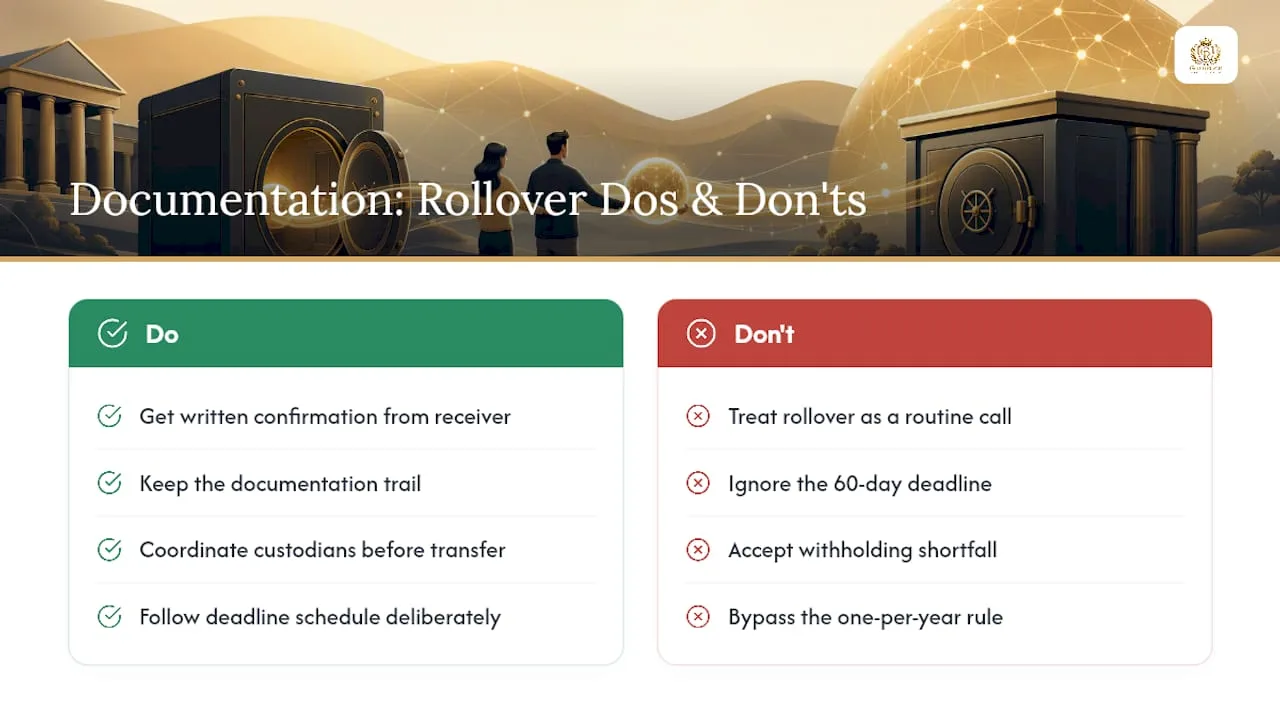
Careful custodian coordination is the difference between a rollover that closes cleanly and one that generates a confusing 1099-R eighteen months later. Every rollover trap in this article, the 60-day clock, the withholding shortfall, the one-per-year limit, gets neutralized by the same habit: get the receiving custodian’s confirmation in writing before funds move, and keep it.
None of the mistakes covered here are exotic. They’re the predictable result of treating a rollover like a routine phone call instead of a paperwork process with hard deadlines. Handled deliberately, with the documentation trail intact, a rollover into a self-directed precious metals IRA is no riskier than any other custodian-to-custodian transfer.
— Blake
Request a Free Precious Metals Consultation
GoldRock Metal Exchange gives you a direct route into physical gold, silver, platinum, or palladium without the paperwork guesswork that trips up so many rollovers. Instead of navigating custodian phone trees alone, GoldRock’s in-house IRA department handles the transfer coordination for you, so the 60-day deadline and withholding headaches covered above never become your problem.

Whether you’re rolling over an old 401(k), consolidating IRAs, or exploring investing retirement funds in coins for the first time, the process starts with a conversation, not a commitment. GoldRock does not promise specific returns or tax outcomes, and every rollover decision should be weighed against your own financial situation. If you want a walkthrough of how a direct transfer into a self-directed metals IRA would work for your accounts, request a free precious metals consultation or call (888) 859-0978 to speak with the IRA team directly. You can also browse current inventory or check live prices before your call.
Where to Verify These Rules Directly
For the underlying rules covered in this article, consult the IRS rollover guidance directly. For general context on tax-advantaged retirement accounts, see this overview of tax-advantaged accounts. FINRA also publishes consumer-facing retirement account safety resources worth reviewing before any transfer.
This article is general information, not a substitute for advice from a qualified financial advisor. Consult a qualified financial professional about your own circumstances before acting on anything here.
Sources
- Rollovers of retirement plan and IRA distributions | Internal Revenue Service
- What you need to know when accepting inherited retirement assets | Ascensus
- This IRA Rollover Mistake Could Trigger a Massive Tax Bill | The Motley Fool