

Private gold ownership has been legal in the United States since Executive Order 6102 was effectively repealed on December 31, 1974, and broad physical confiscation is extremely unlikely under current law and politics. The 1933 order that forced Americans to surrender gold coin and bullion no longer applies to anyone. If you still want to know what modern statutes could theoretically permit, and how to hold gold in a way that minimizes even the smaller frictions government agencies can create, the sections below walk through the legal reality and the practical mitigations.
TL;DR:
- Modern legal statutes, like IEEPA and the Trading With the Enemy Act, do not explicitly authorize mass confiscation of private gold without new legislation.
- Enforcement today would likely involve targeted actions such as civil asset forfeiture, border declaration checks, or custodial account freezes, not wholesale seizure.
- Confiscation risk is extremely low because the U.S. left the gold standard in 1971, removing the monetary policy need for gold centralization that prompted the 1933 order.
- The main legal challenges to confiscation now would involve the constitutional requirement of just compensation under eminent domain, making outright seizure politically and legally difficult.
- Practically, maintaining thorough documentation, choosing secure storage options, and complying with IRS rules are the most effective safeguards against legal friction points.
Table of Contents
- What Executive Order 6102 Actually Did in 1933
- Could Modern Law Authorize a New Confiscation?
- How Likely Is Confiscation, Really?
- The Government Levers Most Likely to Touch Your Gold
- A Practical Checklist for Holding Physical Gold Today
- Spotting Fear-Based Sales Tactics
- Why the Confiscation Narrative Persists, and What It Gets Wrong
- How GoldRock Metal Exchange Supports These Safeguards
- Ready to Take the Next Step?
- Primary Sources and Key References
- Sources
What Executive Order 6102 Actually Did in 1933
President Franklin Roosevelt signed Executive Order 6102 on April 5, 1933, ordering most U.S. citizens to deliver their gold coin, gold bullion, and gold certificates to Federal Reserve Banks by May 1 of that year. The order arrived in the middle of a banking crisis, when gold outflows and hoarding were straining a currency system still tied to the gold standard. Roosevelt needed to stop the drain and give the Treasury room to devalue the dollar against gold, something it could not do while private citizens held large reserves outside the banking system.
The order was not a blanket seizure with no exceptions. The full text, preserved by The American Presidency Project at UCSB, spells out specific carve-outs:
- A $100 exemption per person in gold coin was allowed, without any stated adjustment for inflation.
- An exemption for gold coins with recognized “special value to collectors of rare and unusual coins,” the origin of the modern claim that certain numismatic pieces are somehow immune from future confiscation.
- Industrial, professional, and artistic uses of gold, along with licensed dealers and jewelers operating under Treasury oversight.
- Penalties of up to $10,000 in fines or ten years in prison for willful violations, though in practice prosecutions were rare and enforcement leaned on banks and safe-deposit access rather than door-to-door searches.
Compliance came mostly through the banking system. Banks required customers to declare gold holdings before certain transactions, and safe-deposit boxes became a practical chokepoint for enforcement rather than a matter of state agents inspecting private homes. A year later, the Gold Reserve Act of 1934 nationalized the Federal Reserve’s gold holdings and revalued the dollar from $20.67 to $35 per ounce, a devaluation that only worked because private holdings had already been centralized.
The restriction did not end quickly. Limited private ownership of gold coins and jewelry returned earlier, but full private ownership of gold bullion did not become legal again until the repeal became effective on December 31, 1974, following the legislative process recorded in congressional records. That is a 41-year gap between the order and full legal restoration, longer than the working life of most people who ever held the metal.
Could Modern Law Authorize a New Confiscation?
The short answer from legal analysts is that several statutes theoretically touch gold ownership, but none of them cleanly authorizes a 1933-style mass seizure of privately held physical gold. Each carries real limits that make a repeat scenario legally awkward, if not effectively impossible without new legislation.
The International Emergency Economic Powers Act (IEEPA) is the closest modern equivalent to the authority Roosevelt used, but it is narrower than people assume. IEEPA lets the president regulate or block transactions involving a declared national emergency, and it has historically targeted foreign adversaries, sanctioned entities, and specific transaction types rather than domestic personal property held by U.S. citizens. Legal commentary on the statute makes clear that its focus on foreign interests is a structural limit, not a loophole waiting to be exploited domestically, according to analysis from LegalClarity.
The Trading With the Enemy Act, the statute Roosevelt actually relied on in 1933, has since been amended so its domestic emergency powers were largely transferred to IEEPA. It still exists on the books for wartime and enemy-nation scenarios, but its reach over ordinary domestic asset holdings during peacetime has been narrowed by decades of subsequent legislation.
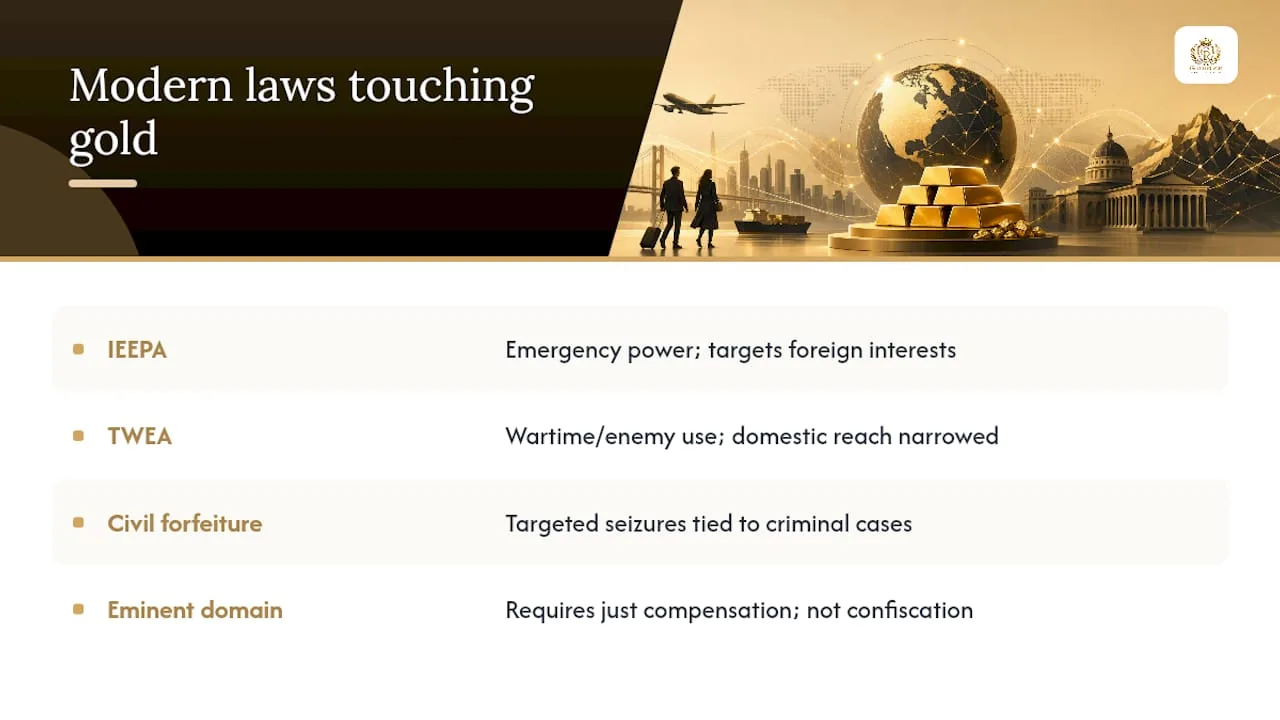
Civil asset forfeiture is the pathway legal analysts flag as the more realistic operational risk, though it works nothing like a nationwide order. Forfeiture allows the government to seize specific property connected to alleged criminal activity, often under a civil standard of proof lower than a criminal conviction requires. This is targeted, case-by-case, and tied to an investigation. It has nothing to do with a general policy against gold ownership, but it means undocumented cash-equivalent assets, including bullion, can become collateral damage in an unrelated legal dispute if ownership and provenance aren’t clearly documented.
Eminent domain, governed by the Fifth Amendment’s Takings Clause, requires “just compensation” whenever the government takes private property for public use. This constitutional requirement is precisely why gold owners in 1933 received cash compensation at the prevailing rate, not a confiscation with no payment. Any future action modeled on eminent domain would carry the same compensation obligation, which changes the political and fiscal calculus enormously compared to an outright seizure.
Historical note: the 1933 order paid gold holders $20.67 per ounce for surrendered metal, then revalued gold to $35 an ounce the following year, a sequence some historians still describe as a disguised windfall for the government at private owners’ expense.
Taken together, these authorities describe tools that could touch gold transactions or specific investigations, not a ready-made mechanism for repeating 1933.
How Likely Is Confiscation, Really?
The single biggest reason 1933 happened is gone: the United States left the gold standard entirely in 1971, and the dollar has floated as fiat currency ever since. Roosevelt needed private gold centralized because the currency’s value was mechanically tied to a fixed gold price. Today the Federal Reserve manages monetary policy through interest rates and open-market operations, tools that don’t require the government to own or control privately held bullion. Remove the motive, and the historical justification for a seizure disappears with it.
Legal analysts who have examined the modern statutory landscape consistently describe mass confiscation as a low-probability scenario, not because the government lacks emergency powers of some kind, but because none of those powers map cleanly onto a repeat of 1933 without new legislation passed by Congress, according to the same legal review. That would require public debate, a vote, and almost certainly immediate court challenges under the Takings Clause. Compare that political lift to raising reporting thresholds through regulatory rulemaking, which requires no new statute at all.
That contrast points to where realistic friction actually lives: reporting requirements, capital gains taxation, and export or import controls are far easier for regulators to adjust than any seizure authority. The IRS already treats physical gold as a collectible for tax purposes, and Customs and Border Protection already requires travelers to declare monetary instruments over $10,000 at the border. These are the kinds of measures that could tighten incrementally, not headline-grabbing seizures.
Pro Tip: If you’re evaluating gold confiscation risk for your own portfolio, spend your energy on documentation and tax compliance rather than on searching for a coin type marketed as “confiscation-proof.” The paperwork trail matters more than the coin’s design.
For an investor, the practical order of concerns looks like this: tax reporting accuracy first, storage and documentation second, and outright confiscation somewhere near the bottom of a very long list that starts with market volatility and liquidity planning.
The Government Levers Most Likely to Touch Your Gold
None of these mechanisms resemble a doorstep seizure, but each has a real operational pathway worth understanding.
- Freezing custodial or vault accounts. Regulated financial institutions, including depositories and IRA custodians, can be compelled to freeze or block transactions tied to sanctions enforcement or a criminal investigation. This affects assets held in third-party custody, not gold stored at home, and typically requires a specific legal order rather than a blanket policy.
- Customs reporting and border risk. Physical gold you carry across an international border isn’t cash, but monetary instruments and certain high-value goods carry disclosure obligations. Travelers who fail to declare items correctly risk delays, questioning, and potential seizure of the specific items in question, independent of any confiscation policy.
- Civil forfeiture proceedings. If gold becomes evidence or alleged proceeds in a criminal case, government attorneys can pursue forfeiture under a civil standard of proof. Owners without clear purchase records, receipts, or a documented chain of custody face a harder, more expensive path to getting the property back even when no wrongdoing is proven.
- Tax and regulatory adjustments. Congress or the Treasury could raise reporting thresholds, adjust collectible-asset capital gains rates, or expand disclosure rules for large purchases. These moves face far less political resistance than a takings-clause fight, and they’re the mechanism most likely to actually change over the next decade.
Each of these is a narrower, slower, and more legally accountable process than the 1933 surrender order, and each leaves a paper trail an owner can respond to.
A Practical Checklist for Holding Physical Gold Today
Reducing your practical exposure to any of the friction points above starts with documentation, not with chasing a coin marketed as legally untouchable.
Keep provenance records for every purchase. Save invoices, serial numbers where applicable, and assay or certificate paperwork. If gold is ever questioned in a forfeiture proceeding, a clean purchase trail from a legitimate dealer is the single strongest defense you can hold, and it costs nothing to maintain beyond a folder or a scanned file.
Think through storage tradeoffs deliberately. Home storage gives you full control but concentrates theft and disaster risk in one place. Insured private delivery gets your metal into your own possession with transit coverage along the way. Allocated storage at a third-party vault separates your specific bars or coins from a pooled inventory, which matters both for legal clarity and for what you actually own if a custodian ever runs into financial trouble. International vaulting adds geographic diversification but layers in cross-border reporting obligations and logistical complexity that most domestic investors don’t need. GoldRock Metal Exchange’s guide to precious metal storage options walks through these tradeoffs in more depth, and the home storage guide for retirement holdings covers the practical side of keeping metal secure.
Understand the IRS rules if you’re holding gold for retirement. A self-directed Precious Metals IRA lets you hold physical bullion inside a tax-advantaged retirement account, but the IRS requires the metal to sit with an approved custodian and meet minimum purity standards, and it strictly prohibits certain transactions, including personal possession of the metal while it remains inside the IRA. GoldRock Metal Exchange’s breakdown of Gold IRA rules covers custodian requirements and prohibited transactions in detail.
Insure what you hold and report what the law requires. Homeowner’s policies routinely cap precious metals coverage far below replacement value, so a rider or a specialized policy matters if your holdings are significant. If you travel internationally with gold, know the disclosure thresholds before you go, since undeclared high-value items create exactly the kind of border friction described above. And keep your tax reporting current. Capital gains on collectible-classified assets like gold are taxed differently than standard investment income, and getting that wrong creates far more real-world risk than any confiscation scenario.
Don’t overpay for “confiscation-proof” marketing claims. No coin available today carries a legal guarantee against a future law that hasn’t been written yet. Buy based on metal content, purity, and liquidity, and treat any dealer’s confiscation-immunity pitch as a sales angle rather than a legal fact. GoldRock Metal Exchange’s guide to gold coin examples breaks down how bullion coins and numismatic pieces actually differ in liquidity and premium.
Pro Tip: If a dealer’s storage recommendation happens to route through a facility they profit from, or their buyback terms are vague, treat that as a reason to ask more questions, not fewer.
Investors weighing where to physically hold gold sometimes extend the same due-diligence habit to other tangible assets. If you’re comparing physical precious metals against other alternative holdings, a partner resource on gemstone investment due diligence walks through similar verification questions for a different asset class.
Spotting Fear-Based Sales Tactics
Confiscation anxiety sells coins, and some marketers lean on it harder than the legal facts support. Watch for these patterns before paying a premium:
- “Guaranteed non-confiscatable” coins. No dealer can legally guarantee immunity from a law that doesn’t exist yet. This phrase is a sales trigger, not a legal fact.
- Urgency pitches tied to news headlines. Pressure to “buy before it’s too late” almost always signals a markup conversation, not a genuine legal deadline.
- Premiums far above melt value with no clear justification. Compare the coin’s metal content and spot price to the asking price before assuming a premium reflects real scarcity.
- Opaque buyback policies. A dealer who won’t clearly state buyback terms in writing is one you should question before you buy, not after.
- Pressure toward a specific storage facility. Ask why, and ask what the dealer’s financial relationship with that facility is.
- Unverifiable legal claims. Ask for the actual statute or executive order being cited, and check it yourself against a primary source like archives.gov.
Why the Confiscation Narrative Persists, and What It Gets Wrong
The confiscation fear has real historical roots, which is exactly why it’s so effective as a sales hook. But 1933 happened for a specific structural reason, a currency mechanically pegged to a fixed gold price, that stopped existing when the U.S. left the gold standard in 1971. Treating a monetary-policy relic as an ever-present threat misreads why the order happened in the first place.
What gets underestimated is how much the compensation requirement changes the entire calculus. In 1933, the government paid $20.67 an ounce for surrendered gold, then repriced gold at $35 the following year. That sequence still angers some historians decades later, and any modern attempt at a comparable move would trigger swift Takings Clause litigation with far more legal infrastructure available to challenge it than existed in 1933. The realistic risk isn’t a knock on your door. It’s a slow tightening of reporting rules, tax treatment, and custodial oversight, the boring stuff that never makes a viral headline but actually shapes what owning gold looks like a decade from now. Investors who spend their attention chasing “confiscation-proof” marketing claims are usually protecting themselves against the wrong threat, while the actual friction points—incomplete records, unclear custody, sloppy tax reporting—sit unaddressed.
— Blake
How GoldRock Metal Exchange Supports These Safeguards
The mitigations above, clean documentation, thoughtful storage, and IRS-compliant retirement structures, are exactly where GoldRock Metal Exchange focuses its services. The company offers insured private delivery of physical gold, silver, platinum, and palladium, providing a documented, insured chain of custody from purchase to your possession. For retirement accounts, GoldRock’s in-house IRA department handles the rollover process for a self-directed Precious Metals IRA, guiding you through custodian selection and IRS purity requirements so the account stays compliant from the start.
None of this is a promise about future law, future prices, or investment returns, and it shouldn’t be treated as personalized tax or legal advice. It’s a factual description of services built around the same documentation and custody principles this article just walked through. If you want to talk through how storage, delivery, and IRA options apply to your specific situation, Request a Free Precious Metals Consultation or call (888) 859-0978 to speak with GoldRock’s team directly.
This article is for general educational purposes only and does not constitute investment, tax, or legal advice. Consult a qualified professional about your specific circumstances.
Ready to Take the Next Step?
Understanding the legal history is one thing. Actually building a documented, compliant gold position is another, and it’s where GoldRock Metal Exchange fits into the picture you’ve just read about. Unlike a general brokerage that treats a bullion order the same as any other line item, purchases can be paired with an in-house IRA department and insured private delivery, so the documentation and custody trail this article recommends is built into the transaction from day one.

Start by checking live spot prices to see current market levels, then browse the product catalog for bullion and coins by weight and metal type. If you’re rolling over an existing retirement account, GoldRock’s Precious Metals IRA page outlines how a self-directed rollover works from start to finish. Whichever path fits your situation, Request a Free Precious Metals Consultation or call (888) 859-0978 to talk through documentation, storage, and IRA options with GoldRock’s in-house team before you buy.
Primary Sources and Key References
- Executive Order 6102 — The American Presidency Project (UCSB): full text with exemptions and penalties.
- Codification of Executive Order 6102 — National Archives: codified Federal Register entry.
- Roosevelt’s Gold Program — Federal Reserve History: monetary policy context for the 1933 order.
- Congress: legislative record of the repeal restoring private gold ownership.
- Can the U.S. Government Legally Take Your Gold? — LegalClarity: legal analysis of IEEPA, forfeiture, and eminent domain limits.
This article is general information, not a substitute for advice from a qualified financial advisor. Consult a qualified financial professional about your own circumstances before acting on anything here.
Sources
- Executive Order 6102 — The American Presidency Project (UCSB)
- Roosevelt’s gold program — Federal Reserve History
- Can the U.S. government legally take your gold? — LegalClarity
- Congress