

Gold ETFs generally suit investors who want liquid, low-cost price exposure over a shorter horizon, while physical gold suits those who want direct custody and are willing to hold for decades. ETFs win on cost and speed of trading; physical gold wins on independence from financial intermediaries and usability in a genuine crisis. Most experienced holders end up doing both, sizing each piece to a specific job rather than picking one and abandoning the other.
TL;DR:
- Gold ETFs offer higher liquidity and lower costs for short-term holdings, with expense ratios ranging from 0.17% to 0.40%, but carry counterparty risks.
- Physical gold involves premiums, buyback discounts, and storage costs, which can accumulate and offset long-term savings compared to ETFs.
- Tax treatment differs: ETFs usually have standard brokerage reporting, while physical gold may require a self-directed IRA for tax-advantaged retirement investing.
- For portfolios under five years or smaller positions, ETFs generally save money and provide easier access, while physical gold suits long-term custody independence.
- Combining both assets can balance liquidity, cost-efficiency, and independence depending on individual investment goals and horizon.
Table of Contents
- Physical Gold vs. ETF: Ownership, Liquidity, and Risk Compared
- What Physical Gold and Gold ETFs Actually Cost You
- How Taxes and Account Rules Affect Each Option
- How to Decide Between Physical Gold and a Gold ETF
- Buying, Storing, and Selling Physical Gold the Right Way
- How GoldRock Metal Exchange Supports Physical Ownership and IRAs
- Request a Free Precious Metals Consultation
- Sources
Physical Gold vs. ETF: Ownership, Liquidity, and Risk Compared
The difference starts with what you actually hold. A gold ETF gives you shares representing a claim on pooled bullion sitting in a custodian’s vault. Physical gold gives you title to a specific bar or coin you can hold, move, or hide. That distinction shapes everything else about how each vehicle behaves.
Retail ETF holders generally cannot convert shares into specific bars or coins. The redemption mechanism favors large institutional blocks known as authorized participants, so your shares represent allocated gold you never actually take delivery of. If you buy an ETF expecting to eventually request your bullion shipped to your door, that path doesn’t exist for most retail accounts.
Liquidity favors ETFs by a wide margin. Shares trade intraday on major exchanges with tight bid-ask spreads, and you can exit a position in seconds during market hours. Selling physical gold is a multi-day process that involves finding a buyer, verifying authenticity, and often accepting a buyback discount below the current spot price.
The trade-off is counterparty exposure. ETFs carry fund, custodian, and brokerage counterparty risk layered on top of the gold price itself. Physical gold removes that layer entirely, which is why some investors hold it specifically for scenarios where they don’t want their wealth dependent on a financial institution staying solvent.
Here’s how the core factors stack up:
- Ownership: ETF shares are a pooled claim; physical gold is direct title to a specific item.
- Liquidity: ETFs trade instantly during market hours; physical sales take days and involve a dealer.
- Cost structure: ETFs charge a recurring expense ratio; physical gold carries an upfront premium plus optional storage fees.
- Crisis usability: Physical gold functions independent of exchanges or brokerages; ETFs require a functioning financial system to trade.
Neither structure is flawed. They’re built for different jobs, and conflating them is where most first-time buyers go wrong.
What Physical Gold and Gold ETFs Actually Cost You
Gold ETFs typically carry annual expense ratios between roughly 0.17% and 0.40%, a cost that compounds quietly every year you hold the fund but comes with no dealer premium or storage bill attached.
Physical gold’s cost stack looks different:
- Dealer premium over spot, which varies by product. One-ounce bars and sovereign coins carry the lowest relative premium; fractional pieces (a tenth-ounce coin, for instance) cost noticeably more per ounce because minting and distribution costs don’t scale down proportionally.
- Buyback discount at resale, typically running 1% to 3% below spot, which is often the real hidden cost investors underestimate.
- Storage and insurance, which ranges from free (a home safe, with its own risk trade-offs) to a modest annual percentage fee at a depository or bank vault.
Run that math before assuming physical gold is automatically cheaper long term.*
Understanding what a gold premium over spot actually means helps you compare products intelligently instead of assuming all physical gold costs the same to acquire.
How Taxes and Account Rules Affect Each Option
The IRS classifies certain precious metals as collectibles for tax purposes, which affects how gains are taxed differently from typical securities. Gold ETF sales, by contrast, are usually reported to you on a standard Form 1099-B, similar to any other brokerage holding.
Account compatibility is where this gets practical:
- Standard brokerage and retirement accounts can hold gold ETFs the same way they hold any other fund.
- Physical gold requires a self-directed IRA structure if you want it inside a retirement account, since conventional IRA custodians don’t hold physical bullion.
- Confirm current rules directly with the IRS or SEC, and talk to a qualified tax advisor before assuming either vehicle fits your specific retirement or estate situation.
How to Decide Between Physical Gold and a Gold ETF
Start with three questions: how soon might you need to sell, how large is the position relative to your overall portfolio, and do you specifically want custody independent of any financial institution?
- Under roughly five years, or a smaller position? ETFs are usually the more cost-efficient default, since you avoid premiums and buyback discounts you’d otherwise eat on a short holding period.
- Multi-decade horizon with a priority on custody independence? Physical gold becomes more attractive, since the breakeven math favors longer holds once the one-time premium is spread across enough years.
- Want both liquidity and independence? A blended allocation is common: an ETF core for tactical flexibility, paired with a smaller physical position held specifically for scenarios where you want an asset outside the financial system entirely.
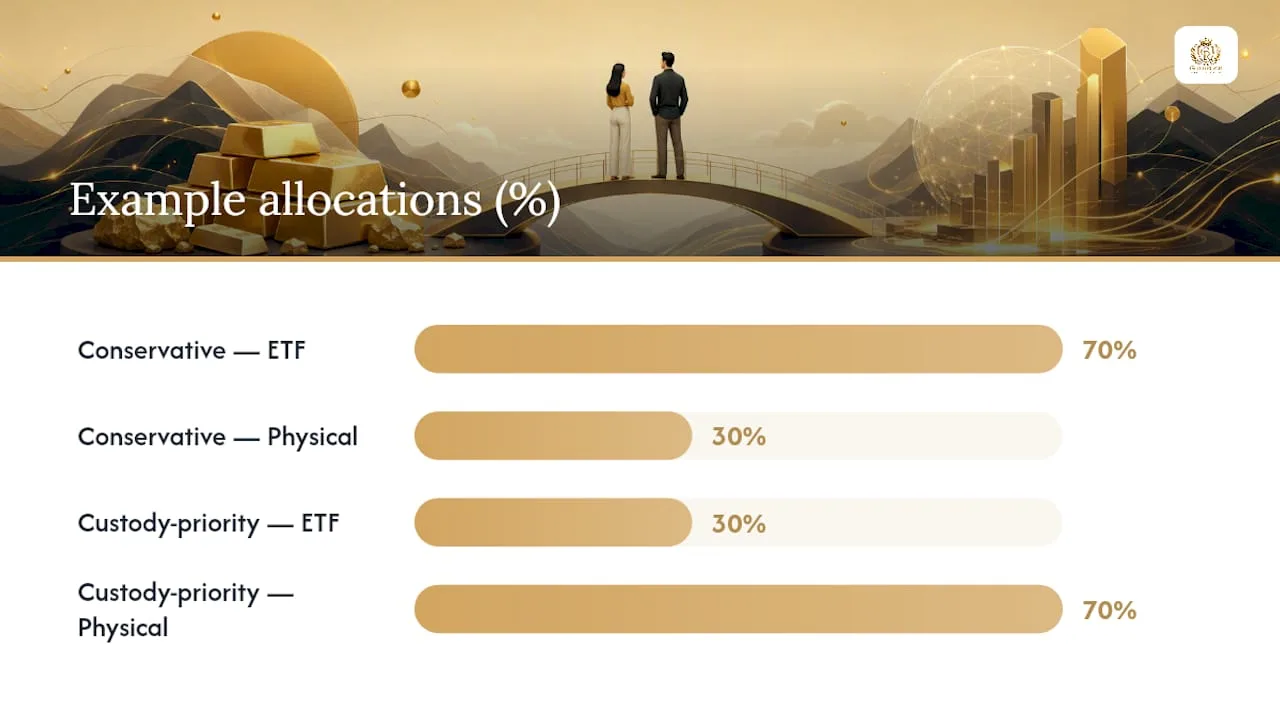
Pro Tip: Illustrative examples some investors use: a conservative split might hold 70% ETF and 30% physical, while someone prioritizing custody independence might flip that to 30% ETF and 70% physical. These are starting points for your own thinking, not personalized recommendations.
For a broader look at how metals fit alongside other assets, this breakdown of top financial investment approaches is worth a look, and our guide on gold’s role in a retirement portfolio walks through allocation thinking in more detail.
Buying, Storing, and Selling Physical Gold the Right Way
If you decide physical gold fits your plan, a few operational habits protect you from the most common mistakes.
- Buy in standard sizes. One-ounce bars and widely recognized sovereign coins carry lower relative premiums than fractional pieces and resell more easily.
- Keep every document. Save receipts, certificates of authenticity, and serial numbers where applicable. This paperwork speeds up resale and supports insurance claims.
- Choose storage deliberately. A home safe, a bank safe deposit box, and a private depository each carry different cost, insurance, and access trade-offs.
- Get multiple quotes before selling. Buyback offers vary by dealer, and comparing a few before committing helps offset the discount you’ll face against spot price.
Pro Tip: Photograph your holdings and store the images separately from the gold itself. It’s a small step that makes insurance claims and estate settlement dramatically simpler.
How GoldRock Metal Exchange Supports Physical Ownership and IRAs
A self-directed Precious Metals IRA lets retirement funds purchase physical gold, silver, platinum, or palladium held through an approved custodian rather than a standard brokerage account. GoldRock Metal Exchange’s in-house IRA department assists with the rollover and setup process, and its insured private delivery option gives direct buyers a documented, insured path to receiving metal outside a retirement account. If you’re weighing whether an IRA rollover or direct purchase fits your situation, requesting a free consultation is a reasonable next step before committing either way.

A Straight Answer on Physical Gold vs. ETF
Match the vehicle to the job, not the other way around. If your money needs to stay liquid or the position is modest, an ETF usually serves you better than physical metal will. If you’re building a decades-long position specifically for custody independence, physical gold earns its premium over time. Whichever way you lean, keep your tax documentation organized and get a qualified opinion before moving retirement funds.
— Blake
Request a Free Precious Metals Consultation
GoldRock Metal Exchange gives you a direct path to physical ownership without guesswork over custody or delivery. Unlike an ETF, where your shares never convert to actual metal, a direct purchase or self-directed IRA through GoldRock puts specific bars or coins in your name, delivered through an insured private delivery process or held through an approved IRA custodian.

Whether you’re rolling over an existing retirement account or buying outright, GoldRock’s in-house IRA department walks through the setup so the paperwork doesn’t fall on you. Check current live prices to see where the market sits today, then request a free precious metals consultation by calling (888) 859-0978 or starting your Precious Metals IRA application online.
This article is for general educational purposes only and does not constitute investment, tax, or legal advice. Consult a qualified financial, tax, or legal professional before making decisions about your retirement accounts or investment portfolio.
Sources
This article is general information, not a substitute for advice from a qualified financial advisor. Consult a qualified financial professional about your own circumstances before acting on anything here.