

Gold IRA shipping fees are usually a small line item next to setup, custodian, storage and dealer charges, and they depend on who ships what, and where. Metals bought inside an IRA go to an approved depository, not to your door. Any shipping or insured-transit charge should appear on a written fee schedule before you move money. Direct purchases of metals outside an IRA are a separate matter, with their own delivery terms.
This guide is educational. It explains how shipping charges fit into the larger cost picture so you can ask better questions. It does not give personal investment, tax or legal advice.
TL;DR
- Metals held in an IRA must stay with an approved custodian or trustee, so “shipping” in a gold IRA normally means insured transit to a depository, not delivery to your home.
- Shipping is one cost layer among several: account setup, annual custodian and storage fees, wire fees, dealer pricing and possible closing or distribution fees.
- The CFTC advises getting every fee, cost and commission in writing before you sign or transfer money.
- Delivery to your own address applies to non-IRA purchases, where insured private delivery is an option.
- Call (888) 859-0978 and ask our IRA department to walk through a written fee schedule for your situation.
Table of Contents
- Where shipping fits in a gold IRA
- When shipping fees can appear
- What typical shipping charges look like
- Shipping is one layer of several
- What is included in insured shipping
- How to check a fee schedule before you commit
- Our perspective
- Two ways to own metal, two delivery paths
- Talk to our IRA team
- Common mistakes to avoid
- FAQ
- Educational disclaimer
- Sources
Where shipping fits in a gold IRA
A self-directed IRA that holds physical metal has a custodian, a dealer that supplies the metal and a depository that stores it. Each can charge for something different. Shipping typically touches only one step: moving the purchased metal from the dealer to the depository.
Because of that, the question “what will shipping cost me?” often has a less dramatic answer than readers expect. The bigger questions are the recurring charges and the price of the metal itself. Our U.S. gold IRA fees overview covers the whole stack, and this article zooms in on delivery.
Why IRA metal does not come to your house
You can own gold in an IRA, but IRA metals must be stored in approved depositories rather than at home. The reason is in the tax code. Summaries of Internal Revenue Code section 408(m) explain that the bullion exception applies only when a trustee has physical possession. If the metal is held personally, the amount may be treated as a distribution, which can carry consequences you should discuss with a qualified tax professional.
We go deeper on this in two guides: why you should not store IRA gold at home and the two Section 408(m) rules investors most often miss.
The practical result: in an IRA, you are not choosing a courier to your doorstep. You are choosing a depository, and the delivery to it is arranged as part of the purchase.
When shipping fees can appear
The timing matters more than the amount. Shipping or handling may be charged in these situations.
| Situation | Does metal move? | Where shipping charges may appear |
|---|---|---|
| New purchase inside an IRA | Yes, dealer to depository | Insured transit to the depository, often bundled into pricing or listed separately |
| Rollover or transfer of cash into an IRA | No metal yet | Wire or transfer fees, not shipping |
| Selling metal held in an IRA | Depository to dealer | Handling or transit, per the depository’s schedule |
| In-kind distribution of metal | Depository to you | Shipping, insurance and distribution fees, plus tax rules to review with a professional |
| Direct purchase outside an IRA | Dealer to you | Delivery charge, insurance, or private delivery |
Treat this table as a map of where to ask, not a promise of how any provider charges. Practices differ, and the written schedule governs.
Buying metals inside an IRA
The dealer ships the metal to the depository, fully insured in transit. Some providers fold that cost into the product price or the account setup, and others list it as its own fee. Ask which one applies and get the answer in writing.
Moving cash by wire
A rollover from a 401(k), TSP or another IRA is first a movement of money. A direct transfer is generally recommended as the way to fund a gold IRA because the custodians handle it after you make the request. Wire fees belong here, and they are not shipping fees even though many fee lists group them together. If you are comparing rollover paths, our Gold IRA eligibility guide explains who qualifies.
Taking metal out as a distribution
If you later take physical metal out of the IRA, shipping and insurance to your address may be charged, alongside any in-kind distribution fee. Taking a distribution also has tax and age-related rules, so read our Gold IRA distribution rules and speak with a tax professional before you act.
What typical shipping charges look like
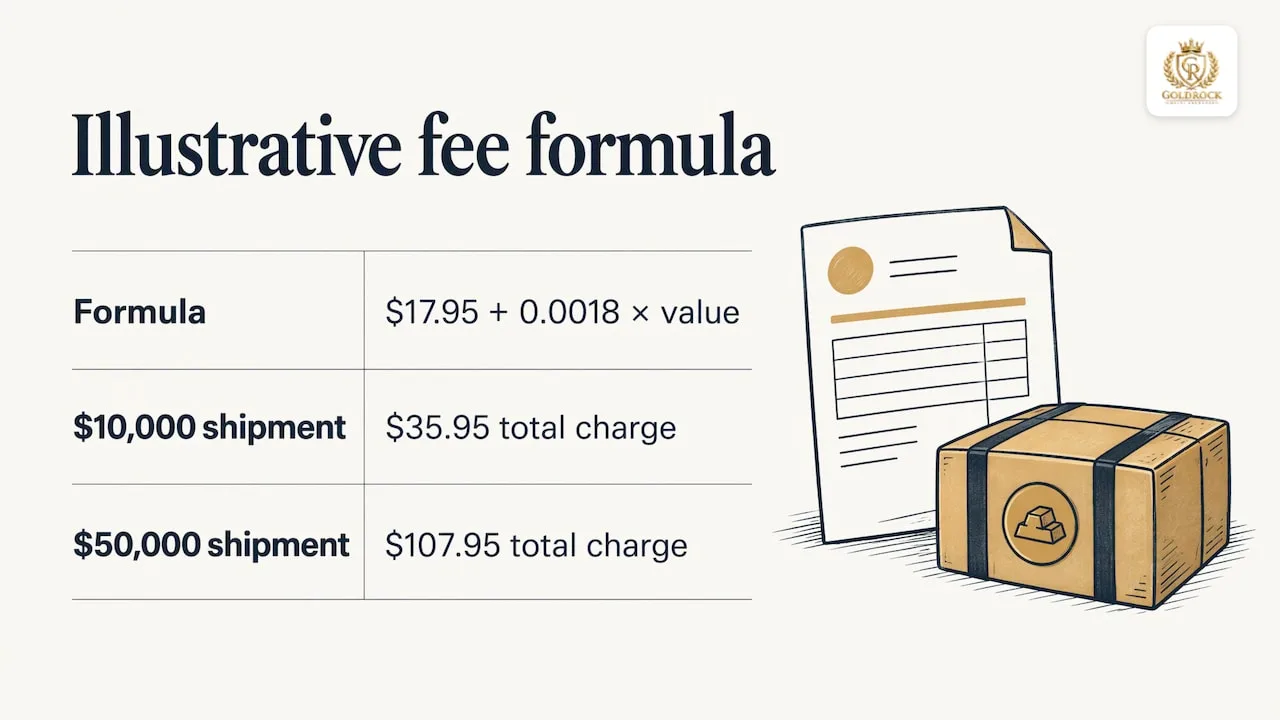
Published figures for insured bullion shipping vary by weight, declared value and carrier. One public example shows the structure. The Texas Bullion Depository’s fee schedule, effective April 1, 2026, lists domestic shipping and handling at $17.95 plus 0.0018 times the spot-price value, covering standard shipments up to 100 ounces of gold, with 100% insurance included. That schedule applies to non-IRA accounts at a state depository, and it is not a quote for any IRA. What it shows is useful anyway: shipping is often a small flat charge plus a percentage of declared value, and insurance may be built in.
So a shipment’s cost rises with the value of what you send, not only its weight. A larger order costs more to insure, which is why you should ask how the fee is calculated and not only what the headline number is.
A worked illustration
Using that structure purely as arithmetic: if a shipment’s declared value were $10,000, the percentage portion would be 0.0018 × $10,000 = $18, added to the $17.95 flat charge for $35.95. At $50,000 the percentage portion would be $90, for $107.95. These numbers illustrate the formula only. Your provider’s schedule decides your actual figure.
Shipping is one layer of several
Readers searching for shipping fees are usually trying to learn what the whole account will cost. The CFTC separates dealer spreads and product pricing from ongoing storage, insurance and administrative costs. In a gold IRA, the layers typically look like this:
- Setup fee. A one-time charge for opening the account.
- Annual custodian fee. Pays for administration and reporting.
- Storage fee. Charged by the depository, either as a flat amount or as a percentage of value. One summary reports flat plans of $100–$300 a year, or 0.15%–0.50% for percentage-based plans, and recommends reviewing the complete fee schedule in writing.
- Transaction or wire fees. Charged when money moves or metal is bought or sold.
- Dealer pricing. The difference between the spot price and what you pay for a coin or bar.
- Shipping and insurance. Transit to the depository, and from it if you sell or take a distribution.
- Closing or distribution fees. Charged if you close the account or take metal in kind.
Notice that shipping is item six. If a quote focuses on shipping and stays vague on the rest, ask for the full list. Our depository insurance checklist helps you separate transit insurance from the coverage a depository carries.
What is included in insured shipping
Insured shipping generally means the shipment is covered for its declared value while in transit, and that the carrier or provider handles packaging and tracking. Who arranges it, who pays and who is liable if something goes wrong should all be spelled out. Questions worth asking:
- Who arranges the shipment, the dealer or the custodian?
- Is insurance for the full declared value?
- At what point does responsibility pass to the depository?
- Is the cost part of the metal’s price or a separate line?
- What happens if a shipment is delayed?
For shipments to individuals, such as non-IRA purchases, private delivery can avoid some limits that apply to postal shipping, and our guide to gold shipping methods walks through the options.
How to check a fee schedule before you commit
The CFTC’s consumer advisory says buyers should get all fees, costs, commissions and the agreed retail price in writing before signing or transferring money, and treat fees missing from the written paperwork as a red flag. It also says to ask separately about storage, insurance, administrative fees and possible taxes or penalties.
Here is a simple process.
- Ask for the complete schedule. Setup, annual, storage, transaction, wire, shipping, insurance, in-kind and closing fees.
- Ask how each is calculated. Flat, percentage of value, or per transaction.
- Confirm what is bundled. Is insured transit part of the price or a separate charge?
- Confirm the depository. Make sure it is approved. Our guide to verifying an IRS-approved depository gives three steps.
- Read the sale paperwork. The written price should match what was quoted.
- Keep copies. Save the schedule and the agreement.
Our perspective
We hear the shipping question from nearly every new IRA client, and the honest answer is that it is rarely the cost that matters most. What matters is whether the whole fee picture is clear before any money moves.
That is why we built a dedicated in-house IRA department. Rollovers involve a custodian, a depository, a dealer and a delivery step, and each hand-off is easier when one team coordinates it and explains it in plain language.
Our approach is personal service and transparent explanations, with insured delivery and ongoing consultations behind every order. We would rather you ask a dozen questions now than be surprised later.
If you prefer to hold metal yourself rather than in an IRA, our insured private delivery is designed for that purpose, separate from retirement accounts.
Blake
Two ways to own metal, two delivery paths
The delivery question comes down to which ownership route you choose.
Inside a self-directed IRA. The metal goes to an approved depository. You do not receive it. Delivery is a back-office step, and the fees to review are the layered ones above. Our Precious Metals IRA page explains how we guide the process, and Open a Precious Metal IRA starts it.
Outside an IRA. You can buy gold, silver, platinum or palladium and have it delivered to you through insured private delivery. Here, shipping is a real part of the purchase, and the points to settle are the insurance, the signature requirements and the declared value.
If you are weighing physical metal against a fund, our comparison of gold ETFs and IRAs explains how storage rules shape the choice.
Talk to our IRA team
We sell physical gold, silver, platinum and palladium, set up self-directed IRAs and arrange insured private delivery. Our in-house IRA department can explain each step of a rollover from a 401(k), TSP or existing IRA, and answer shipping questions before you commit. Details of fees are provided in writing.

When you are ready, Request a Free Precious Metals Consultation or call (888) 859-0978.
Common mistakes to avoid
- Assuming metal can be shipped home from an IRA. Home possession of IRA metal can be treated as a distribution. Review depository versus home storage first.
- Mixing up wire and shipping fees. They are listed together but charged for different steps.
- Looking only at the shipping line. Premiums and recurring fees usually add up to more over time.
- Skipping the written schedule. Verbal estimates are not a record.
- Ignoring the rules. Our Gold IRA rules guide lists what the IRS requires of eligible metal and custody.
FAQ
Does a gold IRA charge shipping fees?
Sometimes. Metal bought inside an IRA is shipped, insured, to an approved depository, and the cost may be bundled into pricing or listed separately. Ask for the schedule in writing so you can see which applies.
Can I have my IRA gold shipped to my home?
Not while it is held in the IRA. IRA metals must stay with an approved custodian or depository. Taking metal home can be treated as a distribution, so speak with a qualified tax professional before considering it.
Are wire fees the same as shipping fees?
No. Wire fees apply when money moves between accounts, such as in a rollover. Shipping applies when physical metal moves. Both can appear on a fee schedule, so confirm each.
What fees should I get in writing before I fund a gold IRA?
The CFTC advises getting every fee, cost and commission in writing, plus the agreed retail price. That includes setup, custodian, storage, insurance, shipping, transaction and closing fees.
Can I buy metal outside an IRA and have it delivered?
Yes. Direct purchases of physical metal can be delivered to you, and we offer insured private delivery for that. The delivery terms are confirmed when you order.
Educational disclaimer
This article is for general education only. It is not investment, tax or legal advice, and it makes no promise of returns, safety, tax benefits or appreciation. Precious metals prices can rise and fall. Consult a qualified financial, tax or legal professional about your own situation.
Sources
- Texas Bullion Depository, Schedule of Fees
- CFTC, 10 Things to Ask Before Buying Physical Gold, Silver, or Other Metals
- Money, How a Precious Metals IRA Works
- LegalClarity, Gold IRA Storage Fees
- Can You Store Your Gold IRA at Home?