You can move annuity money into a gold IRA only if the annuity is qualified, meaning it was funded with pre-tax retirement dollars. The usual path has two stages. The qualified annuity is first rolled into a self-directed IRA. That IRA then buys IRS-eligible physical metals held by an approved custodian. A nonqualified annuity, bought with after-tax money, generally cannot be rolled into an IRA at all.
This guide explains the difference, the contract costs to review, the steps in order and the questions to ask before you act. It is general education, not personal advice. We cover what the rules say so you can have a better conversation with your annuity issuer, your tax professional and us.
TL;DR
- Only a qualified annuity (funded with pre-tax money) can generally be rolled into an IRA. A nonqualified annuity generally cannot.
- Your annuity contract may charge a surrender fee for leaving early. Check the schedule and any free-withdrawal allowance before you request a transfer.
- The IRS allows certain gold, silver, platinum and palladium bullion in an IRA if a bank or approved non-bank trustee holds it. You cannot keep it at home.
- Dealer markups and account fees vary, so compare costs in writing before you commit.
- Our in-house IRA department can walk you through the process. Call (888) 859-0978.
Table of Contents
- Can an annuity go into a gold IRA?
- Check your annuity contract first
- Direct transfer or rollover: how the money moves
- Step-by-step: moving a qualified annuity into a gold IRA
- What the IRS says about metals in an IRA
- Costs to compare before you commit
- Perspective
- Requesting a consultation
- Related situations: 401(k), TSP and pensions
- Questions to ask any provider
- Frequently asked questions
- Educational disclaimer
- Sources
Can an annuity go into a gold IRA?
The short answer depends on one label on your contract: qualified or nonqualified.
A qualified annuity is funded with pre-tax dollars, for example an annuity held inside an employer retirement arrangement. According to Investopedia’s rollover guide, a qualified variable annuity can be rolled into a traditional IRA without incurring taxes if the rollover is done correctly. Once the money sits in a self-directed IRA, that account can hold eligible physical metals.
A nonqualified annuity is bought with after-tax money. The same Investopedia guide explains that this kind of contract cannot be rolled into a traditional IRA. It can generally only move to other nonqualified accounts, for example through a 1035 exchange. A 1035 exchange swaps one annuity for another, so it does not lead to a gold IRA.
If you are unsure which type you own, look at your contract and your annual statements, or ask the issuer directly. Ask whether the contract is held inside an IRA or employer plan, or was purchased with after-tax money.
Why there are two steps
An annuity is an insurance contract. A gold IRA is a retirement account that holds physical metals. They are different products, so money does not flow straight from one to the other. The annuity is liquidated or transferred into an IRA, and the IRA’s custodian then purchases metals through a dealer. Think of the IRA as the container and the metals as one of the things inside it.
Check your annuity contract first
Before starting any paperwork, read the exit terms. Leaving an annuity can carry costs that have nothing to do with the metals.
Surrender charges
Many annuities charge a fee for withdrawing money early. MarketWatch reports that these charges commonly run between 5% and 15% of the amount withdrawn, citing the Maryland Insurance Administration, and that the surrender period typically lasts six to eight years after purchase. The charge usually shrinks each year until it reaches zero.
That guide also quotes an adviser who recommends deciding where the money will go next before surrendering a contract, and weighing the costs and how to reduce them. We agree with that sequence. Decide the destination first, then act.
Other contract terms to ask about
- Free-withdrawal allowance. Some contracts let you take out a set percentage each year without a surrender fee. Ask your issuer whether yours does and how it is calculated.
- Market value adjustment. Some fixed and indexed contracts adjust the payout based on interest rate movement. Ask whether yours has one.
- Living or death benefit riders. Moving funds may end guarantees attached to the contract. Ask what you would give up.
- Timing. Some people wait for the surrender schedule to step down or reach zero. Whether that makes sense is a question for you and your financial professional.
Write down the answers and the issuer’s representative who gave them. They become part of your decision file.
Direct transfer or rollover: how the money moves
When eligible funds move, the method matters. In a direct (trustee-to-trustee) transfer, the money goes from one institution to the new custodian without passing through your hands. In an indirect rollover, you receive a check and must redeposit it within a deadline. Missing that deadline, or mishandling withholding, can turn a rollover into a taxable distribution.
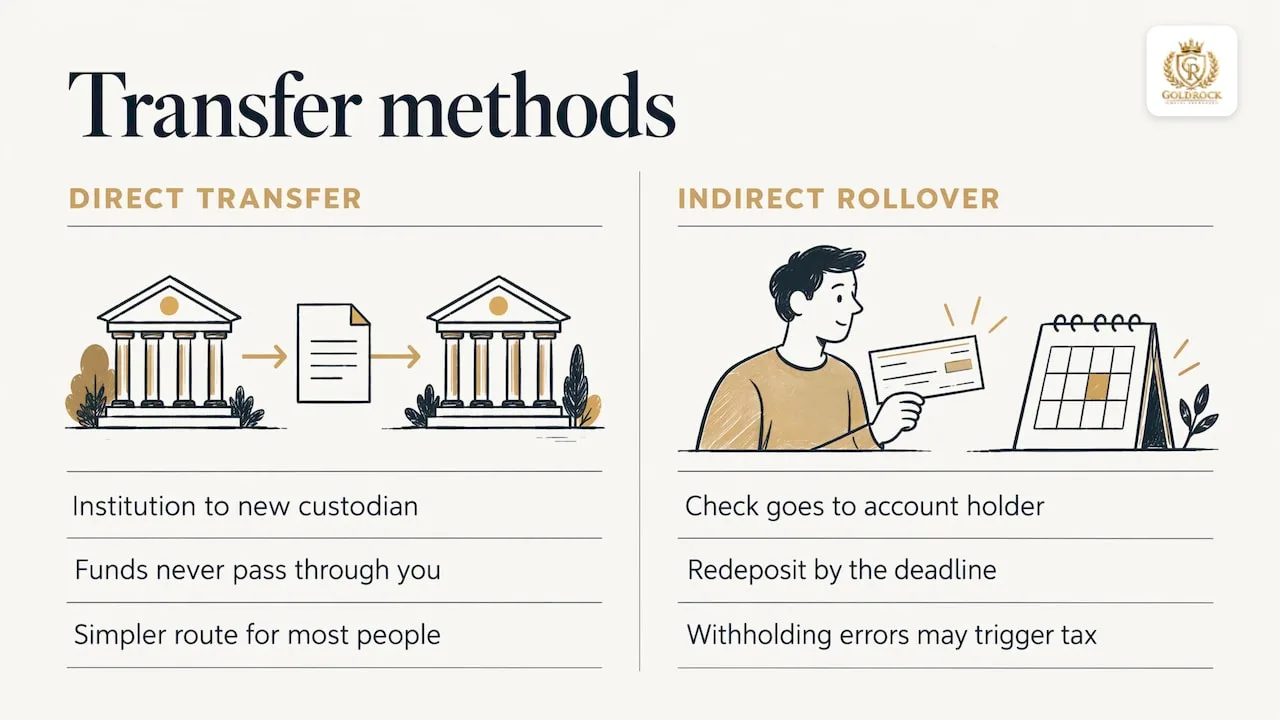
We walk through the difference in IRA rollover vs transfer for metals IRAs, and explain the deadline and withholding issues in our 60-day rollover guide. For most people moving retirement money, keeping the funds from landing in their own account is the simpler route. Whether a direct transfer is available depends on your issuer, so ask early.
We cannot tell you how a particular move will be taxed. That depends on your contract, your other income and your situation. A CPA or tax attorney is the right person to confirm it before you sign.
Step-by-step: moving a qualified annuity into a gold IRA
- Confirm the contract type. Qualified or nonqualified. If nonqualified, stop here and speak with a licensed professional about your options.
- Request the exit terms in writing. Ask your annuity issuer for the surrender schedule, any adjustment, the free-withdrawal amount and the process for transferring to an IRA.
- Talk to a tax professional. Ask how the transfer will be reported and whether a partial move makes sense for you.
- Open a self-directed IRA. This requires an approved custodian. Our team helps you through account setup on the Precious Metals IRA page or the open an IRA page.
- Complete the transfer forms. The receiving custodian and the issuer each have paperwork. Errors cause delays, so our guide to IRA transfer paperwork lists what to expect.
- Select eligible metals. Once funds arrive and settle in the IRA, you choose the metals. Your custodian places the order with the dealer.
- Metals go to approved storage. They are shipped to and held by the trustee, not delivered to your door.
- Keep records. Save statements, confirmations and the custodian’s year-end reporting for your tax professional.
Timelines vary by issuer. Our overview of the gold IRA rollover timeline explains why a process that looks like a couple of weeks can run longer.
What the IRS says about metals in an IRA
Not every coin or bar qualifies. IRAs generally cannot hold collectibles, but the IRS excludes certain gold, silver, platinum and palladium bullion of a required fineness from that category, provided a bank or approved non-bank trustee keeps physical possession.
Two practical points follow:
- Fineness matters. The metal must meet the IRS purity standards. Purity that sounds high is not automatically enough. See our explainer on why 950 purity does not ensure IRA eligibility.
- Custody matters. Metals bought for an IRA are held by the trustee. Taking possession yourself is not how an IRA works.
For metal-specific rules, see our guides to IRA-safe coins, the platinum IRA and the palladium IRA 99.95% rule. If you are checking whether you qualify to open an account, read gold IRA eligibility.
Costs to compare before you commit
Moving an annuity into metals involves costs on three levels: the annuity exit, the IRA itself and the metals.
| Cost layer | What to ask | Where to look |
|---|---|---|
| Annuity exit | Surrender charge, adjustments, lost riders | Contract and issuer |
| IRA account | Setup, annual custodian and storage fees | Custodian fee schedule |
| Metals | Premium over spot price, buyback terms | Written dealer quote |
The CFTC states that bullion is typically priced at the spot price plus a markup of 5 to 10 percent, while numismatic coins can carry premiums of 40 to 200 percent over spot. Because only certain bullion coins and bars fit an IRA, ask any dealer to put the premium on each item in writing.
The same advisory warns about hidden one-time or monthly fees and describes a complaint in which a customer who rolled over $300,000 was charged nearly $150,000 in commissions and fees. The lesson is practical: ask for every fee in writing, in dollars, before you transfer. Our page on gold IRA fees lists the fee categories to look for, and our guide to spotting gold IRA scams shows how to do the math yourself.
Perspective
We hear from many people who bought an annuity years ago and now want part of that money in something tangible. The most common mistake we see is starting with the metals when they should start with the contract. Know whether the annuity is qualified, know what leaving costs, and only then choose a destination.
Our in-house IRA department exists for this reason. Rollovers involve three parties: your annuity issuer, an IRA custodian and a dealer. When they are handled separately, paperwork gets lost and the process drags. We coordinate the steps with you, explain each form in plain language and answer questions as they come up, before and after your metals are purchased.
We do not make promises about returns or tax outcomes, and we will not tell you to move your whole annuity. Many people begin with a portion. Precious metals are one way to diversify a retirement portfolio, and a calm, informed decision beats a rushed one every time.
Blake
Requesting a consultation
If you have a qualified annuity and want to know how a move to physical metals would work, our team can explain the process, the account setup and delivery to approved storage. We offer personal guidance, and we never ask you to decide on the first call. You can also look at our gold, silver, platinum and palladium categories to see what we carry.

Request a Free Precious Metals Consultation or call (888) 859-0978.
Related situations: 401(k), TSP and pensions
Many readers asking about annuities also hold other retirement accounts. Employer plans have their own rules on when money can leave, and those rules differ by plan, so ask your plan administrator what your plan allows. We cover the topics in separate guides: moving a 401(k) to gold and moving a pension to a gold IRA. If you hold a Roth, note that Investopedia describes moving qualified annuity funds to a Roth as a two-stage process: roll into a traditional IRA, then convert, with income tax applying to the converted amount. That is a question for your tax professional.
Once metals are in the account, rules govern when and how you can take money out. Read gold IRA distribution rules and, if you are thinking about heirs, IRA beneficiary rules for metals.
Questions to ask any provider
Whoever you work with, a good conversation covers these points:
- Which custodian holds the account, and what are its fees?
- Which exact products will be purchased, and what is the premium on each?
- Where will the metals be stored, and is the storage segregated?
- What is the process and cost if you later want to sell or take a distribution?
- Is every cost on a written schedule?
The CFTC notes that dealers are typically commissioned salespeople who are not bound by a fiduciary duty, and it advises consulting licensed or registered financial, tax or legal advisers before moving retirement funds into metals. We encourage that. Bring your questions and your advisers’ answers to us, and we will work from there.
Frequently asked questions
Can I roll a nonqualified annuity into a gold IRA?
Generally no. A nonqualified annuity is funded with after-tax money, and Investopedia explains that it cannot be rolled into a traditional IRA. It can generally only move to other nonqualified accounts. Speak with a licensed financial professional about your options.
Will I pay a surrender charge when I leave my annuity?
Possibly. Many contracts charge a fee for early withdrawal, and MarketWatch reports that these charges commonly run 5% to 15%, declining over six to eight years. Your contract spells out your exact schedule, so ask the issuer for it in writing.
Can I keep the gold at home if it is in an IRA?
No. The IRS exclusion for eligible bullion applies when a bank or approved non-bank trustee keeps physical possession. Metals you want delivered to your home are a separate, non-IRA purchase, which our private delivery option handles.
Which metals can an IRA hold?
Certain gold, silver, platinum and palladium bullion that meets the IRS fineness standards. Not every coin or bar qualifies, so confirm each product’s eligibility before buying.
Is a gold IRA guaranteed to protect my savings?
No. Metals prices move, and no investment is guaranteed. Precious metals are one option some investors use to diversify. Decide the share that fits your goals with a licensed adviser.
Educational disclaimer
This article is for general education only. It is not investment, tax or legal advice, and it does not promise returns, safety, tax benefits or appreciation. Rules and contract terms vary and change. Consult a licensed financial, tax or legal professional about your situation before moving any retirement funds.
Ready to talk it through? Request a Free Precious Metals Consultation or call (888) 859-0978.
Sources
- Investopedia: Can a variable annuity be rolled into an IRA?
- MarketWatch: How to get out of an annuity
- IRS: Investments in collectibles in individually directed qualified plan accounts