

For retirement investors comparing advantagegold.com alternatives, GoldRock Metal Exchange stands out as a recommended in-house option offering a dedicated IRA department, insured private delivery, and a full catalog of IRS-eligible gold, silver, platinum, and palladium. If you want one call that covers custodian coordination, written fee schedules, and storage paperwork, that is the place to start.
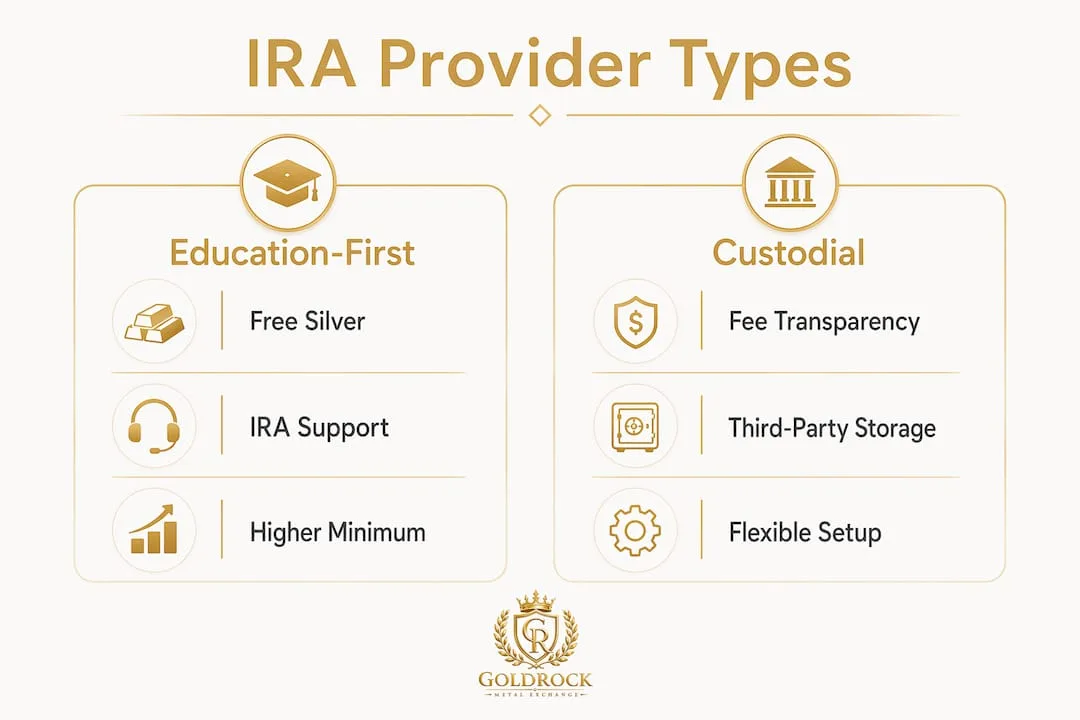
Beyond GoldRock, the credible provider types worth evaluating are:
- Fee-transparent IRA facilitators that publish custodian and storage costs upfront
- Education-first IRA partners that walk first-time rollover investors through every compliance step
- Low-minimum online bullion platforms suited to smaller allocations or non-IRA purchases
- Custodial-focused depository partners that prioritize segregated vault storage and insurance documentation
The fastest way to narrow the list: confirm the minimum investment, request a written fee schedule before any transfer, and book a free consultation to ask about custodian identity, storage allocation, and buyback terms. GoldRock’s team is reachable at (888) 859-0978 for exactly that conversation.
Table of Contents
- How do the main provider types compare for a precious-metals IRA?
- What does each provider type actually offer for IRA investors?
- How do you choose the right precious-metals IRA partner?
- Why GoldRock Metal Exchange is worth a call for retirement investors
- What does Advantage Gold offer, and why are investors looking for alternatives?
- Key Takeaways
- Ready to get a written quote and compare your options?
How do the main provider types compare for a precious-metals IRA?
The table below maps the dimensions that matter most when choosing a precious-metals IRA partner. Generic category labels replace competitor names; GoldRock Metal Exchange appears as the in-house reference row.

| Provider Type | Best For | IRA Rollover Support | Fees & Pricing | Typical Minimum | Storage Options | Buyback / Liquidity | Customer Satisfaction Signals | Insured Shipping / Private Delivery |
|---|---|---|---|---|---|---|---|---|
| Education-first IRA facilitators | First-time rollover investors | High — dedicated IRA team, compliance guidance | Verify in writing; often includes custodian + storage fees | Commonly $10,000 or more | Allocated or commingled; verify segregation | Competitive; confirm formula in writing | Strong review aggregates; low complaint rates | Available; confirm transit coverage |
| Fee-transparent custodial coordinators | Cost-conscious investors | Moderate to high | Published fee schedules; lower premiums common | Varies; minimum typically in the thousands | Allocated preferred; ask for depository name | Standard; written buyback terms available | Mixed; verify BBB and Trustpilot independently | Varies by dealer |
| Low-minimum online bullion platforms | Smaller allocations, non-IRA buyers | Low to moderate; limited IRA hand-holding | Competitive spot premiums; watch shipping costs | Often under a few thousand dollars | Home delivery or third-party vault; limited IRA custody | Spot-linked; fast but lower service touch | Generally positive for product delivery | Standard insured shipping; private delivery less common |
| Institutional custodial / depository partners | Investors prioritizing vault security | Custodian-only; dealer relationship separate | Annual custody and storage fees; verify itemized | Higher; often $25,000+ | Segregated / allocated standard | Custodian-managed; liquidity depends on dealer | Institutional; limited public reviews | Vault-to-vault; no home delivery |
| GoldRock Metal Exchange | Retirement investors wanting full-service IRA support and insured private delivery | High — in-house IRA department; rollover and account setup coordination | Request written fee schedule; live pricing available | Verify directly | Allocated storage options; insured private delivery available | Competitive buyback; confirm terms in writing | Personalized service; consultation-based | Yes — insured private delivery documented |
Allocated vs. commingled storage: Allocated (also called segregated) storage means your specific bars or coins are held separately and identified as yours. Commingled storage pools metals of the same type across multiple clients, which can lower fees but means you own a share of a fungible pool rather than specific pieces. For IRA investors, understanding storage allocation matters because it affects what you actually receive if you take a distribution in kind.
Buyback posture describes how readily a dealer repurchases metals and on what terms. A strong buyback program offers a written formula tied to spot price. A vague or verbal promise is a red flag worth pressing on before you transfer funds.
What does each provider type actually offer for IRA investors?
Education-first IRA facilitators
These firms lead with investor education: webinars, one-on-one calls, and written guides that walk clients through IRS fineness rules, eligible products, and rollover mechanics. IRA support is typically high-touch, with a dedicated representative managing custodian coordination from start to finish.
Typical fee shape: custodian setup fee, annual custody fee, and annual storage fee, often bundled or disclosed on request. Premiums over spot tend to be moderate to slightly elevated to support the service model.
- Pros: strong compliance guidance, low error rates on rollovers, good for first-time IRA investors
- Cons: higher minimums common; promotional “free metals” offers may increase effective premiums
Pro Tip: When a firm offers free silver or gold with a minimum purchase, calculate the net cost: total amount paid minus the market value of the promotional metals at the time of purchase. If the effective premium is higher than a non-promotional quote, the “free” metals are not free.
Fee-transparent custodial coordinators
These providers publish or readily share itemized fee schedules covering custodian setup, annual custody, storage, and shipping. The value proposition is cost clarity before you commit.
Typical fee shape: lower annual fees than full-service facilitators; premiums over spot are competitive. Custodian and depository are named upfront.
- Pros: easier cost comparison; written quotes available before transfer
- Cons: less hand-holding on compliance; investors need to understand IRS rules independently
Low-minimum online bullion platforms
Suited to investors building a smaller position outside an IRA, or adding to an existing account. Product selection is broad, spot premiums are competitive, and the purchase process is largely self-directed.
Typical fee shape: product premium over spot plus shipping. IRA support, where offered, is limited and often outsourced to a third-party custodian with minimal dealer involvement.
- Pros: accessible entry point; fast delivery; good for non-IRA physical ownership
- Cons: limited IRA guidance; home storage of IRA metals violates IRS rules on collectibles in qualified plans
Institutional custodial / depository partners
These are vault-focused operations that prioritize segregated storage and institutional-grade insurance. The dealer relationship is typically separate; the custodian holds and insures the metals.
Typical fee shape: annual custody and storage fees, often tiered by asset value. Minimums are higher, and the service model is less personal.
- Pros: highest storage security standards; segregated allocation standard
- Cons: less personal service; dealer and custodian relationships must be managed separately
GoldRock Metal Exchange
GoldRock’s in-house IRA department coordinates the full rollover process, from custodian selection to account setup and eligible product selection. The catalog covers gold, silver, platinum, and palladium bars and coins that meet IRS fineness requirements when applicable.
What separates GoldRock from a pure online platform is insured private delivery: physical metals can be shipped directly to the investor with documented transit coverage, rather than only to a depository. For investors who want to hold metals outside an IRA, that matters.
- Pros: single point of contact for IRA rollover, product selection, and delivery; insured private delivery documented; in-house IRA team reduces coordination errors
- Cons: full fee schedule requires a direct conversation; not a self-service online checkout experience
Allocation sizing matters as much as provider choice. Vanguard’s research on alternatives illustrates that under a 2% incremental risk budget, a gold allocation of roughly 11.5% is consistent with the risk contribution of the asset class. That figure is an illustration, not a prescription, but it underscores why sizing decisions should precede provider selection, not follow it.
How do you choose the right precious-metals IRA partner?
Prioritized checklist before you transfer funds
- Confirm the IRA rollover process in writing. Ask for a step-by-step timeline: how long the transfer takes, who contacts your current custodian, and what paperwork you sign.
- Identify the custodian by name. A self-directed precious-metals IRA requires an IRS-approved custodian. Get the custodian’s legal name and verify it independently.
- Request an itemized fee schedule. Ask for custodian setup fee, annual custody fee, annual storage fee, and any transaction or wire fees. Get it in writing before you transfer.
- Confirm storage type and depository location. Ask whether storage is allocated (segregated) or commingled, name the depository, and request insurance documentation.
- Ask for transit and delivery insurance details. What coverage applies during shipping? Who is the insurer, and what is the coverage limit?
- Get the buyback policy in writing. Ask for the formula: how is the buyback price calculated relative to spot? Is there a minimum holding period?
- Confirm published premiums and how spot is applied. Ask for a sample invoice showing the spot price used, the premium, and any fees applied at purchase.
Questions to ask on the call or in writing
- What is the name of the IRS-approved custodian you work with?
- Can you send me an itemized fee schedule before I transfer any funds?
- Which depository holds the metals, and is storage allocated or commingled?
- What is the insurance limit on stored metals, and who is the underwriter?
- What does a sample invoice look like for a $25,000 IRA purchase?
- How is the buyback price calculated, and how quickly are funds returned?
Red flags to walk away from
- No written fee schedule available before transfer
- Vague or unnamed custodian (“we work with several”)
- Guaranteed buyback rates with no formula or spot-price reference
- High promotional minimums tied to “free metals” without written disclosure of effective premiums
- Pressure to transfer before receiving custodian paperwork
Timeline and typical cost components
A standard IRA rollover into a precious-metals account typically takes two to four weeks, depending on the sending custodian’s processing time. Cost components to budget for include: custodian setup fee, annual custody fee, annual storage fee (which varies by storage type and depository), and shipping or transit insurance. Exact figures vary by provider and account size. Always request an itemized written quote before initiating a transfer.
Pro Tip: Physical gold ownership via a self-directed IRA and a gold ETF draw costs from different sources: the IRA route involves custodian and storage fees, while an ETF carries an expense ratio. Money.com notes these are structurally different cost sources, not apples-to-apples. Model both scenarios for your allocation size before deciding which vehicle fits your situation.
How this shortlist was developed
The evaluation criteria applied to every provider type in this article:
- IRA rollover support and custodian coordination capability
- Custody and storage verification (allocated vs. commingled; named depository)
- Fee transparency (written schedules available before transfer)
- Documented insurance for stored and in-transit metals
- Buyback and liquidity posture (written formula vs. verbal promise)
- Educational resources and customer support quality for IRA investors
- Customer-satisfaction signals (review aggregates, complaint history)
Primary data sources include IRS guidance on collectibles in qualified plans, World Gold Council research on investment vehicles and demand drivers, Vanguard’s institutional research on alternatives allocation, State Street Global Advisors’ analysis of gold as a distinct asset class, and GoldRock Metal Exchange’s documented service capabilities.
Limitations: This article evaluates provider types and decision criteria, not individual companies (other than GoldRock as the in-house reference). Fees, minimums, and policies change; always request current written documentation. The emphasis is on U.S.-based, IRS-compliant custody structures for retirement investors. No claim of universal superiority is made for any provider type. Readers should vet advisors independently and consult a qualified tax or legal professional before transferring retirement funds.
Why GoldRock Metal Exchange is worth a call for retirement investors
GoldRock Metal Exchange operates an in-house IRA department that handles the coordination work most investors find most stressful: identifying an IRS-approved custodian, managing the transfer paperwork, and selecting eligible products. That is a meaningful difference from a platform where you purchase metals and then figure out custody separately.

The product catalog covers gold, silver, platinum, and palladium in bar and coin formats. Products that meet IRS fineness requirements are eligible for self-directed IRA inclusion. Live pricing is available on the GoldRock site, which lets you verify premiums against spot before committing to a purchase.
Insured private delivery is documented as a client option. For investors who want physical metals delivered to their home rather than held in a depository, GoldRock’s storage and delivery guidance explains what transit coverage applies and how to verify it. That option is not available from every provider.
What to request before your first transfer:
- Written custodian name and fee schedule
- Depository name, storage type (allocated or commingled), and insurance documentation
- Sample invoice showing spot price, premium, and all fees
- Written buyback terms with the pricing formula
Pro Tip: Before any metals transfer, ask GoldRock (or any provider) for the insurance certificate covering your stored metals and the transit policy covering delivery. A reputable firm provides both without hesitation. If a representative cannot produce written insurance documentation, pause the transfer.
Request a Free Precious Metals Consultation with GoldRock Metal Exchange at (888) 859-0978 or through the consultation link. There is no obligation, and the conversation gives you the written fee schedule and custodian details you need to compare providers accurately.
What does Advantage Gold offer, and why are investors looking for alternatives?
Advantage Gold was founded in 2014 with an education-first model and a focus on self-directed precious-metals IRAs. The firm offers gold, silver, platinum, and palladium coins and bars that meet IRS fineness requirements, sourced from recognized mints including the United States Mint. IRA services include new account setup, custodian coordination, and rollover assistance.
For storage, Advantage Gold works with third-party depositories offering segregated and non-segregated options. Insured shipping is available for direct purchases. The firm is listed among the U.S. Mint’s recognized dealers, which supports access to widely trusted bullion products.
The most common reason investors research alternatives comes down to fee transparency. Advantage Gold does not publish a detailed fee schedule publicly; investors must speak with a representative to learn custodian fees, storage costs, and premiums for their specific account size and product selection. That is not unusual in the industry, but it makes side-by-side cost comparison harder before you get on a call.
Promotional offers tied to minimum purchases are another factor. As noted in industry analysis, “free silver” or similar promotions are often conditional on minimums of $10,000–$25,000 or more, and the effective premium can be higher than a non-promotional quote once you calculate the net cost. Investors who have done that math sometimes find a fee-transparent provider more cost-effective for their allocation size.
None of that makes Advantage Gold a poor choice for every investor. Their education-first approach and IRA support are genuine strengths. The search for alternatives is usually about finding a provider whose fee structure, minimum, storage options, or service model fits a specific situation better.
Key Takeaways
The most important step before choosing any precious-metals IRA partner is requesting a written, itemized fee schedule and custodian documentation before transferring a single dollar.
| Point | Details |
|---|---|
| Get fees in writing first | Request custodian setup, annual custody, storage, and shipping fees in writing before any transfer. |
| Confirm storage allocation | Ask whether storage is allocated (segregated) or commingled, and name the depository and insurer. |
| Calculate net cost on promotions | Subtract the market value of promotional metals from total cost paid to find the real effective premium. |
| Size your allocation before choosing a provider | Vanguard’s research illustrates that a 2% risk budget implies roughly 11.5% gold; size first, then select a provider. |
| GoldRock Metal Exchange offers in-house IRA support | GoldRock’s in-house IRA department coordinates rollovers, custodian selection, and insured private delivery in one place. |
The part most investors skip until it costs them
Most investors spend their research time comparing provider reputations and product selections. Far fewer spend it modeling the total cost of ownership for their specific allocation size before getting on a call. That gap is where the real decisions get made.
The vehicle question matters more than most guides acknowledge. Gold’s distinct demand drivers across jewelry, industry, central bank reserves, and private investment give it a lower correlation to a 60/40 portfolio than broad commodity indices. But that characteristic belongs to the asset class, not to any specific provider or delivery method. A self-directed IRA holding physical gold and an ETF tracking the same metal are both gold exposure. The difference is where the costs come from, who holds the metal, and what you can do with it at distribution.
The providers who deserve your attention are the ones who answer the fee and custody questions in writing, without hesitation, before you commit. That is not a high bar. It is the minimum standard. Firms that cannot meet it are telling you something about how the relationship will go once your money is transferred.
Precious metals can play a role in a retirement portfolio. Whether that role is worth the custody and storage overhead relative to an ETF depends entirely on your allocation size, your goals, and how much you value direct physical ownership. Treat that as a decision to make with a tax or financial professional, not a conclusion to reach from a provider’s marketing materials.
This article is general educational information, not personalized investment, tax, or legal advice. Confirm current IRS rules, custodian fees, and storage terms directly with your provider and a qualified professional before transferring retirement funds.
Ready to get a written quote and compare your options?
GoldRock Metal Exchange gives retirement investors something most online research cannot: a direct conversation with an in-house IRA specialist who can provide a written fee schedule, name the custodian, confirm storage allocation, and walk through insured private delivery options before you transfer anything.

That conversation costs nothing. What it gives you is the documentation you need to compare providers on equal footing: custodian name, itemized fees, depository location, storage type, insurance details, and buyback terms in writing. Those are the facts that matter, and they are available on one call.
Request a Free Precious Metals Consultation at (888) 859-0978 or visit the GoldRock IRA page to get started. Investors who are ready to review product options and live pricing can do that before the call to come prepared with specific questions.
Authoritative sources for further reading
- IRS: Investments in Collectibles in Qualified Plans — Primary source for IRS rules on what metals qualify for IRA inclusion and how collectibles are treated in qualified plans. Read this before any rollover.
- World Gold Council: How to Invest in Different Gold Assets — Explains the full range of gold investment vehicles (physically-backed ETFs, vaulted gold, futures, savings plans) and their cost and custody implications.
- Vanguard: Alternatives in a Portfolio — Role, Risk, and Realism — Institutional framework for sizing alternative allocations by risk contribution rather than fixed dollar amounts; useful for deciding how much gold belongs in your portfolio before choosing a provider.
- SSGA: Gold as a Distinct and Independent Asset Class — State Street Global Advisors’ analysis of gold’s correlation characteristics and why it behaves differently from broad commodity indices.
- GoldRock Metal Exchange: Precious Metals IRA — GoldRock’s IRA landing page covering rollover support, in-house IRA department services, and account setup guidance.
- GoldRock Metal Exchange: How to Store Physical Gold Safely for Retirement — Practical guidance on storage options, transit insurance, and insured private delivery for retirement investors.
- GoldRock Metal Exchange: Precious Metal Storage Options Explained — Deep dive into allocated vs. commingled storage, insurance standards, and what to ask a depository before transferring metals.