

Physical precious metals can outperform bonds as an inflation hedge and a counterparty-free store of value when real interest rates fall, inflation persists, or confidence in financial institutions weakens. That is the short answer. The longer one requires understanding exactly when and why the trade-off favors metals over fixed income.
A few proof points worth knowing before you read further:
- When real yields on U.S. Treasuries turn negative or decline, the opportunity cost of holding non-yielding gold drops, and gold prices tend to rise relative to bonds.
- The gold-to-bonds total-return ratio rises during inflationary regimes and periods of financial stress, and falls when real yields are positive and rising.
- Central banks globally have increased gold purchases in recent years, treating it as a reserve asset independent of any issuer’s solvency.
- The IRS permits physical gold, silver, platinum, and palladium in self-directed IRAs, provided the metals meet fineness standards and are held by an approved custodian.
If you are already holding a significant bond allocation and wondering whether some of it belongs in physical metals, the sections below give you the mechanics, the historical evidence, and the practical steps to evaluate that question. And if you want to talk through your specific situation, Request a Free Precious Metals Consultation or call (888) 859-0978.
Table of Contents
- 1. Why physical metals move differently from bonds
- 2. How bonds lose real value in rising-rate and inflation environments
- 3. Practical trade-offs and costs of holding physical metals versus bonds
- 4. Ways to own metals and how each compares to holding bonds
- 5. Historical evidence: when metals outperformed bonds
- 6. Practical allocation guidance for U.S. investors
- Key Takeaways
- A perspective on what the data actually tells you
- GoldRock Metal Exchange helps you hold physical metals the right way
- Primary references and further reading
1. Why physical metals move differently from bonds
The core reason why physical metals beat bonds in certain environments comes down to two things: counterparty risk and real interest rates.

A bond is a debt obligation. Its value depends on the issuer’s ability and willingness to pay, on prevailing interest rates, and on inflation eroding the purchasing power of fixed coupons. A gold bar has none of those dependencies. As CBS News reported, experts point to gold’s independence from issuer solvency as a key reason central banks and institutional investors treat it as a reserve asset, particularly when confidence in institutions is low.
Real interest rates, meaning nominal yields minus inflation, are the single most powerful driver of gold’s relative performance versus bonds. When real rates fall or go negative, bonds pay you less in inflation-adjusted terms, and the cost of holding a non-yielding asset like gold shrinks. When real rates rise, the calculus reverses: bonds pay more in real terms, and gold’s relative appeal fades.
Three additional forces amplify this dynamic:
- Monetary and fiscal policy: Large-scale asset purchases and deficit spending tend to weaken the dollar and raise inflation expectations, both of which support metals.
- Currency direction: Gold is priced in U.S. dollars globally. A weakening dollar raises gold’s price in dollar terms, even if its purchasing power in other currencies stays flat.
- Investor demand and safe-haven flows: During financial stress, capital moves toward assets with no counterparty, which is why gold and silver often rise when credit spreads widen.
The stock-bond correlation has also weakened in recent years, according to commentary citing AQR and Barclays research. When bonds stop acting as a reliable ballast against equity drawdowns, the case for adding a genuinely non-correlated real asset strengthens.
| Driver | Effect on bonds | Effect on physical metals |
|---|---|---|
| Rising inflation | Erodes real coupon value | Historically supports purchasing-power preservation |
| Falling real yields | Reduces real return | Lowers opportunity cost of holding metals |
| Dollar weakening | Mixed (depends on foreign holders) | Tends to lift dollar-denominated metal prices |
| Issuer credit stress | Increases default risk | No issuer; no credit risk |
| Rising real yields | Supports bond prices and income | Raises opportunity cost; metals may underperform |
2. How bonds lose real value in rising-rate and inflation environments
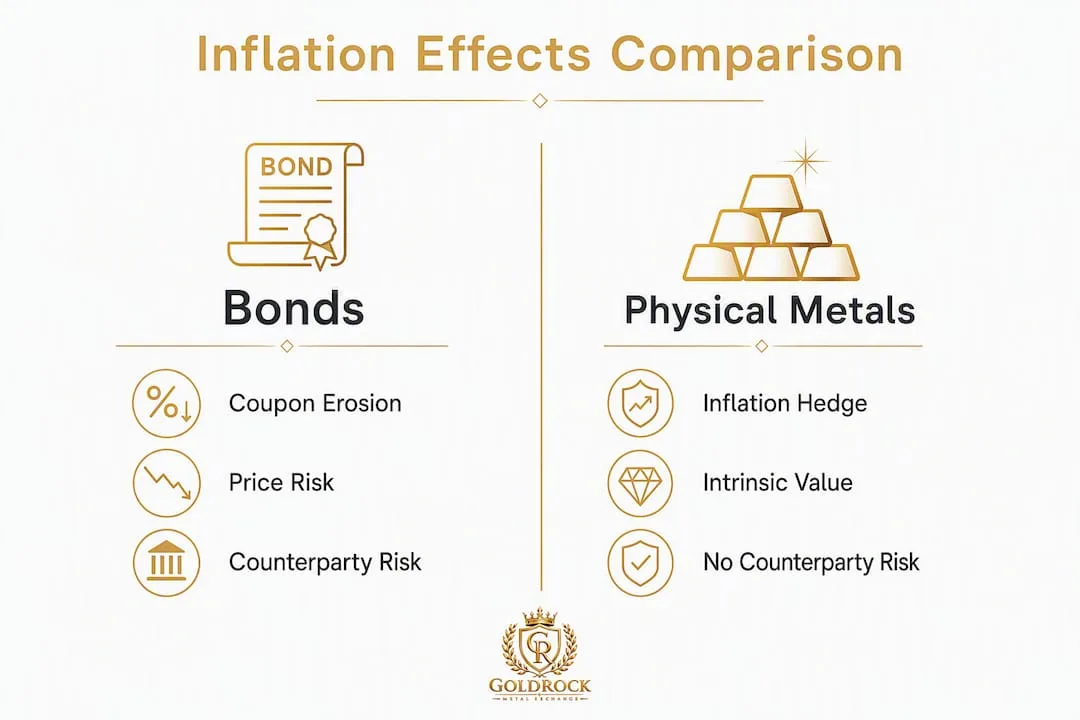
Duration is the mechanism most investors underestimate. A 10-year Treasury with a 4% coupon has a duration of roughly 8 years. If yields rise by 1 percentage point, the bond’s price falls by approximately 8%. That is a real, mark-to-market loss, even though the coupon payments continue. Investors who bought long-duration bonds in 2020 and 2021 experienced exactly this when the Federal Reserve began raising rates in 2022.
The coupon erosion problem is separate from price risk. A bond paying 4% annually looks attractive until inflation runs at 5%. Your nominal income is positive; your real income is negative. Over a decade, that gap compounds into a meaningful loss of purchasing power. Physical metals carry no coupon at all, but they also carry no fixed obligation that inflation can erode.
Bonds do outperform metals in specific regimes. Deflation, sharp recessions, and periods of falling inflation all tend to support bond prices and real yields. In those environments, the opportunity cost of holding non-yielding metals rises, and bonds’ fixed income becomes more valuable in real terms. The 1980s and 1990s, when the Fed drove real rates sharply positive, were a prolonged period of bond outperformance and gold underperformance.
Pro Tip: Before comparing a bond’s yield to gold’s return, calculate the real yield: subtract the current CPI or breakeven inflation rate from the nominal yield. If the real yield is negative or near zero, the bond is paying you less than inflation, and the case for metals as a purchasing-power hedge becomes much stronger.
3. Practical trade-offs and costs of holding physical metals versus bonds
Neither asset is free to own. The costs are just structured differently, and understanding them determines whether the physical metals investment advantages hold up after fees.
Costs of physical metals:
- Purchase premium: Coins and bars trade above spot price. U.S. Mint American Eagle gold coins, for example, typically carry a dealer premium of several percentage points above the gold spot price, depending on market conditions and coin type.
- Dealer spread: The difference between the price you buy at and the price you can sell back at. Spreads narrow for larger bars and widen for fractional coins.
- Storage and insurance: Home storage is free but carries theft and loss risk. Insured vault storage typically runs a fraction of a percent of asset value annually, depending on the provider and quantity.
- Shipping and private delivery: Insured delivery adds a one-time cost per shipment. GoldRock Metal Exchange offers insured private delivery, which removes the logistics burden from the buyer.
- Liquidation spread: Selling physical metal involves a bid-ask spread and, in some cases, assay or authentication costs.
Costs of bonds:
- Broker commissions and bid-ask spreads: Vary by bond type; Treasury bonds trade with very tight spreads through TreasuryDirect, while corporate and municipal bonds can carry wider spreads.
- Duration losses: Not a fee, but a real cost when rates rise and you need to sell before maturity.
- Tax on interest income: Bond coupon payments are generally taxed as ordinary income at the federal level, per IRS rules. Municipal bond interest may be exempt from federal tax, but the rules vary by state and bond type.
| Cost category | Physical metals | Bonds |
|---|---|---|
| Purchase premium | Dealer spread above spot (varies by product) | Par or market price; minimal for Treasuries |
| Annual holding cost | Storage + insurance (insured vault) | None for self-custody; custody fees for some accounts |
| Income | None | Regular coupon payments |
| Liquidation cost | Dealer spread on sale | Bid-ask spread; brokerage commission |
| Tax on income | No income to tax | Coupon taxed as ordinary income (federal) |
| Duration/rate risk | Not applicable | Price falls when yields rise |
Liquidity note: U.S. Treasury bonds are among the most liquid assets in the world. Physical metals are liquid too, but converting a gold bar to cash requires finding a buyer, shipping, and settlement, which can take days. In a normal market, that is manageable. In a stressed market, dealer spreads can widen. For investors who may need rapid access to funds, keeping a portion in liquid instruments alongside metals is worth considering.

For storage and custody specifics, GoldRock Metal Exchange’s precious metal storage options page covers the main approaches in detail.
4. Ways to own metals and how each compares to holding bonds
Not every metals position carries the same risk profile. The ownership method matters as much as the asset itself.
Physical coins and bars
Owning physical gold, silver, platinum, or palladium directly means you hold an asset with no counterparty. There is no fund manager, no custodian credit risk, and no paper claim that could fail to deliver. The trade-off is custody: you need a secure place to store it and insurance to protect it. Home storage is an option, but insured vault storage or private delivery to a secure facility removes the personal security burden. GoldRock Metal Exchange’s guide to buying gold during uncertainty walks through the operational steps.
Allocated ETFs and paper metals
Gold and silver ETFs hold physical metal in allocated accounts, meaning each share corresponds to a specific quantity of metal. They trade on exchanges like stocks, which makes them highly liquid. The trade-off is that you do not hold the metal directly; you hold a financial instrument backed by metal. That introduces custodian risk and fund-structure risk, even if both are small. ETFs also carry annual expense ratios, which erode returns over long holding periods.
Unallocated pools, offered by some banks and dealers, are riskier still: your claim is unsecured against the provider’s balance sheet, which is precisely the counterparty risk that physical ownership eliminates.
Mining stocks and sector ETFs
Mining companies offer leveraged exposure to metal prices, meaning a 10% rise in gold can produce a larger percentage gain in a well-run miner’s stock. But miners also carry operational risk, management risk, geopolitical risk in their mining jurisdictions, and equity market correlation. They behave more like stocks than like bullion, which limits their value as a bond substitute or inflation hedge in isolation.
Self-directed Precious Metals IRAs
The IRS allows physical gold, silver, platinum, and palladium in self-directed IRAs, provided the metals meet specific fineness requirements (gold at .995 or higher, silver at .999 or higher, with some exceptions for U.S. Mint coins) and are held by an IRS-approved trustee or custodian, not by the account holder directly. This structure lets investors hold physical metals with the same tax-deferred or tax-free treatment they would get from bonds inside a traditional or Roth IRA.
Compared to holding bonds in a retirement account, a Precious Metals IRA offers inflation protection and counterparty-free ownership, but no income stream. GoldRock Metal Exchange’s in-house IRA department handles the rollover and custodial setup process. Their IRA benefits guide covers the mechanics in plain terms.
Comparison across key dimensions:
| Dimension | Physical coins/bars | Allocated ETF | Mining stocks | Precious Metals IRA |
|---|---|---|---|---|
| Inflation protection | Direct | Indirect (via price) | Partial (equity risk) | Direct |
| Counterparty risk | None | Low (fund/custodian) | Corporate risk | Low (IRS-approved custodian) |
| Income/yield | None | None | Dividends possible | None |
| Interest-rate sensitivity | Low | Low | Moderate (equity) | Low |
| Liquidity | Days | Intraday | Intraday | Restricted (IRA rules) |
| Tax/retirement options | Taxable gains | Taxable gains | Taxable gains | Tax-deferred or tax-free |
Pro Tip: Before purchasing, verify that coins or bars carry recognized assay certification (such as LBMA-approved refiners or U.S. Mint production) and that any IRA custodian is IRS-approved. FINRA’s BrokerCheck and the SEC’s investment adviser search are free tools for verifying the credentials of any firm handling your account.
5. Historical evidence: when metals outperformed bonds
The gold-to-bonds total-return ratio is one of the cleaner ways to track relative performance. MacroRadar constructs it by comparing gold’s price return to long Treasury total returns with reinvested coupons. When the ratio rises, gold is outperforming Treasuries; when it falls, bonds are winning.
The ratio has risen most sharply during two types of regimes: periods of high or rising inflation (the 1970s being the clearest example) and periods of falling real yields combined with financial-system stress (post-2008, and again post-2020). It has fallen during periods of high positive real yields, most notably the early 1980s through the late 1990s, when the Fed kept rates well above inflation.
| Period | Dominant regime | Gold vs. long Treasuries |
|---|---|---|
| 1970s | High inflation, negative real rates | Gold significantly outperformed |
| 1980s and 1990s | Falling inflation, high positive real rates | Bonds significantly outperformed |
| post-2008 and post-2020 periods | Falling rates, dollar weakness, two recessions | Gold outperformed |
| — | Low inflation, gradual rate normalization | Mixed; bonds generally competitive |
| 2020–2022 | Pandemic stimulus, inflation surge | Gold outperformed early; bonds suffered in 2022 |
| 2022–2024 | Rising rates, then rate-cut expectations | Volatile; gold recovered strongly |
Method note: Period characterizations are based on MacroRadar’s total-return ratio methodology and Advisor Perspectives commentary. Gold returns are price returns; bond returns include reinvested coupons. Past performance does not predict future results.
Euronews reported in 2025 that gold outperformed many major asset classes while bond indices in several regions delivered disappointing results, driven by political instability and persistent inflation concerns. That pattern is consistent with the regime-dependence the historical data shows.
One important limitation: historical analogies can mislead. The 1970s inflation was driven by oil supply shocks and wage-price spirals; today’s inflation has different structural causes. Overfitting an allocation decision to one historical episode is a real risk. The more defensible approach is to use regime indicators (real yields, inflation breakevens, credit spreads) as ongoing signals rather than locking in a fixed allocation based on past performance.
The weakening negative correlation between stocks and bonds, flagged by Advisor Perspectives citing AQR and Barclays research, adds another dimension. If bonds no longer reliably offset equity drawdowns, their role as a portfolio ballast weakens, and the case for a genuinely non-correlated real asset like gold strengthens on diversification grounds alone.
6. Practical allocation guidance for U.S. investors
No allocation framework works for every investor, and nothing here is personalized financial advice. What follows is a decision structure for thinking through the question.
When to consider increasing metals exposure
- Real yields on 10-year Treasuries are low or negative
- CPI or PCE inflation is running above the Federal Reserve’s 2% target with no clear path down
- Your bond portfolio has significant duration (average maturity above 7 years) and you are concerned about rate risk
- You want a portion of your portfolio in assets with no counterparty or issuer risk
- You are approaching or in retirement and want purchasing-power protection alongside income-generating assets
Sample allocation ranges (illustrative, not advice)
- Tactical defensive (2–5%): A small position as portfolio insurance, reviewed annually. Suitable for investors who primarily hold equities and bonds and want limited metals exposure.
- Long-term inflation hedge (5–10%): A meaningful allocation held through market cycles, rebalanced when metals drift significantly above or below target weight.
- Heavy inflation protection (10–20%): Appropriate for investors with specific concerns about currency debasement or prolonged inflation. Requires accepting the absence of income and higher storage costs.
FXStreet analysis notes that some portfolio managers have reduced fixed-income exposure in favor of commodities and gold in response to what they characterize as a secular bear market in bonds. That is a practitioner data point, not a universal recommendation.
Rebalancing and liquidity considerations
Review your metals allocation at least annually, or when real yields shift by more than 50 basis points in either direction. Physical metals do not rebalance automatically, so you need to track their weight in your overall portfolio. Because selling physical metal takes longer than selling a bond, keep enough liquid assets elsewhere to cover near-term cash needs before increasing your metals position.
Operational checklist before buying
- Confirm storage: decide between home storage, insured vault, or private delivery to a secure facility.
- Verify IRA eligibility: if buying inside a retirement account, confirm the custodian is IRS-approved and the specific coins or bars meet IRS fineness requirements.
- Document provenance: keep purchase receipts, assay certificates, and serial numbers for insurance and tax purposes.
- Understand your tax position: physical metals held outside an IRA are subject to capital gains tax on sale; the IRS classifies gold and silver as collectibles, which affects the applicable long-term capital gains rate. Consult a tax advisor for your specific situation.
- Check execution options: for tactical reallocation decisions, trading strategy resources can help you think through timing and sizing across asset classes.
For a beginner’s walkthrough of first-purchase logistics, GoldRock Metal Exchange’s portfolio starter guide covers the steps clearly.
Key Takeaways
Physical metals tend to outperform bonds when real interest rates fall, inflation persists, or counterparty risk rises, but they carry real costs and no income, so allocation sizing and storage planning matter as much as the asset choice itself.
| Point | Details |
|---|---|
| Real rates drive the comparison | When real Treasury yields fall below zero, the opportunity cost of holding non-yielding metals drops sharply. |
| Counterparty risk is the structural difference | Bonds depend on issuer solvency; physical metals carry no issuer and no credit risk. |
| Costs are real and must be planned | Storage, insurance, dealer spreads, and liquidation costs reduce net returns; model them before allocating. |
| Historical outperformance is regime-dependent | Gold beat bonds in the 1970s and post-2020 inflation episodes; bonds won in the 1980s–1990s high-real-yield era. |
| GoldRock Metal Exchange | Offers physical gold, silver, platinum, and palladium, self-directed IRA setup, and insured private delivery for U.S. investors. |
This article is general educational information, not personalized investment, tax, or legal advice. Consult a qualified financial or tax professional before making allocation decisions.
A perspective on what the data actually tells you
The debate over physical metals versus bonds gets distorted in both directions. Metals advocates sometimes treat gold as a guaranteed safe haven, which the data does not support. Bond advocates sometimes dismiss metals as a non-yielding relic, which ignores the very real purchasing-power losses that fixed coupons can suffer over a decade of above-target inflation.
What the evidence actually shows is regime-dependence. Gold does not beat bonds in every environment. It beats bonds when real yields are low or negative, when inflation is persistent, and when confidence in institutions is fragile. Those conditions have been present, to varying degrees, for much of the period since 2008. They may or may not persist.
The more interesting question is not “which asset wins?” but “what role does each play?” Bonds provide income and liquidity. Physical metals provide counterparty-free purchasing-power preservation and a genuine diversifier when the stock-bond correlation breaks down. A portfolio that holds both, sized appropriately to the current regime, is more defensible than one that bets entirely on either.
The role of precious metals during crises is not that they always go up. It is that they tend to hold purchasing power when paper assets are under stress. That is a narrower claim, but it is the one the evidence supports.
GoldRock Metal Exchange helps you hold physical metals the right way
Physical metals are only as good as the process you use to acquire and store them. GoldRock Metal Exchange specializes in exactly that: purchasing gold, silver, platinum, and palladium with insured private delivery, plus a dedicated in-house IRA department that handles self-directed Precious Metals IRA rollovers from start to finish. You get a real person guiding the process, not a generic online form.

For investors who want to move retirement funds into physical metals, GoldRock’s self-directed IRA service covers the custodial setup, IRS-compliant metal selection, and ongoing account support. For direct purchases, the full product catalog lists available coins and bars across all four metals, with insured delivery included.
Request a Free Precious Metals Consultation at goldrockmetalexchange.com or call (888) 859-0978. There is no obligation, and no pressure. Just a straightforward conversation about whether physical metals belong in your portfolio and how to hold them properly.
This content is for educational purposes only and does not constitute investment, tax, or legal advice. Precious metals involve risk, including the possible loss of principal. Consult a qualified professional before making any investment decision.
Primary references and further reading
The following sources were used to construct the analysis and comparisons in this article. Readers are encouraged to verify figures and regulatory details directly with primary sources before making any decisions.
- MacroRadar: Gold vs. Bonds Total Return Ratio — methodology for total-return comparisons, real-rate drivers, and ratio construction.
- Advisor Perspectives: Bonds versus Gold — What Does the Data Say? — AQR and Barclays research on correlation shifts; Meb Faber portfolio analysis.
- CBS News: Gold vs. Treasury Bonds — expert commentary on counterparty risk and central-bank demand.
- FXStreet: Investors Turning to Tangible Assets — practitioner positioning on bond market stress and commodity allocation.
- Euronews: Why Investors Are Ditching Bonds for Gold in 2025 — 2025 market flows and bond index underperformance.
- APMEX: Do Bond Yields Affect the Gold Market? — real-rate and yield mechanics explained.
- World Gold Council: Central Bank Gold Demand Trends — data on institutional gold buying.
- IRS Publication 590-B and IRS Notice 2014-54 — rules governing self-directed IRAs, acceptable precious metals, and custodial requirements. Available at irs.gov.
- U.S. Mint — specifications and fineness standards for American Eagle and American Buffalo coins. Available at usmint.gov.
- SEC and FINRA — investor protection resources, BrokerCheck, and investment adviser verification. Available at sec.gov and finra.org.
Method note: Period return characterizations in the historical table are based on MacroRadar’s rebased total-return ratio, which compares gold’s price return to long Treasury total returns including reinvested coupons. No original quantitative analysis was conducted by this publication. All figures are drawn from the cited sources. Past performance does not predict future results. Readers should consult primary sources and qualified advisors for current data and personalized guidance.