

Gold can serve as a durable hedge against structural U.S. dollar devaluation when held as a portfolio ballast, with most practitioners pointing to a 5–10% permanent allocation is the right starting point. It is not a guaranteed short-term trade. Over days or weeks, gold can move against you even as the dollar weakens, because real interest rates, Fed policy signals, and liquidity conditions all compete with the dollar relationship. Over years and across cycles, the case for gold as a purchasing-power anchor is well-supported.
TL;DR — What to do right now:
- Allocation: Target a 5–10% share of your investable portfolio in gold; conservative investors often start at 5%, while growth-oriented investors may choose up to 10%.
- Fastest legal route in the U.S.: Physical bullion coins or bars through a reputable dealer (personal ownership), or a self-directed precious-metals IRA for retirement funds.
- Immediate next step: Request a Free Precious Metals Consultation with GoldRock Metal Exchange or call (888) 859-0978 to discuss your allocation and the right ownership structure for your situation.
GoldRock Metal Exchange offers insured private delivery, an in-house IRA department, and personalized guidance for investors at every stage of this process.
Table of Contents
- How the U.S. dollar drives gold prices — and when it doesn’t
- Concrete ways to own gold: pros, cons, and when to prefer each
- What to ask yourself — and your dealer — before buying
- Step-by-step: how to buy, verify, and store physical gold in the U.S.
- Precious-metals IRAs: IRS rules, qualified metals, and what you must know
- Costs, liquidity limits, and the real risks of using gold as a dollar hedge
- Which indicators to watch and how to rebalance your gold allocation
- How GoldRock Metal Exchange supports your gold hedge strategy
- Key Takeaways
- Ready to implement your gold hedge? GoldRock can help
How the U.S. dollar drives gold prices — and when it doesn’t
Gold and the U.S. dollar tend to move in opposite directions. When the dollar weakens against other major currencies, gold priced in dollars becomes cheaper for foreign buyers, which lifts demand and pushes prices up. When the dollar strengthens, the reverse applies. That is the basic mechanism, and it holds often enough to be useful. But it is not a law.

Macrobond’s analysis finds that gold and the DXY (U.S. Dollar Index) are negatively correlated most of the time, yet there are extended historical periods where that relationship reverses. The hedge is regime-dependent, not automatic.
The primary drivers of the dollar–gold inverse link:
- Real interest rates (nominal rates minus inflation): when real yields fall below zero, the opportunity cost of holding non-yielding gold drops, making it more attractive. This is the single most reliable driver.
- Inflation expectations: rising CPI expectations erode the dollar’s purchasing power and push investors toward hard assets.
- Fed policy cycles: rate-cutting cycles typically weaken the dollar and support gold; tightening cycles do the opposite.
- DXY movements: a falling dollar index directly supports gold prices through the pricing mechanism described above.
- Flight-to-safety demand: during equity selloffs or credit stress, gold often attracts liquidity even when the dollar is also rising.
When the hedge is strongest: low or negative real yields, elevated inflation expectations, Fed easing, and geopolitical stress all tend to reinforce each other and create the most favorable conditions for gold.
When the hedge is weakest: rapid Fed tightening, sharply rising real yields, and a strong-dollar environment driven by global risk-off flows (where the dollar and gold both attract safe-haven demand simultaneously) can all compress gold’s performance.
“Central bank accumulation and geopolitical risks are influencing gold in 2026, making the dollar–gold relationship less absolute.” — J.P. Morgan Private Bank
That shift matters. Central-bank gold purchases reached approximately 244 metric tons in Q1 2025 alone, and de-dollarization trends among emerging-market central banks have created a structural demand floor that operates independently of short-term U.S. monetary policy. Gold’s outperformance relative to Treasuries since 2022 reflects exactly this dynamic: even as the Fed raised rates aggressively, gold held its ground better than most traditional safe havens because central-bank buying absorbed the selling pressure that higher real yields would normally generate.
For a deeper look at how gold behaves alongside equities, GoldRock’s analysis of gold’s stock market correlation is worth reviewing alongside the dollar relationship.
Concrete ways to own gold: pros, cons, and when to prefer each
Six ownership structures are available to U.S. investors. Each carries a different cost profile, liquidity characteristic, and risk exposure. The right choice depends on your time horizon, tax situation, and how much counterparty risk you are willing to accept.

| Ownership Method | Liquidity | Upfront Cost / Premium | Ongoing Fees | Counterparty Risk | Tax / IRA Treatment | Best For |
|---|---|---|---|---|---|---|
| Physical bullion (personal) | Moderate — dealer buy/sell spread | 2–8% over spot (coins higher than bars) | Storage + insurance (home or vault) | None — you own it outright | Collectibles rate (28% max) on gains; no IRA wrapper | Long-term hedge, wealth preservation |
| Allocated segregated storage | Moderate — liquidate through custodian | Similar to physical + setup fee | Annual storage and insurance fee | Low — metals are titled to you | Same as physical if personal; IRA-eligible if custodial | Investors wanting physical without home storage |
| Gold ETFs | High — exchange-traded intraday | Low (near spot; small bid-ask) | Annual expense ratio | Moderate — fund structure and custodian | Standard capital gains rates; IRA-eligible | Tactical exposure, short-term trading |
| Gold futures / options | Very high — deep market | Margin-based; leverage amplifies cost | Brokerage commissions + rollover costs | Moderate to high — exchange-cleared but leveraged | Mark-to-market | Sophisticated traders only |
| Mining stocks / ETFs | High — exchange-traded | Near market price | Fund expense ratio or brokerage fee | High — equity beta, operational risk | Standard capital gains; IRA-eligible | Growth-oriented investors; amplified exposure |
| Precious-metals IRA | Low to moderate — custodian liquidation | Dealer premium + IRA setup fee | Annual custodian + storage fees | Low for physical; custodian risk exists | Tax-deferred (Traditional) or tax-free growth (Roth) | Retirement savers; long-term hedge |
Practical trade-offs worth understanding:
- Physical bullion carries zero counterparty risk but requires you to solve storage and insurance. A home safe works for small amounts; allocated vaulting is more practical above a few thousand dollars.
- ETFs offer the cleanest liquidity and lowest ongoing cost, but you own a financial instrument, not metal. In a severe systemic crisis, that distinction can matter.
- Futures and options require active management and an understanding of roll costs. They are not appropriate as a set-and-forget hedge.
- Mining stocks amplify gold’s moves in both directions. A 10% rise in gold prices does not translate to a 10% rise in a mining stock — operational costs, management quality, and equity-market sentiment all intervene.
- Precious-metals IRAs combine the physical-ownership benefit with a tax-advantaged wrapper, but IRS rules restrict which metals qualify and require an approved custodian to hold the assets.
For most long-term hedge investors, physical bullion or a precious-metals IRA is the preferred route. ETFs work well for tactical allocation adjustments. Mining stocks belong in a separate growth sleeve, not the hedge allocation.
What to ask yourself — and your dealer — before buying
Before placing any order, work through this checklist. It takes ten minutes and prevents the most common mistakes.
Decision checklist:
- Investment objective: Are you hedging structural dollar devaluation (long-term ballast) or seeking tactical exposure to a near-term dollar move? The answer determines which ownership method fits.
- Time horizon: Under three years, physical gold’s premium and liquidation costs can eat into returns. Over five years, those costs become negligible relative to the hedge benefit.
- Target allocation: Decide your percentage before you call a dealer. Most practitioners suggest a 5–10% allocation; start at 5% if you are new to the asset class.
- Liquidity needs: Could you need to sell quickly? ETFs are the right tool. Physical gold requires a dealer transaction that may take days.
- Tax status: Are you buying in a taxable account or rolling retirement funds into a precious-metals IRA? The tax treatment differs significantly.
- Storage preference: Home safe, private insured delivery to your address, or allocated custodial vaulting? Each has different cost and security implications.
- Cost tolerance: Are you more sensitive to upfront premiums (physical) or ongoing fees (storage, custodian)? Match the ownership structure to your preference.
Questions to ask any dealer or custodian:
- What proof of authenticity do you provide (assay certificate, serial number, hallmark)?
- What are your insured delivery options, and who is the carrier?
- What are your buy/sell spreads, and how do they change in volatile markets?
- For IRA accounts: what is the full custody process, who is the approved custodian, and what are the annual fees?
- What is the settlement timeline from order to delivery or vault confirmation?
- What documentation will I receive confirming ownership and storage?
Pro Tip: If you are converting a cash allocation to gold, consider staggered purchases over 3–6 months (dollar-cost averaging) rather than a single lump-sum buy. This approach reduces the risk of buying at a short-term peak and is easy to implement through a dealer with no tax consequences in a taxable account. For IRA rollovers, the trustee-to-trustee transfer process has its own timeline — ask your custodian for a written schedule before initiating.
For a deeper checklist on evaluating dealers specifically, GoldRock’s gold dealer selection guide covers red flags and credentials worth verifying.
Step-by-step: how to buy, verify, and store physical gold in the U.S.
Step 1: Decide your allocation and product type
Set your dollar amount and choose between coins (American Gold Eagles, American Gold Buffalos) or bars. Coins carry higher premiums but are more liquid with most dealers. Bars are more cost-efficient at larger sizes. The U.S. Mint produces the American Gold Eagle and American Gold Buffalo, both of which meet IRS purity standards for precious-metals IRAs.
Step 2: Choose your ownership vehicle
Personal ownership or IRA? If IRA, initiate the rollover or transfer process with your chosen custodian before placing a product order. The custodian places the order on behalf of the IRA, not you personally.
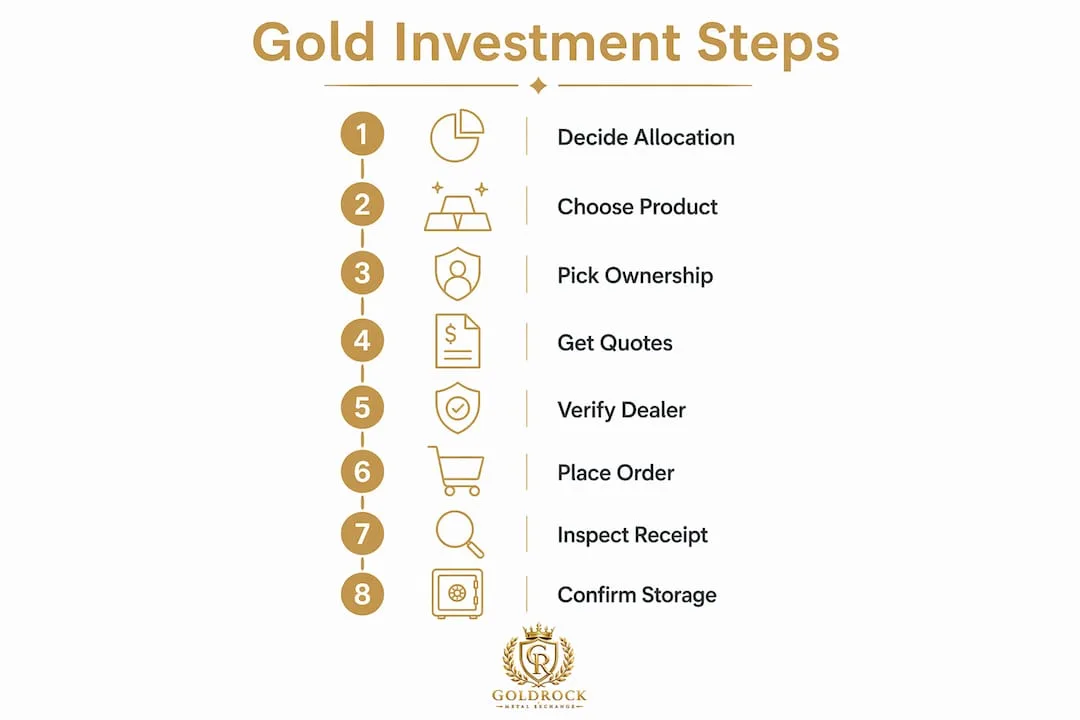
Step 3: Get price quotes
Request a quote that itemizes spot price, dealer premium, shipping, insurance, and any storage fees. Compare the all-in cost, not just the spot price. Premiums on one-ounce American Gold Eagles typically run higher than on one-ounce gold bars of comparable purity.
Step 4: Verify dealer credentials
Check that the dealer is a member of the Industry Council for Tangible Assets (ICTA) or a similar trade body. Confirm their FINRA BrokerCheck status if they offer securities-related products. Ask for references or check independent review platforms.
Step 5: Place your order with insured delivery
Insist on a fully insured, trackable shipment. Reputable dealers use carriers with declared-value insurance covering the full market value of the shipment. Get the tracking number and insurance certificate before the package ships.
Step 6: Inspect and verify upon receipt
Check hallmarks, weight, and dimensions against the product specification. For bars, confirm the serial number matches the assay certificate. If you have any doubt, an XRF (X-ray fluorescence) assay test at a local assayer provides independent verification for a modest fee.
Step 7: Confirm storage and insurance
Once the metal is in your possession or at your chosen vault, confirm your storage insurance is active. For allocated segregated vaulting, request a written confirmation that your specific bars or coins are titled to you, not pooled with other clients’ holdings.
Pro Tip: Allocated segregated storage costs more than pooled vaulting, but it eliminates the risk that a custodian’s insolvency could leave you as an unsecured creditor. For amounts above $25,000, the cost difference is usually worth it.
For a full breakdown of storage options and their trade-offs, GoldRock’s guide to storing physical gold safely covers home safes, private delivery, and allocated vaulting in detail.
Key verification points:
- Hallmark and purity stamp (e.g., .9999 for gold bars)
- Serial number matching the assay certificate
- Weight within tolerance (a 1 oz bar should weigh 31.1 grams)
- Packaging integrity on delivery (tamper-evident packaging for sealed products)
Precious-metals IRAs: IRS rules, qualified metals, and what you must know
Precious-metals IRAs are legal and well-established, but the IRS rules are specific. Getting them wrong can trigger taxes, penalties, and disqualification of the entire account.
The core IRS requirements:
- The IRA must be a self-directed IRA (SDIRA) held by an IRS-approved custodian.
- Metals must meet minimum purity standards: gold at .995 fineness or higher for bars; coins must be specifically approved (American Gold Eagle coins are an exception — they are IRS-approved despite being .9167 fine).
- The metals must be held by the custodian or an approved depository. You cannot take personal possession of IRA-owned metals without triggering a distribution.
- Prohibited transactions include buying metals from a disqualified person (yourself, family members) or using IRA metals for personal benefit before distribution.
Qualified gold products (common examples):
- American Gold Eagle coins (1 oz, ½ oz, ¼ oz, 1/10 oz)
- American Gold Buffalo coins (.9999 fine)
- Gold bars and rounds of .995 fineness or higher from approved refiners
The IRS states in Publication 590-A that collectibles are generally prohibited in IRAs, but certain gold, silver, platinum, and palladium coins and bullion meeting purity standards are explicitly exempted from that prohibition.
Funding paths:
- Direct rollover: funds move from a 401(k) or other qualified plan directly to the new SDIRA custodian. No tax withholding if done correctly.
- Trustee-to-trustee transfer: funds move between IRA custodians without passing through your hands. No tax event.
- Annual contribution: subject to standard IRA contribution limits ($7,000 for 2025 if under 50; $8,000 if 50 or older, per IRS guidance).
Custody and documentation to request:
- Annual account statements showing metal holdings by type, weight, and value
- Assay reports for bars held in your account
- Storage receipts confirming allocated or pooled status
- Custodian fee schedule in writing before opening the account
For investors specifically focused on gold’s role in retirement portfolios, GoldRock’s dedicated IRA guidance covers the full process from rollover to storage confirmation.
This section is general educational information about IRS rules as publicly published. It is not tax or legal advice. Consult a qualified tax professional or review IRS publications directly for guidance specific to your situation.
Costs, liquidity limits, and the real risks of using gold as a dollar hedge
Gold’s hedging benefits come with genuine costs and constraints. Understanding them before you buy prevents unpleasant surprises.
Principal costs:
- Dealer premium over spot: ranges from roughly 2–3% for large gold bars to 5–8% for popular coins. Premiums widen during periods of high demand.
- Shipping and insured delivery: typically $30–$50 for small orders; larger shipments may carry higher declared-value insurance fees.
- Storage and insurance: allocated segregated vaulting typically costs 0.5–1.0% of metal value annually. Home storage requires a quality safe and a homeowner’s insurance rider.
- Buy/sell spreads: the difference between what a dealer pays you (bid) and what they charge you (ask). Spreads widen in volatile markets and for less-liquid products (large bars, rare coins).
- IRA custodian fees: setup fees plus annual fees that vary by custodian and storage arrangement.
Liquidity considerations:
Physical gold is not instantly liquid. Selling requires contacting a dealer, agreeing on a price, shipping the metal (or arranging a vault release), and waiting for settlement. ETFs settle in two business days like any stock. Futures are the most liquid but require active management. For a long-term hedge allocation, physical gold’s liquidity profile is acceptable. For a tactical trade, ETFs are more practical.
Academic research confirms that gold’s safe-haven and variance-reduction properties are most pronounced during financial and geopolitical crises, and less consistent during normal market conditions or short time frames. That finding aligns with practitioner guidance: gold works best as a long-term structural position, not a short-term trade.
Key risks:
- Timing risk: gold can underperform significantly during Fed tightening cycles when real yields rise sharply. The 2022 rate-hike cycle is the clearest recent example.
- Counterparty risk: ETFs, futures, and pooled storage all introduce some form of counterparty exposure that physical allocated ownership eliminates.
- Tax and reporting risk: selling gold in a taxable account triggers a capital gains event. Physical gold held personally is taxed at the collectibles rate (maximum 28%), which is higher than the long-term capital gains rate for most securities.
- Political and regulatory risk: while gold ownership is legal and well-established in the U.S., regulatory changes to IRA rules or reporting requirements are always possible.
One constraint worth stating plainly: gold produces no income. No dividends, no interest, no yield. Its entire return comes from price appreciation. That makes it a poor substitute for income-producing assets and a poor choice for investors who need cash flow from their portfolio. It belongs in the portion of a portfolio allocated to capital preservation and purchasing-power protection, not the income sleeve.
For context on precious metals during market stress, GoldRock’s crisis guide covers historical performance across multiple economic cycles.
Which indicators to watch and how to rebalance your gold allocation
Monitoring a handful of macro indicators tells you whether the conditions that make gold an effective hedge are strengthening or weakening. You do not need to watch all of them daily; a monthly review is sufficient for a long-term allocation.
Indicators to track:
- DXY (U.S. Dollar Index): a falling DXY generally supports gold. Watch for sustained directional moves, not daily noise.
- 10-year real yield (TIPS yield): the most direct driver of gold’s opportunity cost. Falling real yields are bullish for gold; rising real yields are the primary headwind.
- CPI and inflation surprises: a CPI print above consensus expectations tends to support gold by raising inflation expectations and pressuring real yields.
- Fed meeting signals (dot plot, FOMC statements): forward guidance on rate paths matters more than individual rate decisions. A dovish pivot is a gold-positive signal.
- Central-bank gold purchases: monthly data from the World Gold Council tracks central-bank buying. Sustained accumulation provides a structural demand floor.
- Geopolitical risk indexes: escalating geopolitical tension historically supports gold as a safe-haven asset, independent of dollar movements.
How to interpret the signals:
Rising real yields are the clearest warning sign that gold may underperform. When the 10-year TIPS yield moves from negative to positive territory, gold historically faces headwinds. Conversely, when real yields are falling and the Fed is signaling accommodation, gold tends to perform well even if the DXY is not moving sharply.
Central-bank accumulation and de-dollarization trends can create multi-year structural support that overrides short-term monetary policy signals. That is the dynamic that made gold resilient through the 2022–2023 tightening cycle.
Simple rebalancing approach:
| Scenario | Signal | Action |
|---|---|---|
| Gold allocation drifts higher | Price appreciation | Trim back to 10% target |
| Gold allocation falls lower | Price decline or portfolio growth | Add to restore 10% target |
| Real yields rise sharply | Headwind signal | Hold; do not add aggressively |
| DXY falls more than 5% in a quarter | Tailwind signal | Consider adding toward upper band |
| Quarterly review (no drift) | Routine check | No action required |
A target-band approach (5–10% target, rebalance when allocation drifts more than 2.5 percentage points in either direction) keeps the process mechanical and removes the temptation to time the market. If you are adding exposure during a period of dollar weakness, stagger purchases over 4–8 weeks rather than buying all at once. Volatile dollar declines often produce volatile gold prices, and a laddered entry smooths your average cost.
How GoldRock Metal Exchange supports your gold hedge strategy
GoldRock Metal Exchange is a full-service precious metal dealer built specifically for investors who want to implement a physical gold strategy, whether in a personal account or through a self-directed IRA.
What GoldRock offers:
- Full-service precious metal dealing: gold, silver, platinum, and palladium in coins and bars, with transparent pricing and dealer spreads disclosed upfront.
- In-house IRA department: a dedicated team that handles the rollover and transfer process from start to finish, coordinating with approved custodians so investors do not have to manage the paperwork independently.
- Insured private delivery: physical metals shipped directly to your address with full insurance coverage and tracked delivery, or delivered to an approved depository for IRA accounts.
- Personalized guidance: one-on-one consultation to help investors choose the right products, ownership structure, and allocation for their specific situation.
- Allocated storage options: GoldRock can connect investors with allocated segregated storage arrangements that keep your metals titled to you, not pooled with other clients’ holdings.
Pro Tip: When initiating an IRA rollover through GoldRock, ask the IRA department for a written timeline covering each step from transfer initiation to vault confirmation. Knowing the expected timeline prevents the common mistake of assuming the process is complete before the metals are actually secured.
| Service | Personal Account | Precious-Metals IRA |
|---|---|---|
| Physical bullion (coins and bars) | Yes | Yes (IRS-qualified products only) |
| Insured private delivery | Yes | Delivery to approved depository |
| In-house IRA rollover support | N/A | Yes — dedicated IRA department |
| Allocated segregated storage | Available | Available through approved custodian |
| Personalized consultation | Yes | Yes |
The mid-article next step is straightforward: Request a Free Precious Metals Consultation with GoldRock’s IRA department, or call (888) 859-0978 to discuss your rollover or personal purchase options. The consultation is educational and carries no obligation.
Key Takeaways
Gold serves as a durable hedge against structural U.S. dollar devaluation when held as a permanent portfolio allocation of 5–10%, monitored against real yields and Fed policy, and owned through a structure that matches your tax situation and liquidity needs.
| Point | Details |
|---|---|
| Allocation target | A permanent gold allocation of modest size reduces portfolio variance across cycles without overconcentrating in a non-yielding asset. |
| Ownership structure matters | Physical bullion eliminates counterparty risk; precious-metals IRAs add a tax-advantaged wrapper; ETFs suit tactical adjustments. |
| IRS rules are strict | Precious-metals IRAs require IRS-approved custodians, qualified metals meeting IRS purity standards, and no personal possession of IRA-owned metals. |
| Watch real yields, not just the dollar | The 10-year TIPS yield is the most direct driver of gold’s opportunity cost; rising real yields are the primary headwind to monitor. |
| GoldRock Metal Exchange | Offers insured private delivery, an in-house IRA department, and personalized consultation for U.S. investors implementing a gold hedge. |
This article is general educational information, not personalized investment, tax, or legal advice. Consult a qualified financial or tax professional and review current IRS publications for guidance specific to your situation.
A measured perspective on gold as a dollar hedge
The conventional framing around gold and dollar devaluation tends toward two extremes: either gold is the ultimate crisis asset that will protect everything, or it is a relic that pays no yield and belongs nowhere in a modern portfolio. Both views miss the point.
Gold’s value as a hedge is not that it always goes up when the dollar goes down. It is that over long periods and across multiple cycles, it tends to preserve purchasing power when paper currencies are under structural pressure. The 2022–2023 period is instructive: the Fed raised rates at the fastest pace in decades, real yields surged, and gold still held its value better than long-duration Treasuries. That is not what the simple inverse-dollar model would have predicted. It happened because central-bank buying and de-dollarization flows created a demand floor that the model did not account for.
What investors underestimate is how much the regime matters. Gold during a tightening cycle is a different asset than gold during an easing cycle. Buying a 10% allocation and ignoring it for a decade is a reasonable strategy. Trying to trade in and out based on daily dollar moves is not. The investors who get hurt by gold are almost always the ones who bought too much at a peak driven by fear, then sold at a loss when the Fed tightened and gold underperformed for 18 months.
The practical lesson: size the allocation to what you can hold through a two-year drawdown without flinching. For most investors, that is 5–10%. Own it in a structure that matches your tax situation. Monitor real yields and central-bank flows quarterly. Rebalance mechanically, not emotionally. That is the whole strategy.
Ready to implement your gold hedge? GoldRock can help
Physical gold ownership and precious-metals IRAs involve real decisions about products, storage, and custody. Getting those details right from the start saves time, cost, and paperwork later.

GoldRock Metal Exchange brings together insured private delivery, a dedicated in-house IRA team, and personalized one-on-one guidance under one roof. Whether you are funding a new self-directed IRA with a rollover, adding physical bullion to a personal account, or simply working out the right allocation for your situation, GoldRock’s team handles the process transparently and without pressure.
Browse GoldRock’s full product catalog to see available coins and bars, or go directly to the precious-metals IRA page if you are focused on retirement accounts. To speak with a specialist, call (888) 859-0978 or Request a Free Precious Metals Consultation today.
Useful sources for further research
The following primary and institutional sources were used in preparing this guide and are worth consulting directly for regulatory updates, market data, and deeper analysis.
- IRS Publication 590-A: The authoritative source for IRA contribution and rollover rules, including the specific exemptions that allow qualified precious metals in self-directed IRAs.
- U.S. Mint: Official source for American Gold Eagle and American Gold Buffalo specifications, including purity and weight standards relevant to IRA qualification.
- FINRA BrokerCheck: Use this to verify the registration and disciplinary history of any broker or dealer before transacting.
- J.P. Morgan Private Bank — Gold Outlook: Institutional-level analysis of gold’s drivers in 2026, including central-bank demand and geopolitical factors.
- Macrobond — Gold and the Dollar Hedge Revisited: Quantitative analysis of the gold–DXY correlation across historical regimes, including periods where the relationship reversed.
- Investopedia — De-Dollarization and Gold: Accessible summary of how central-bank buying and de-dollarization trends are reshaping gold demand.
- ScienceDirect — Gold as a Safe Haven for the U.S. Dollar: Academic study examining gold’s safe-haven properties across currency pairs and crisis periods, with portfolio variance findings.
- SmartAsset — Gold as an Inflation Hedge: Balanced practitioner summary of gold’s inflation-hedging pros, cons, and cost considerations.
- Galami Gold — Portfolio Diversification: External background on gold’s role in diversified portfolios, including product context and diversification theory.
“Gold serves as a dual hedging instrument, protecting international investment portfolios against both currency risk and systemic market shocks.” — F1000Research, The Effectiveness of Gold as a Hedging Tool against Dollar Risks and Systemic Crises