

A bonded metals courier is a courier whose company and staff are covered by a surety bond — a third-party financial instrument that guarantees compensation for theft, fraud, or dishonesty by employees during transport of precious metals and other valuables. For investors and IRA holders moving physical gold, silver, platinum, or palladium, that bond provides a financial backstop against insider theft. It does not replace transit insurance, and it is not the same as armored transport. Understanding what the bond actually covers — and what it does not — is the difference between adequate protection and a costly gap.
Table of Contents
- What does “bonded” actually mean for a courier service?
- What does a surety bond cover — and what does it exclude?
- How do customs-bonded couriers handle international metals shipments?
- What security measures and chain-of-custody practices should you expect?
- When should you hire a bonded metals courier?
- How do you verify and hire a legitimate bonded metals courier?
- What do bonded courier services typically cost, and how do claims work?
- What are the real risks and limitations of relying on bonding alone?
- Key Takeaways
- Why verified bonding and insured delivery matter more than most investors realize
- GoldRock Metal Exchange offers insured private delivery for precious metals investors
- Useful sources for verifying bonded courier and customs requirements
What does “bonded” actually mean for a courier service?
The word “bonded” has two distinct meanings in courier services, and confusing them is a common and expensive mistake.
Surety (fidelity) bond: This is the most common meaning. A surety bond protects clients against employee dishonesty — theft, fraud, or deliberate misdelivery by courier staff. The bond is issued by a surety company (an insurer authorized to write bonds), and it names the courier company as the principal. If a covered employee steals a shipment, the surety pays the client up to the bond’s face value, then seeks reimbursement from the courier. The client is the protected party; the government is not involved.
Customs (CBP) bond: In international logistics, “bonded” means something different. A customs-bonded carrier is licensed by U.S. Customs and Border Protection to move shipments that have not yet cleared customs between bonded facilities — without paying duties at the time of entry. The bond here guarantees regulatory compliance to the U.S. government, not financial protection to the client.
For precious metals, both bond types can apply at different stages:
- A surety bond protects you against employee theft on any domestic or international leg.
- A customs bond is required when your metals cross a U.S. port of entry and need to move to a bonded warehouse or vault before formal duty settlement.
Pro Tip: Before signing any carrier agreement, ask specifically: “Which bond type covers my shipment?” Then request the bond certificate, the surety company’s name, and the bond number. A legitimate provider will hand these over without hesitation.
What does a surety bond cover — and what does it exclude?
A surety bond is precise about what it covers. Knowing the boundaries prevents unpleasant surprises during a claim.
Typical covered events:
- Theft or misappropriation of goods by a bonded employee
- Deliberate misdelivery or diversion of a shipment by courier staff
- Fraud or intentional dishonest acts by covered personnel
- Contractual nonperformance directly tied to a covered dishonest act
Common exclusions:
- Accidental loss or damage during transit (dropped packages, vehicle accidents)
- Natural disasters, fire, or flood
- Theft by a third party not employed by the courier
- Negligence by subcontractors or third-party handlers not named on the bond
- Mysterious disappearance without evidence of employee dishonesty
When a covered loss occurs, the claim process typically follows these steps:
- Notify the courier in writing immediately, with a detailed description of the loss.
- Preserve all chain-of-custody records: signed handoffs, GPS logs, tamper-evidence photos.
- File a formal claim with the surety underwriter, attaching shipment documentation and proof of value.
- Cooperate with the surety’s investigation, which may include interviews and subrogation proceedings against the responsible employee.
- Receive settlement up to the bond’s face value; pursue any remaining balance through the courier’s cargo insurance.
Key point: The bond face value sets a hard ceiling on recovery. If your shipment of gold bars is worth $200,000 and the bond face value is $50,000, the bond covers only $50,000. Transit insurance must cover the rest.
How do customs-bonded couriers handle international metals shipments?
When precious metals cross a U.S. border, the word “bonded” shifts to its regulatory meaning. A customs-bonded carrier operates under CBP authority to move uncleared goods between authorized facilities without immediate duty payment. The bond guarantees to the U.S. government that duties will be paid or the goods will be exported — and that the shipment will not be diverted before clearance.
The typical flow for an international metals shipment looks like this:
- Metals arrive at a U.S. port of entry and are placed under CBP control.
- A customs-bonded carrier transports the sealed shipment to a bonded warehouse or vault.
- The shipment stays under bond until the importer files a formal entry and pays duties, or re-exports the goods.
- Only after clearance can the metals move to a non-bonded facility.
Sealed containers are mandatory throughout. The carrier cannot break seals, reroute to an unregistered location, or accept delivery instructions that would divert the shipment outside the bonded chain. For IRA-held metals moving through a custodian’s approved depository, this regulatory structure also intersects with IRS rules on approved storage facilities.
What security measures and chain-of-custody practices should you expect?
Bonding is a financial guarantee. Physical security is a separate operational discipline, and for precious metals, the two must work together. A bonded label alone does not mean armored or high-security transport — investors must verify security protocols independently.
Operational controls a reputable provider maintains:
- Criminal background checks and credit checks on all drivers and handlers
- Confidentiality agreements covering shipment details, routes, and client identities
- Role segregation so no single employee controls pickup, transit, and delivery
- Regular audits of employee conduct and access logs
Physical and technical measures:
- Tamper-evident seals applied at origin and verified at delivery
- GPS tracking with real-time monitoring accessible to the client
- Secure, locked vehicles with no unauthorized stops
- Escorted transfers for high-value loads
Pro Tip: Request a sample chain-of-custody record before you hire. A provider that cannot show you a redacted example of their standard documentation is a provider you should not trust with your metals.
At each stage, the documentation trail should include:
- Signed pickup receipt with employee ID, time, and seal number
- GPS-logged transit record with timestamps at each checkpoint
- Tamper-evidence verification at any intermediate handoff
- Signed delivery confirmation with recipient ID and seal-integrity check
- Digital proof-of-delivery retained in the courier’s system
This paper trail is what makes a claim defensible. Without it, even a valid bond claim can stall.
When should you hire a bonded metals courier?
Not every metals shipment needs a bonded courier. The decision turns on declared value, theft attractiveness, and regulatory requirements.
- Legal or institutional transfers: Banks, law firms, and auction houses routinely require bonded couriers for sensitive materials because the bond provides a contractual and financial guarantee beyond standard carrier liability.
If your shipment is low value, moves entirely within a secure facility, or is already covered by a comprehensive armored service with full liability, a standalone bonded courier may be redundant. For most investor-grade precious metals moving outside a vault, bonding combined with insurance is the baseline, not the ceiling. Consider pairing your delivery decision with a broader look at precious metal storage options to make sure your post-delivery custody is equally protected.
How do you verify and hire a legitimate bonded metals courier?
“Bonded” is a marketing term as much as a legal one. Verification takes ten minutes and can save you from a fraudulent or underinsured provider.
- Request the bond certificate. It should show the surety company’s name, the bond number, the principal (courier company), and the face value. No certificate means no bond.
- Call the surety directly. Look up the surety company’s number independently (not from the courier’s website) and confirm the bond is active, in good standing, and covers the relevant services.
- Request the certificate of insurance. Confirm it shows “all-risk” transit coverage, the policy limits, and the effective dates. Check that the limits are adequate for your shipment’s declared value.
- For customs-bonded moves, request CBP bond documentation. The carrier should be able to show their CBP authorization number and the customs bond details.
- Ask for employee vetting policies in writing. Background check procedures, frequency of audits, and confidentiality agreement templates are reasonable requests.
- Request a sample chain-of-custody record. Redacted is fine; the format and completeness matter.
Red flags that should stop the conversation:
- Vague claims of being “bonded” with no certificate or surety name
- Bond face value far below your shipment’s declared value
- No cargo insurance or policy limits that don’t cover your metals
- Refusal to provide chain-of-custody samples
- No documented employee vetting process
Pro Tip: Cross-reference the surety company’s name against the National Association of Surety Bond Producers or confirm the insurer’s license status with your state’s Department of Insurance. Legitimate sureties are licensed in every state where they write bonds.
Ready to arrange insured private delivery for your precious metals? GoldRock Metal Exchange offers insured private delivery options for physical gold, silver, platinum, and palladium — with full documentation and in-house IRA support. Call (888) 859-0978 or request a Free Precious Metals Consultation today.
What do bonded courier services typically cost, and how do claims work?
Pricing for bonded metals courier services varies considerably based on several factors. There is no single market rate, but the cost drivers are consistent.

| Cost Factor | How It Affects Price |
|---|---|
| Declared value | Higher declared value raises insurance premiums and bond requirements |
| Bond premium | Roughly 1–3% of the bond face value for applicants with good credit |
| Armored escort | Per-stop fees and hourly escort rates add significant cost for high-value loads |
| Distance and route | Mileage, fuel, and per-stop charges scale with geography |
| Expedited delivery | Same-day or next-day service carries a premium over standard scheduling |
| Specialized handling | Vault-to-vault service, climate control, or sealed-container requirements add cost |
On timing: same-day metropolitan deliveries are achievable for local bonded couriers. Regional transfers typically run 12–48 hours. Customs-bonded international moves depend heavily on CBP processing times and can extend to several days or longer when formal entry paperwork is pending.
When a loss occurs, the claims process follows a predictable path:
- Open a claim with the courier immediately and in writing.
- Submit all chain-of-custody documentation, proof of value, and the shipment contract.
- The courier’s insurer and/or surety underwriter will investigate, which may take weeks.
- If the bond covers the loss, the surety pays up to the face value and pursues subrogation against the responsible party.
- Remaining losses above the bond face value are pursued through the cargo insurance policy.
Delays in claims are common when documentation is incomplete. That is the strongest argument for insisting on a full chain-of-custody record at every handoff.
What are the real risks and limitations of relying on bonding alone?
A surety bond is one layer of protection, not a complete solution. Several limitations deserve direct attention.
- Bond face value caps your recovery. If the bond is written for $25,000 and your shipment is worth $150,000, you are exposed for $125,000 unless transit insurance fills the gap.
- Exclusions are real and specific. Accidental loss, third-party theft, and negligence by subcontractors are typically outside the bond’s scope.
- Surety credit risk exists. A bond is only as good as the surety company behind it. Confirm the surety is licensed and financially rated.
- Regulatory gaps for cross-border moves. A surety bond does not satisfy CBP requirements. You need a separate customs bond for in-bond international movement.
- Bond covers specified acts, not every loss. If a shipment disappears and there is no evidence of employee dishonesty, the bond may not pay.
Best practices to reduce your exposure:
- Split large shipments across multiple deliveries to limit single-event loss.
- Always buy all-risk transit insurance with limits matching the full declared value.
- Insist on physical security (armored or vetted private delivery) when the shipment value and theft risk justify it.
- Schedule pickups and deliveries at secure, monitored locations.
- For cross-border metals, confirm customs-bond compliance with your carrier before the shipment moves.
For investors holding metals inside a self-directed IRA, the stakes are higher still. IRS rules require metals to be held at an approved depository, and any break in the custody chain during transport can create compliance problems. Understanding how to reduce portfolio risk with precious metals starts with getting the custody and delivery chain right.
Key Takeaways
A bonded metals courier provides a financial guarantee against employee dishonesty, but full protection for precious metals requires layering a surety bond with all-risk transit insurance and, for high-value shipments, armored or vetted private delivery.
| Point | Details |
|---|---|
| Two meanings of “bonded” | Surety bonds cover employee dishonesty; customs bonds authorize CBP-regulated movement with deferred duties. |
| Bond limits and exclusions | Bond face value caps recovery; accidental loss, third-party theft, and negligence are typically excluded. |
| Layered protection is required | Combine a surety bond, all-risk transit insurance, and armored transport for high-value precious metals shipments. |
| Verification checklist | Always request the bond certificate, surety name, bond number, and insurance policy limits before hiring. |
| GoldRock Metal Exchange | Offers insured private delivery with full documentation for gold, silver, platinum, and palladium — call (888) 859-0978. |
Why verified bonding and insured delivery matter more than most investors realize
The conventional wisdom says “just make sure your courier is bonded.” That framing undersells the problem. Most investors who ask whether a courier is bonded stop at the word “yes” and move on. They do not ask for the bond number, they do not call the surety, and they do not check whether the face value covers their shipment. That gap between the label and the reality is where losses happen.
What actually matters is the combination: a verifiable surety bond with adequate face value, all-risk transit insurance with limits that match your declared value, and physical security protocols that reduce the chance of a loss in the first place. The bond is the last line of financial recourse. You want to never need it.
For IRA investors, the stakes extend beyond the financial. A custody break during transport can create IRS compliance issues that are far more expensive than the shipment itself. The documentation chain is not bureaucratic overhead — it is the evidence that keeps your retirement account intact.
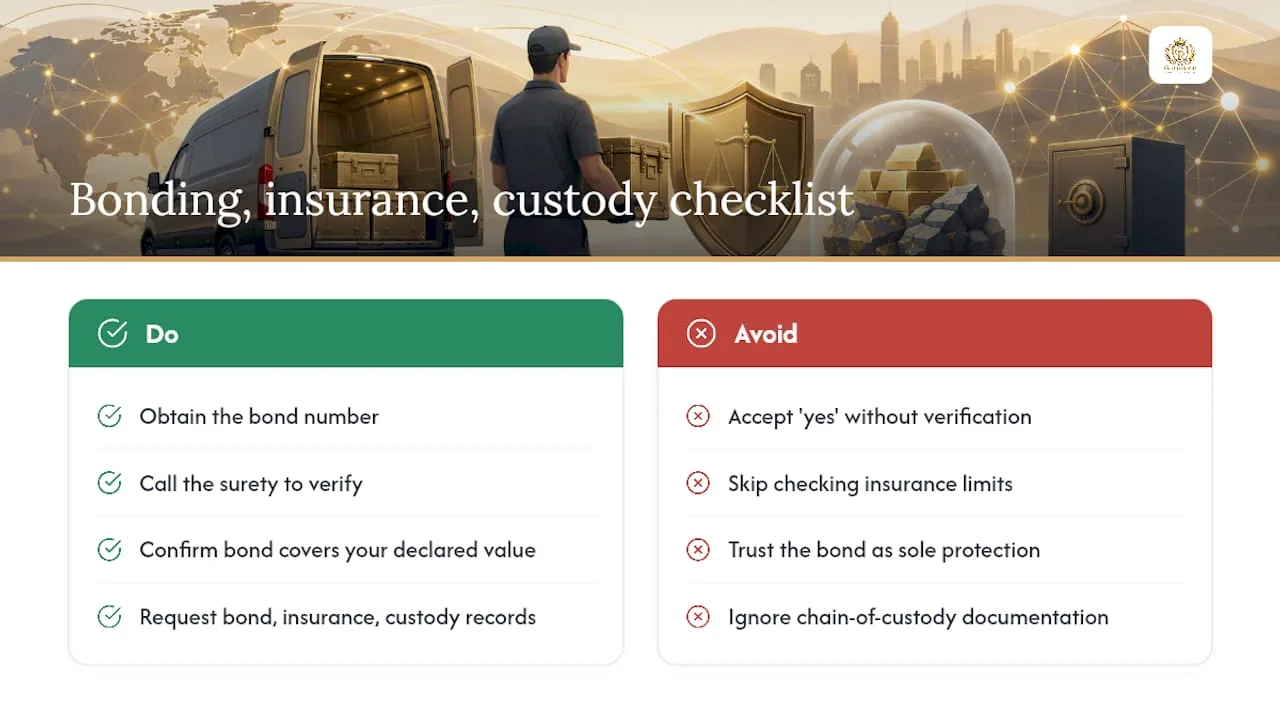
The providers worth trusting are the ones who hand over their bond certificate, their insurance certificate, and a sample chain-of-custody record without being asked twice. Anything less is a reason to keep looking.
GoldRock Metal Exchange offers insured private delivery for precious metals investors

Physical precious metals are worth protecting at every step, from purchase to vault. GoldRock Metal Exchange provides insured private delivery for gold, silver, platinum, and palladium, with full chain-of-custody documentation and in-house IRA support for retirement account transfers. Whether you are taking direct delivery of a new purchase or moving metals into a self-directed IRA, GoldRock’s team walks you through every step, including delivery options, insurance coverage, and custodian requirements. Browse available products or call (888) 859-0978 to request a Free Precious Metals Consultation. The in-house IRA department is available to guide you through rollovers, storage, and delivery arrangements from start to finish.
Useful sources for verifying bonded courier and customs requirements
The following primary sources provide authoritative guidance on the regulatory and legal frameworks covered in this article:
- Why Bonded Drivers Matter for Sensitive Deliveries | DC Courier Services Blog
- Understanding Bonded Carriers for Florida Businesses
- What is a Bonded Courier? Definition, Features, Process, Pros & Cons
- When to Use Bonded Carriers and Armored Services for High-Value Loads – Insurance Curator
- What Is A Bonded Courier
- Understanding Bonded Carriers: Requirements & Benefits
This article is for general educational purposes only and does not constitute investment, tax, legal, or financial advice. Regulations, bond requirements, and IRS rules change; confirm current requirements with CBP, the IRS, or a qualified professional before making decisions about precious metals transport or retirement account management.