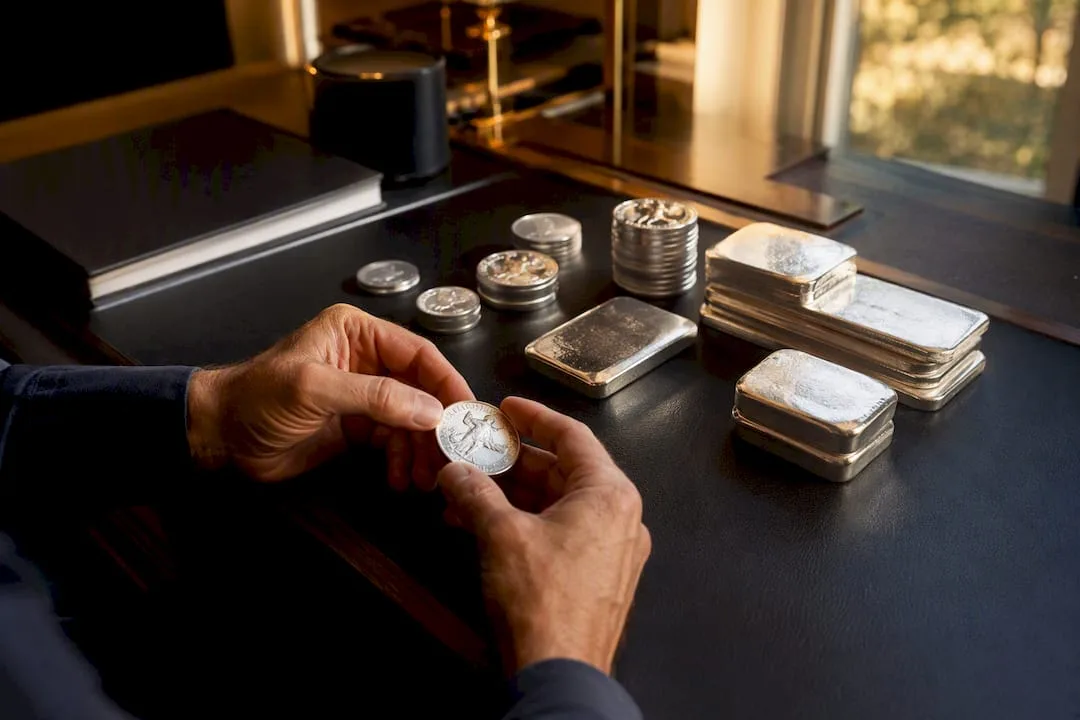
A silver premium is the dollar amount, usually expressed per troy ounce, that a buyer pays above the live spot price to own a physical silver product. If spot silver trades at a price per troy ounce and a one ounce coin sells notably above spot, the premium is the difference in dollars and percentage terms. That gap covers minting, distribution, and dealer margin, not extra metal.
- Spot price = the quoted market value of raw silver
- Premium = markup added for fabrication, distribution, and dealer margin
- Retail price = spot + premium (+ tax and shipping, where they apply)
The sections below break down what builds that markup, how it shifts by product, and how to calculate it yourself before you buy.
Key Takeaways
The retail price of physical silver always equals spot price plus a premium that covers fabrication, distribution, and dealer margin, and that premium varies meaningfully by product form.
| Point | Details |
|---|---|
| Premium defined | The dollar or percent markup a buyer pays above live spot price for a physical silver product. |
| Silver premiums run higher than gold’s | Fixed fabrication costs represent a larger share of silver’s lower per-ounce value. |
| Product form drives cost | Government coins carry higher premiums than generic rounds or large bars. |
| Calculate before buying | Melt value = weight × purity × spot; subtract from retail price for dollar premium. |
| Get personalized guidance | GoldRock Metal Exchange offers consultations and insured private delivery to help match product format to your goals. |
Where to Verify Live Spot and Premium Data
Check Kitco’s live silver chart for current spot pricing, and consult U.S. Mint product pages for official coin specifications before comparing any dealer quote against the examples in this guide.
- Kitco: real-time spot price tracking
- U.S. Mint: official coin specifications and mintage data
- Dealer aggregates: benchmark premium ranges across products
Table of Contents
- Spot Price vs. Silver Premium: What’s the Real Difference?
- What Makes Silver Premiums Rise or Fall?
- Government Coins, Rounds, or Junk Silver: Which Has the Lowest Premium?
- How Do You Calculate the Silver Premium on a Product?
- What Are Typical Silver Premium Ranges Today?
- How Does the Premium Affect Your Investment Returns?
- How Can You Reduce the Silver Premium You Pay?
- How Do You Use a Silver Melt Value Calculator Correctly?
- Get Expert Guidance on Buying Physical Silver
- Frequently Asked Questions
- Sources
Spot Price vs. Silver Premium: What’s the Real Difference?
Spot price is the wholesale value of raw silver, quoted per troy ounce and updated continuously as futures markets trade. It reflects the metal itself, stripped of any form, minting, or branding. You’ll see this number on any live spot price feed, and it moves by the second during market hours.
The premium is everything layered on top of that number to turn raw metal into a product you can actually hold. It pays for striking or casting the coin or bar, packaging it, shipping it through a distribution chain, and the dealer’s own margin for carrying inventory and taking on the transaction. On top of the premium, most buyers also face sales tax depending on their state and the product, shipping and insurance if the dealer doesn’t offer free delivery, and sometimes a payment processing fee for certain payment methods.
The math is simple: retail price = spot price + premium (+ tax + shipping/fees). Kitco’s live spot data showed .999 fine silver valued at roughly $62.78 per troy ounce in one recent snapshot, so a one ounce coin selling for $67 that day carries a premium near $4.22, before tax or shipping enter the picture.
Quick math: Spot $32.00 + Premium $4.50 = Retail $36.50 per ounce, before tax or shipping.
- Sales tax (varies by state and product type)
- Shipping and handling fees
- Insurance for higher-value orders
- Payment processing surcharges on some transaction types
What Makes Silver Premiums Rise or Fall?
Premiums aren’t fixed. They shift with a handful of forces that have nothing to do with the price of raw metal itself.
Fabrication cost is the baseline. Striking a coin or casting a bar costs money in machinery, dies, and labor, and that cost gets spread across every ounce produced. Shipping and insurance add more, especially for smaller retail orders where fixed logistics costs get divided across fewer ounces. Mints occasionally pause or ration production, particularly sovereign mints like the U.S. Mint, and when that happens, dealers competing for limited allocation push premiums higher across the board. Seasonal demand plays a role too. Retail buying often surges during economic uncertainty, and dealer inventory tightens fast when that happens.
- Fabrication and minting costs
- Value density (cost per ounce relative to metal’s own worth)
- Shipping, handling, and insurance
- Mint production limits or sovereign coin shortages
- Seasonal or event-driven retail demand spikes
- Dealer inventory levels and bid/ask spreads
Silver’s percentage premiums are structurally higher than gold’s for a specific reason: fixed fabrication and handling costs eat up a much larger share of silver’s lower per-ounce value than they do gold’s, as Minted Metal explains. A $2 fabrication cost is 6% of a $32 silver ounce but barely a rounding error against a $2,600 gold ounce. This is worth understanding if you’re weighing why silver is more affordable than gold as an entry point into metals.
Pro Tip: When a mint announces a temporary production halt, retail premiums on that specific coin can double within days even though spot price hasn’t moved at all. Watch mint announcements, not just spot charts.

Government Coins, Rounds, or Junk Silver: Which Has the Lowest Premium?
Product form drives premium more than almost anything else. Recognizability, guaranteed purity, and mint fees all stack differently depending on what you buy.
Government-minted coins like the American Silver Eagle, Canadian Silver Maple Leaf, and British Silver Britannia sit at the top of the premium range. They carry sovereign backing, guaranteed purity, and instant global recognizability, all of which dealers and buyers pay for. Generic silver rounds, struck by private mints without government backing, typically run cheaper because they skip the sovereign minting fees. Pre-1965 U.S. “junk silver” coinage, worn dimes and quarters valued for their 90% silver content rather than collectibility, often lands in the middle, prized for small-denomination flexibility and easy divisibility.
| Product Form | Typical Premium (USD/oz) | Liquidity/Resale Ease | Numismatic Premium Potential |
|---|---|---|---|
| American Silver Eagle | Higher end | Excellent | Low to moderate |
| Canadian Silver Maple Leaf | Higher end | Excellent | Low |
| British Silver Britannia | Higher end | Very good | Low |
| Generic silver rounds | Lower end | Good | None |
| Pre-1965 junk silver | Moderate | Very good | Low, unless rare date |
- Best value for pure metal exposure: generic rounds or large bars
- Best liquidity for quick resale: recognized government coins
- Junk silver splits the difference with easy divisibility
How Do You Calculate the Silver Premium on a Product?
Calculating premium takes six steps, and once you’ve done it once, it becomes second nature.
- Confirm the item’s total weight and unit (grams or troy ounces).
- Convert grams to troy ounces if needed (divide grams by 31.1035).
- Apply the purity or fineness (.999, .925, or 90% for junk silver).
- Multiply the pure silver content by the live spot price to get melt value.
- Subtract melt value from the retail price to get the dollar premium.
- Divide the dollar premium by melt value and multiply by 100 for percent premium.
Worked example: Spot price is $32.00 per troy ounce. A one ounce .999 fine silver round sells for $35.20. Melt value = 1 oz × .999 × $32.00 = $31.97. Dollar premium = $35.20 minus $31.97 = $3.23. Percent premium = $3.23 ÷ $31.97 × 100 = about 10.1%.
The dollar figure tells you the actual cost. The percent figure tells you how that cost compares across different products and price points, which matters more when spot itself is moving.
What Are Typical Silver Premium Ranges Today?
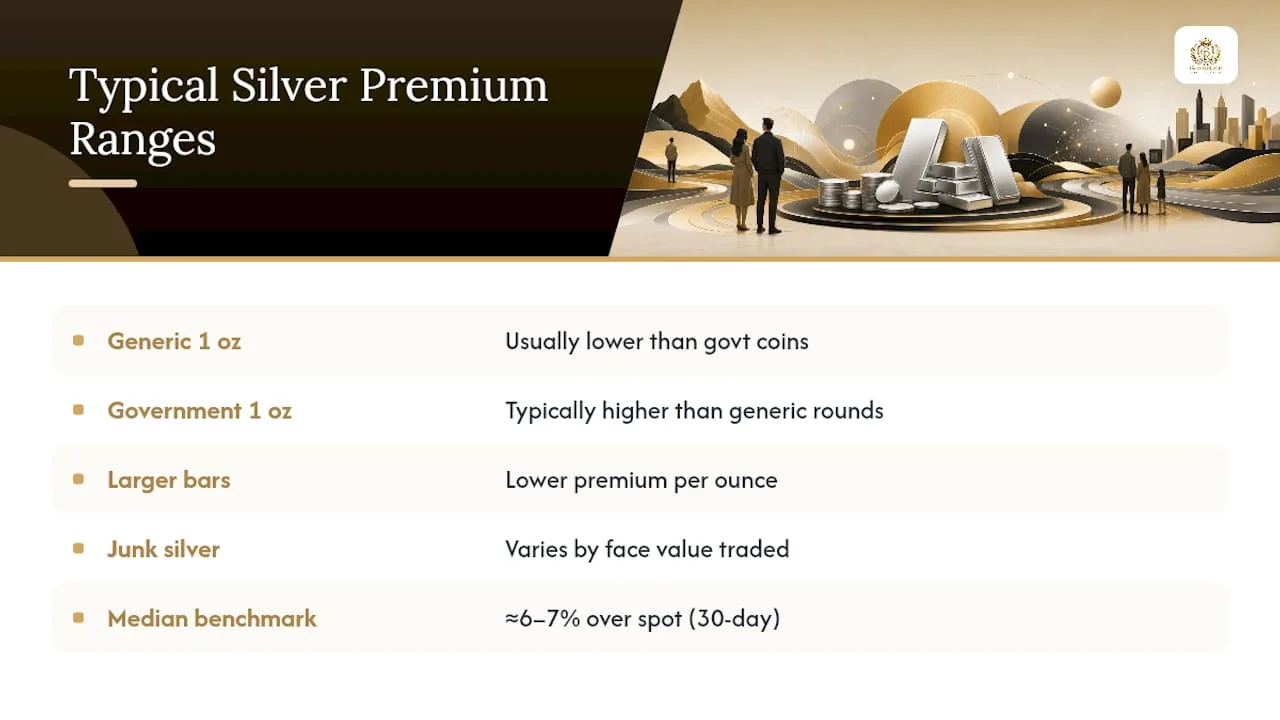
Premiums vary by product weight and form, and the ranges below are a starting point, not a live quote.
Typical retail premiums vary by product form and size, with generic 1 oz rounds generally carrying lower premiums than government 1 oz coins. Larger bars tend to have lower premiums per ounce. Junk silver premiums vary depending on face value traded. These general patterns are consistent with tracked dealer pricing data compiled by FindBullionPrices.com. Separately, aggregated dealer tracking has shown a median lowest silver premium around 6% to 7% over recent 30-day windows, which gives a rough benchmark for what “reasonable” looks like in normal market conditions. These figures shift constantly. Always check a live dealer quote or spot aggregate before assuming last month’s numbers still hold.
How Does the Premium Affect Your Investment Returns?
The premium you pay when buying is rarely the same premium you receive when selling. Dealers typically buy back metal at a price closer to spot, meaning your entry premium becomes a cost you have to recover through price appreciation before you break even.
This matters far more for short holding periods. Sales tax, shipping costs, and the dealer’s bid-ask spread all factor into your true break-even point, a dynamic Fortune has covered in the context of gold and silver purchases generally.
- Buy price includes premium; sell price often reflects a smaller markup
- Short-term trades absorb premium costs harder than long-term holds
- Factor tax, shipping, and dealer spread into your break-even estimate
How Can You Reduce the Silver Premium You Pay?
A few practical habits keep more of your money in metal instead of markup.
Buying larger bars lowers your percent premium because fixed fabrication costs spread across more ounces. Comparing live prices across the current product catalog before committing helps you spot outliers. Generic rounds tend to cost less than sovereign coins if pure metal exposure, not collectibility, is your goal. Buying in bulk often unlocks tiered discounts. And watching for mint shortages or sudden retail demand spikes lets you avoid buying right when premiums are temporarily inflated.
- Compare the total delivered price, not just the sticker price.
- Confirm dollar premium and percent premium separately.
- Check whether sales tax applies in your state.
- Ask about shipping, insurance, and return policy before ordering.
- Consider larger formats if you don’t need coin-level liquidity.
- Time larger purchases around calmer market periods when possible.
How Do You Use a Silver Melt Value Calculator Correctly?
A melt-value calculator estimates your product’s floor value using weight, purity, and the live spot price, but it does not predict what a dealer will charge you.
Getting purity wrong is the single most common error new buyers make, and it can throw off a valuation substantially.
Pro Tip: Always double-check whether your calculator input is in grams or troy ounces. Mixing the two up is the fastest way to misjudge a coin’s real melt value.
Remember that the calculator gives you the metal floor, not the market price. Dealers price above that floor to cover the same fabrication, distribution, and margin costs discussed earlier in this guide.
A Practical Note From Blake
If you take one thing from this guide, check the premium per ounce and compare it across product formats before you buy, not after.
Get Expert Guidance on Buying Physical Silver
Understanding premiums is only half the equation. Knowing which format fits your goals, and having someone confirm your total delivered cost before you commit, is where a full-service dealer earns its place. GoldRock Metal Exchange offers personalized guidance on choosing between coins, rounds, and bars based on your priorities, whether that’s liquidity, lower percent premiums, or long-term accumulation.
For retirement savers, GoldRock Metal Exchange’s in-house IRA department handles the entire rollover process for self-directed Precious Metals IRAs, so you can hold physical gold, silver, platinum, or palladium inside a retirement account without navigating the paperwork alone. Every purchase ships through insured private delivery, giving you a documented, protected chain of custody from order to arrival. If you’re ready to talk through which silver products fit your goals and see current premiums on live inventory, request a free precious metals consultation or call (888) 859-0978.
Frequently Asked Questions
What does silver premium mean in simple terms?
It’s the extra amount, in dollars or as a percentage, that you pay above the live spot price to own a physical silver coin, round, or bar. That extra amount covers minting, distribution, and dealer costs, not additional metal.
Why is silver premium high compared to gold?
Fabrication and handling costs are roughly similar in dollar terms across metals, but they represent a much larger percentage of silver’s lower per-ounce value, which pushes silver’s percentage premium higher than gold’s.
How do I calculate silver premium myself?
Multiply your item’s weight by its purity, then by the live spot price to get melt value. Subtract melt value from the retail price for your dollar premium, then divide by melt value for the percent premium.
Do junk silver coins have lower premiums than government coins?
Often, yes, though it depends on face value traded and market conditions. Junk silver typically sits below sovereign coin premiums but above generic round premiums, since it offers recognized silver content without full mint branding.
Does the premium I pay when buying match what I get when selling?
Usually not. Dealers typically buy back metal closer to spot price, so your original premium becomes a cost you need price appreciation to recover, which matters most on shorter holding periods.
This article is for educational purposes only and does not constitute investment, tax, or legal advice. Precious metals prices fluctuate, and past pricing patterns do not guarantee future results. Consult a qualified financial or tax professional before making investment decisions.
This article is general information, not a substitute for advice from a qualified financial advisor. Consult a qualified financial professional about your own circumstances before acting on anything here.
Sources
- Silver Price Calculator
- Findbullionprices
- Silver Premiums Explained: Why You Pay More Than Spot | Minted Metal
- Silver Price Today | Price of Silver Per Ounce | 24 Hour Spot Chart | KITCO