

Gold typically functions as a hedge against equity risk, meaning it tends to move independently of stocks over time, but it is not a guaranteed safe haven that automatically rises whenever markets fall. A Markov-switching analysis of US and UK equity indices found gold consistently behaved as a hedge on average, while its safe-haven behavior, jumping in value specifically during crashes, showed up only intermittently and depended heavily on the market regime at the time. During the COVID-19 selloff in March 2020, gold initially fell alongside stocks as investors liquidated everything for cash, then recovered and rallied for months afterward.
The practical takeaway: a modest, funded allocation to gold, paired with a clear rebalancing rule, gives you a reasonable shot at cushioning a crash without betting the portfolio on one metal.
- Gold acts as a hedge on average, not a crash-proof insurance policy
- Its protective behavior depends on why markets are falling
- Sizing and rebalancing rules matter more than timing the purchase
Key Takeaways
Gold functions as a reliable long-run diversifier for equity portfolios and an inconsistent short-term safe haven, so its value depends on sizing, funding, and rebalancing discipline rather than on timing a crash.
| Point | Details |
|---|---|
| Gold hedges on average, not always | Academic research confirms gold reduces equity correlation over time but doesn’t spike predictably during every crash. |
| Watch real yields and the dollar | Rising real rates and a strengthening dollar are the two conditions most likely to make gold underperform during stress. |
| Size the position before you need it | Allocations within a modest range historically improved risk-adjusted returns, with the suitable amount depending on portfolio composition and region. |
| Use a rebalancing rule, not instinct | Set a percentage band in advance so you trim gains and add on dips instead of reacting to headlines. |
| Work with a full-service dealer for execution | GoldRock Metal Exchange provides insured private delivery and in-house IRA rollover support for investors building a physical gold position. |
Table of Contents
- How to Hedge a Stock Market Crash With Gold: What History Shows
- What Actually Drives Gold Prices During a Downturn?
- Physical Bullion, ETFs, Futures, or an IRA: Which Fits Your Goal?
- How Much Gold Should You Hold to Hedge a Crash?
- Buying, Storing, and Securing Physical Gold the Right Way
- What Happens Tax-Wise When You Sell Gold in a Downturn
- Gold vs. Treasuries vs. Volatility Products: What Hedges Best?
- How Investors Actually Used Gold During Past Crashes
- When to Add, Hold, or Trim a Gold Hedge Around a Crash
- The Real Risks of Using Gold as a Crash Hedge
- What the Data Actually Supports, and What Gets Oversold
- Work With a Full-Service Precious Metals Dealer
- Frequently Asked Questions
- Sources
How to Hedge a Stock Market Crash With Gold: What History Shows
Gold’s track record during equity crashes is mixed enough that anyone selling it as automatic protection is oversimplifying. The pattern that actually holds up: gold performs differently depending on why stocks are crashing, not just that they’re crashing.
During the 1987 crash, gold barely moved. That crash was a liquidity and portfolio-insurance event, program trading and margin calls cascading through equities, and gold wasn’t the asset investors reached for. The 2008 financial crisis told a more complicated story. Gold dropped alongside stocks in the fall of 2008 as banks and hedge funds sold anything liquid to raise cash, then began a multiyear climb once central banks started printing money and real interest rates fell. Investors who held through the initial dip and into 2009 and beyond saw gold work exactly as a hedge is supposed to.
The 2011 debt-ceiling standoff and Eurozone crisis pushed gold to then-record highs, a case where gold behaved more like a safe haven than a mere hedge, rising in tandem with genuine fear about sovereign debt and currency stability. Then came March 2020: gold fell with everything else for about two weeks as the COVID crash triggered a scramble for dollars, before staging one of its sharpest rallies of the decade as the Federal Reserve slashed rates and flooded markets with liquidity.
Gold’s crash behavior by shock type
- Liquidity crunches (1987, initial 2008, initial 2020): gold often falls with stocks short term as investors sell everything for cash
- Monetary and inflation shocks (2008 aftermath, 2011): gold tends to outperform as real yields fall and currency concerns rise
- Geopolitical shocks: gold’s response is inconsistent, sometimes it spikes, sometimes real-yield expectations override the fear trade
Research covering conditional comovements across 24 countries reinforces this: gold’s role as hedge or safe haven varies by country and by regime, which is why blanket claims about gold “always” protecting portfolios don’t survive contact with the data. The pattern across cycles is consistent enough to plan around, even if it isn’t perfectly predictable event by event. Reviewing how gold correlates with the stock market across recent cycles helps set realistic expectations before you allocate a dollar.
What Actually Drives Gold Prices During a Downturn?
Gold doesn’t move because of sentiment alone. Three mechanisms explain most of its behavior, and understanding them tells you when gold is likely to help and when it’s likely to sit still or even fall.
Real yields set the opportunity cost. Gold pays no interest and no dividend, so its appeal rises and falls with the return available on safer alternatives. When inflation-adjusted Treasury yields drop, holding gold costs you less relative to bonds, and demand tends to climb. When real yields rise sharply, as they did during parts of 2022 and again during recent geopolitical flare-ups, gold can underperform even amid genuine fear. Morgan Stanley’s analysis of a recent conflict found gold prices actually fell as real-rate expectations rose, despite the headline risk.
The dollar moves gold inversely, most of the time. Gold is priced in dollars globally, so a stronger dollar makes gold more expensive for foreign buyers and typically pressures prices lower, while dollar weakness tends to support gold. This currency channel operates alongside, and sometimes against, the real-yield effect.
Central bank buying and ETF flows shape liquidity. Official-sector gold purchases and swings in ETF holdings can amplify or dampen price moves independent of what stocks are doing, adding structural demand that isn’t purely reactive to equity markets.
- Falling real yields: generally supportive of gold
- Rising real yields: generally a headwind, even during crises
- Strong dollar: typically pressures gold lower
- Central bank and ETF buying: adds structural demand beyond crisis-driven flows
Gold is most likely to disappoint during forced deleveraging (everyone selling everything for cash), periods of dollar strength, and any stretch where real yields climb fast.
Pro Tip: Before adding to a gold position during a selloff, check where real 10-year Treasury yields are headed. If they’re rising fast, gold’s hedge properties weaken regardless of how scary the headlines look.
Physical Bullion, ETFs, Futures, or an IRA: Which Fits Your Goal?
The vehicle you choose determines whether gold actually does what you want it to do in your portfolio. Each option trades liquidity for control, or cost for convenience, in a different way.
- Physical bullion (bars and coins). You own the metal outright with no counterparty risk, but you pay a premium over spot price, and you need to arrange secure storage, insurance, and eventually a sale process. World Gold Council data shows physical bars and coins still make up a major share of retail investment demand precisely because investors want an asset with no issuer behind it.
- Physical-backed ETFs and ETCs. These trade like stocks, offer same-day liquidity, and track spot prices closely, but you don’t hold the metal directly, and you’re relying on the fund structure and custodian.
- Futures and derivatives. These offer leverage and precise hedging for sophisticated investors, but margin requirements and contract-roll costs make them a poor fit for anyone not actively managing the position.
- Gold mining stocks. These aren’t a substitute for the metal itself. You’re buying a company with operational risk, labor costs, geopolitical exposure in mining jurisdictions, and management decisions layered on top of the gold price.
- Self-directed Precious Metals IRAs. These let you hold physical metal inside a tax-advantaged retirement account, but the IRS sets specific custody and eligible-metal rules that a self-directed custodian has to follow.
Quick tradeoffs to weigh:
- Want direct ownership and no counterparty risk? Physical bullion.
- Want maximum liquidity and ease of trading? ETFs.
- Want retirement-account tax treatment on physical metal? A self-directed IRA.
- Want leverage and active hedging? Futures, but understand the margin risk first.
Reading through how different gold assets work before choosing a vehicle saves you from picking one that doesn’t match your actual goal.
How Much Gold Should You Hold to Hedge a Crash?
The World Gold Council’s own research on hypothetical portfolios found that allocations between 4% and 15% historically improved risk-adjusted returns, depending on the rest of the portfolio’s composition and region. That’s a wide range, and where you land in it depends on how much equity risk you’re carrying and how much volatility you can stomach without selling at the wrong time.
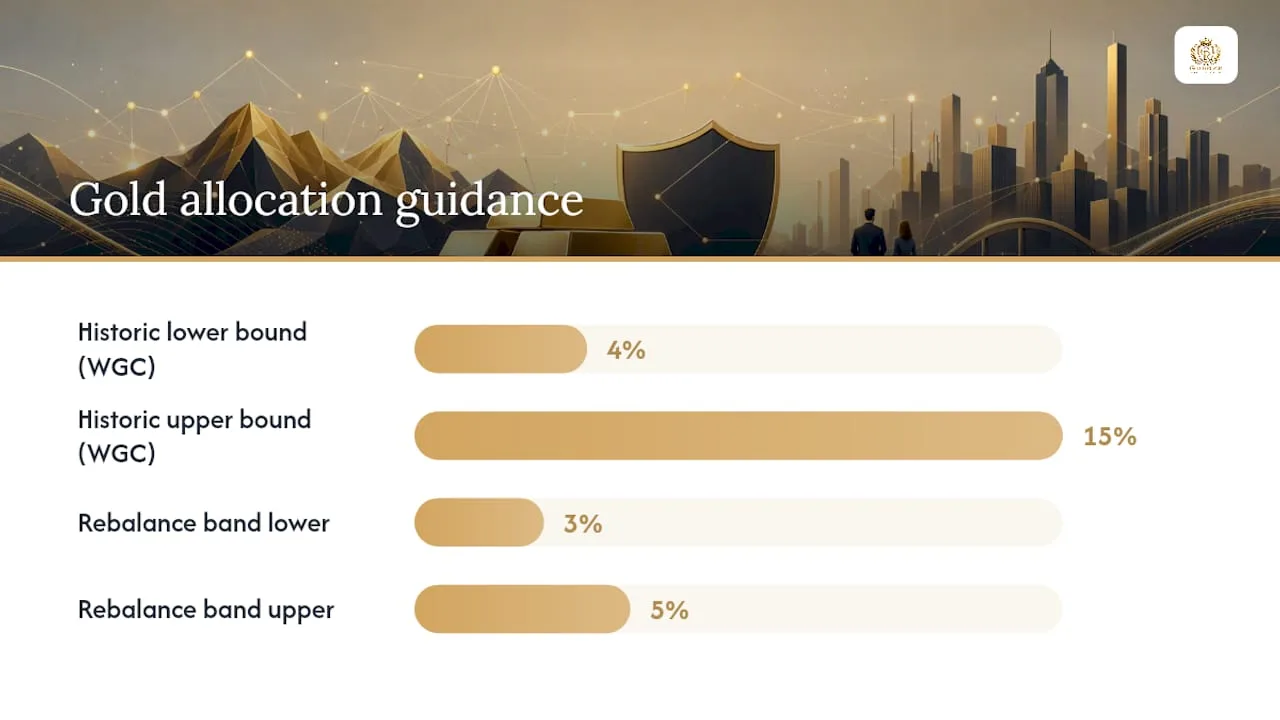
Funding the position matters as much as the size. Trimming equities to fund a gold purchase reduces your overall risk exposure, which is usually the point. Funding it from cash leaves your equity risk untouched, and funding it by cutting bonds can backfire if you’re removing one diversifier to add another that behaves differently.
Rebalancing rules prevent emotional decisions. Set a band, say, rebalance if gold drifts more than 3 to 5 percentage points from target, rather than reacting to headlines. This keeps you from buying gold after it’s already spiked in a panic or selling it right when it’s finally doing its job.
A defensive toolkit checklist worth building:
- A gold allocation sized to your actual risk tolerance, not a headline number
- Short-duration Treasuries or cash for liquidity needs
- A predetermined rebalancing band, written down before the next crisis, not during it
- Clarity on which asset you’d sell first if you needed cash in a downturn
Pro Tip: Write your rebalancing rule down now, while markets are calm. The whole point of a rule is that you follow it when panic makes following it hardest.
Buying, Storing, and Securing Physical Gold the Right Way
Once you’ve decided to add physical metal, execution details protect the value of what you’re buying. Skipping steps here is where investors lose money, not from gold’s price moving against them.
- Verify spot price and premium before you buy. Know the live spot price and what percentage premium you’re paying over it; premiums vary by product and by dealer.
- Request hallmark and assay documentation. Reputable products carry mint marks and purity stamps you can verify.
- Confirm transit insurance before shipment. Any dealer moving physical metal to you should carry insured, bonded courier arrangements for the full value of the shipment.
- Authenticate on delivery. Check weight, dimensions, and hallmarks against the product specification the moment the package arrives.
- Choose your storage path deliberately. Professional vaulting offers insurance and third-party verification; home storage gives immediate access but shifts all security and insurance responsibility to you.
For retirement accounts, a self-directed Precious Metals IRA has its own procedural path: you open the account with a qualified custodian, fund it through a rollover or transfer from an existing retirement account, select IRS-eligible metals, and the metal is held by an approved depository rather than in your home. These are general educational steps, not personalized tax or legal advice, so confirm your specific situation with a qualified advisor and the IRS’s own guidance before initiating a rollover.
Due-diligence red flags: pressure to decide same-day, prices far below or above published spot, no written storage or delivery terms, and reluctance to provide verifiable business registration.
Pro Tip: Before authenticating anything yourself, review a structured checklist for authenticating delivered gold so you know exactly what to check the moment a shipment arrives.
GoldRock Metal Exchange’s in-house IRA department walks investors through rollover paperwork and custody setup, and its insured private delivery process covers transit from purchase to your door or to a depository. If you want a guided path through any of this, Request a Free Precious Metals Consultation by calling (888) 859-0978.
What Happens Tax-Wise When You Sell Gold in a Downturn
Selling physical gold at a gain typically triggers capital gains treatment, and the IRS classifies most physical precious metals as collectibles, which can carry a different maximum tax rate than standard long-term capital gains on stocks. That distinction catches a lot of investors off guard when they sell gold that’s appreciated significantly during a crisis rally.
Gold held inside a self-directed IRA follows the tax rules of the account type itself, a traditional IRA defers taxes until distribution, while a Roth IRA can allow qualified withdrawals tax-free, rather than triggering a capital gains event at the point of sale. That’s one reason investors who want to actively trade gold around volatility often prefer holding it inside a retirement structure rather than in a personal account, though the tradeoff is reduced liquidity before retirement age.
Losses matter too. If you sell gold at a loss outside a retirement account, you may be able to use that loss to offset other capital gains, subject to the same general rules that apply to other capital assets. None of this is personalized guidance, tax treatment depends on your holding period, account type, state of residence, and overall tax situation, so confirm specifics with a qualified tax professional and the IRS’s own rollover and distribution guidance before making a sale decision during a volatile period.
Gold vs. Treasuries vs. Volatility Products: What Hedges Best?
Gold isn’t the only tool for managing equity risk, and it’s worth seeing how it stacks up against the alternatives investors reach for during a selloff.

Treasury bonds offer income and, historically, have moved inversely to stocks during growth-scare selloffs, the kind where investors expect the Federal Reserve to cut rates. But Treasuries can fail as a hedge during inflation-driven downturns, when rising rates hurt both bonds and stocks simultaneously, a pattern that showed up clearly in 2022. Gold’s response to that same scenario is different: it isn’t directly tied to a coupon payment, so it doesn’t suffer the same duration risk.
Volatility products, like VIX-linked futures or options, spike hard during acute equity panics and can deliver outsized short-term protection. Their problem is decay. Most volatility products lose value steadily during calm markets, making them expensive to hold as a standing hedge rather than a short-term tactical position.
Gold sits between these two: less directly tied to interest-rate mechanics than Treasuries, and far less prone to the constant value erosion of volatility products, but also less reliably reactive in acute panics than either. Fidelity International’s research on the changing role of gold as a safe haven argues gold works best as a complement to bonds within a broader defensive toolkit, not a replacement for them. That’s the more honest framing than treating any single asset as the answer.
How Investors Actually Used Gold During Past Crashes
The 2008 to 2011 stretch offers the clearest real-world case study of gold working as intended. Investors who held a modest gold allocation heading into the financial crisis, rather than adding after prices had already spiked, absorbed a temporary dip in late 2008 alongside their equities. Gold’s initial decline mirrored the broader liquidity crunch, everything got sold to raise cash.
What separated the investors who benefited from those who didn’t wasn’t timing the bottom. It was having a rebalancing rule already in place.
A second pattern shows up in March 2020. Investors who had gold allocations funded well before COVID hit watched the metal dip briefly during the initial panic, then rally hard over the following months as the Fed’s rate cuts pushed real yields sharply negative. The lesson from both episodes is the same: the allocation has to already exist and be sized appropriately before the crash starts. Investors scrambling to buy gold for the first time mid-panic tend to pay higher premiums, face longer delivery windows, and often buy near a short-term local peak.
When to Add, Hold, or Trim a Gold Hedge Around a Crash
Timing a gold hedge well doesn’t mean predicting the crash. It means having the position sized and funded before volatility hits, because scrambling to buy during a panic usually means worse pricing and slower delivery.
Before a downturn: this is when your gold allocation should already be at its target weight. Building the position during calm markets means you’re not competing with a surge of other buyers, and premiums tend to be more stable.
During a crash: resist the urge to dump gold if it dips alongside stocks in the first days of a liquidity-driven selloff, that early correlation spike is common and often temporary. This is also not the moment to chase gold higher if it’s already rallied sharply, buying into a spike is how investors end up paying the highest premiums of the cycle.
After the initial shock: as monetary policy responses take shape, typically rate cuts or liquidity injections, gold’s hedge properties tend to reassert themselves. This is often the window where a predetermined rebalancing rule earns its keep, letting you trim an outsized gold position that’s run well past target back toward your original allocation.
The consistent theme across 2008, 2011, and 2020 is that reactive buying underperforms proactive positioning. Investors who wait for a crash to start buying gold are, functionally, trying to time two things at once: the crash and the metal’s response to it.
The Real Risks of Using Gold as a Crash Hedge
Gold’s biggest risk isn’t a price collapse, it’s disappointing you exactly when you need it most. During forced-deleveraging events, when investors sell every liquid asset to meet margin calls or raise cash, gold can fall in lockstep with stocks for days or weeks, as the Markov-switching research on gold’s hedge properties notes explicitly. If you needed gold to hold steady during that exact window, you’d have been disappointed.
Rising real yields present a second, more sustained risk. Because gold pays no yield itself, periods when Treasury Inflation-Protected Securities and other real-rate benchmarks climb quickly tend to pressure gold lower, even amid geopolitical stress, as seen in the Morgan Stanley analysis of a recent conflict period. Dollar strength compounds this, since a rising dollar makes gold costlier for the rest of the world and typically dampens demand.
There’s also a behavioral risk that has nothing to do with gold’s fundamentals: overallocating out of fear. And physical gold carries carrying costs, storage, insurance, and the bid-ask spread on eventual resale, that a paper hedge doesn’t. None of these risks disqualify gold from a portfolio. They just mean it works as one piece of a broader plan, not a stand-alone insurance policy.
What the Data Actually Supports, and What Gets Oversold
The conventional pitch on gold treats it like a fire alarm: buy it, and it goes off exactly when you need protection. The Markov-switching research doesn’t support that story, it supports a quieter, more useful one. Gold reduces correlation with stocks over full market cycles, consistently. Its role as a crash-day spike asset is real but occasional, tied to specific conditions around real yields and the dollar rather than fear itself.
Where I think most retail guidance fails investors is timing advice. Articles love to tell you gold “protects” during crashes, then leave you to figure out when to buy it. The research actually points the other way: the allocation needs to exist before the crash, sized modestly, funded from equity risk you were already planning to reduce, with a rebalancing band written down while you’re calm.
If you take one thing from the evidence, it’s this: gold is a portfolio decision, not a panic decision. Investors who treat it that way, sizing it deliberately and rebalancing on a rule rather than a headline, get most of what gold has to offer. Investors who buy it mid-crisis usually pay the highest premium of the cycle for the least reliable version of the hedge.
Work With a Full-Service Precious Metals Dealer
Building a gold hedge that actually protects your portfolio takes more than clicking “buy” on a spot price. It takes verified pricing, insured delivery, and, if you’re moving retirement funds, a custodian process that follows IRS rules to the letter. GoldRock Metal Exchange runs all three under one roof: a full-service precious metals dealer with a dedicated in-house IRA department that handles rollovers and account setup directly, rather than routing you to a third party and hoping the paperwork lines up.

If you’re ready to see current pricing before you commit to a position, check live spot prices and premiums or browse available bullion and coins. If you’re weighing a rollover into a self-directed Precious Metals IRA, GoldRock’s team can walk you through custody rules and funding options step by step, backed by insured private delivery on every physical order.
Request a Free Precious Metals Consultation by calling (888) 859-0978, and get a straight answer on how a gold hedge would fit your specific portfolio.
Frequently Asked Questions
Does gold always go up when the stock market crashes?
No. Gold’s response depends on the type of crash. During liquidity-driven crashes, when investors sell everything to raise cash, gold can fall alongside stocks in the short term before recovering.
What percentage of my portfolio should be in gold to hedge a crash?
There’s no universal number that fits every investor.
Is physical gold better than a gold ETF for hedging?
It depends on your goal. Physical bullion eliminates counterparty risk but comes with storage and premium costs; ETFs offer easier liquidity but don’t give you direct possession of the metal. Neither is universally superior, they solve different problems.
Can I hold physical gold in my retirement account?
Yes, through a self-directed Precious Metals IRA, which follows specific IRS custody and eligible-metal rules. This requires a qualified custodian and an approved depository rather than home storage.
When is gold most likely to fail as a hedge?
Gold tends to underperform during forced-deleveraging events, when investors sell all liquid assets simultaneously, and during periods when real interest rates and the dollar both rise sharply.
This article provides general educational information about precious metals investing and is not personalized investment, tax, or legal advice. Consult a qualified financial, tax, or legal professional before making investment decisions.
This article is general information, not a substitute for advice from a qualified financial advisor. Consult a qualified financial professional about your own circumstances before acting on anything here.
Sources
- Is Gold a Sometime Safe Haven or an Always Hedge for Equity Investors? A Markov-Switching CAPM Approach for US and UK Stock Indices
- Is gold a hedge or a safe haven against stock markets? Evidence from conditional comoments
- How To Invest In Different Gold Assets | World Gold Council