

Silver is defined as a tangible, inflation-sensitive asset that preserves purchasing power by rising in value when the dollar weakens. The role of silver in inflation hedging is well documented, from the 1970s stagflation era through today’s green energy supply deficits. Unlike gold, silver carries a dual identity: part monetary store of value, part industrial commodity. That duality makes it a more complex hedge than most investors expect. Financial advisors commonly recommend 5–10% portfolio allocation to silver for balanced inflation protection, and understanding why that range exists requires looking at both the history and the mechanics behind silver’s price.
What is the role of silver in inflation hedging?
Silver acts as an inflation hedge by holding or increasing its real value when consumer prices rise. When the purchasing power of paper currency falls, tangible assets like silver tend to appreciate because they cannot be printed or devalued by central bank policy. This makes silver a natural counterweight to monetary inflation.

The strongest historical evidence comes from the 1970s. During that decade’s stagflation, silver prices rose over 1,500%, outperforming nearly every other asset class. That performance reflected both investor fear of currency debasement and a genuine shortage of physical supply. The lesson is clear: when inflation runs hot and confidence in fiat currency drops, silver benefits sharply.
Silver’s correlation with the Consumer Price Index is strong over long-term horizons but erratic in short periods. This means silver works best as a multi-year holding rather than a tactical trade. Investors who bought silver in 1971 and held through 1980 saw extraordinary gains. Investors who bought in 1980 and sold in 1985 did not.
“Silver is not a magic shield against inflation. Used as a long-term portfolio diversifier with regular rebalancing, it earns its place. Used as a short-term bet, it punishes impatience.”
The role of precious metals in crisis periods consistently shows silver performing best when held with a clear time horizon and realistic expectations about volatility.
How has silver performed historically during inflationary periods?
Silver’s track record across major economic disruptions is instructive, though not uniformly positive.
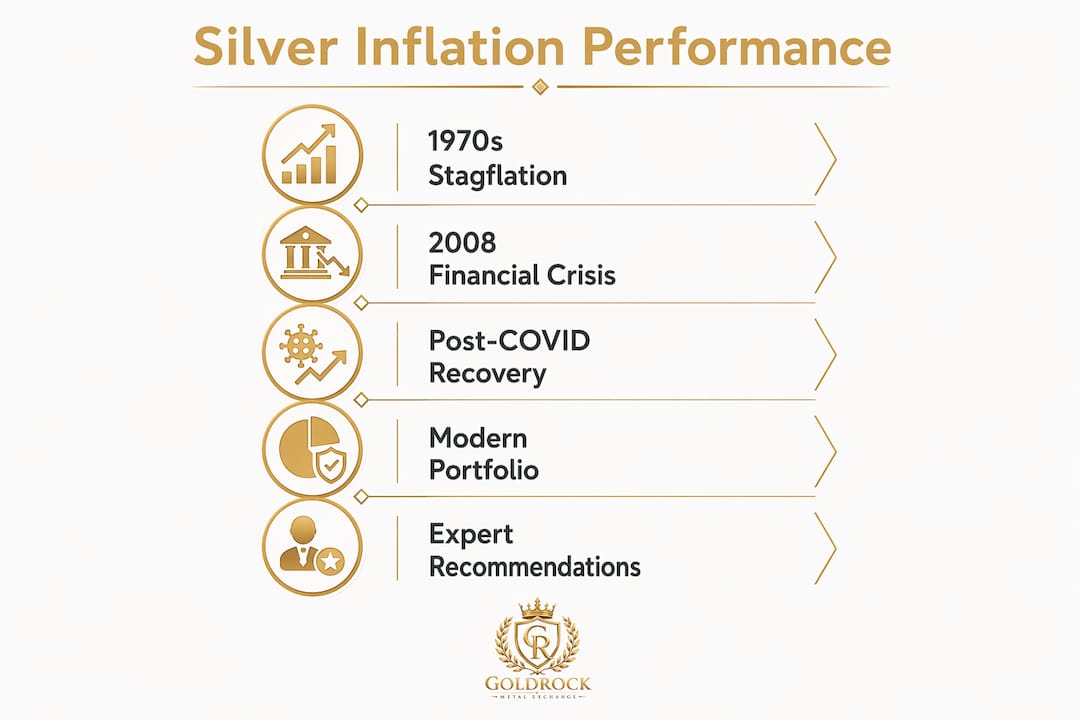
| Period | Inflation Driver | Silver’s Response |
|---|---|---|
| 1970s stagflation | Oil shocks, dollar debasement | Rose over 1,500% |
| 2008 financial crisis | Credit collapse, Fed stimulus | Dropped sharply, then recovered strongly by 2011 |
| 2020–2022 post-pandemic | Supply chain disruption, money printing | Surged from roughly $12 to above $29 per ounce |
| 2025–2026 | Clean energy demand, persistent inflation | Renewed investor and industrial demand |
The 2008 pattern is worth examining closely. Silver initially fell during the crisis because industrial demand collapsed. It then surged as the Federal Reserve’s quantitative easing program flooded markets with liquidity. That sequence illustrates silver’s dual sensitivity: it responds to both monetary policy and manufacturing output.
Post-pandemic, silver’s recovery was driven partly by the same monetary forces that lifted gold, and partly by surging demand from solar panel manufacturing and electronics. Renewed investor interest in silver in 2025–2026 reflects inflation fears, clean energy industrial demand, and central bank policies converging simultaneously. That combination is historically rare and potentially significant for silver’s price floor.
Why is silver different from gold as an inflation hedge?
Gold functions as a pure monetary hedge. Its price moves almost entirely on investor sentiment, central bank demand, and currency dynamics. Silver does all of that, but it also moves on factory output, solar panel installations, and semiconductor manufacturing.
Silver acts as both a monetary asset and an industrial commodity, making its price sensitive to manufacturing output as well as inflationary pressures. That sensitivity is a double-edged quality. During inflationary booms with strong industrial activity, silver can outperform gold significantly. During stagflation with weak manufacturing, silver’s industrial demand can drag its price down even as monetary inflation pushes it up.
Silver’s monetary premium is also evolving. Supply deficits in green technology sectors are increasingly setting silver’s price floor, shifting its role from a purely monetary asset to a scarcity-driven one. Solar panels alone consume a growing share of annual silver production, which means structural demand now underpins silver’s value in ways that did not exist 30 years ago.
| Feature | Gold | Silver |
|---|---|---|
| Primary price driver | Monetary sentiment | Monetary + industrial demand |
| Volatility | Lower | Higher |
| Industrial use | Minimal | Significant (solar, electronics) |
| Entry cost per ounce | High | Lower, more accessible |
| Recession behavior | Holds value well | Can fall with industrial slowdown |
Pro Tip: If you want a cleaner, lower-volatility inflation hedge, gold is the more predictable choice. If you want exposure to both monetary inflation and industrial growth cycles, silver offers that combination at a lower entry price per ounce.
What allocation of silver do financial experts recommend for inflation protection?
Silver works best as a secondary inflation hedge, not a primary one. Its volatility makes it unsuitable as the anchor of a defensive portfolio, but its upside during inflationary cycles makes it worth including.
Financial advisors recommend 5–10% of a diversified portfolio in silver to balance inflation protection against price swings. That range reflects a practical tradeoff: enough exposure to benefit from silver’s gains, not so much that a sharp price drop damages the overall portfolio.
Key considerations for building your silver allocation:
- Physical silver (coins, bars) gives you direct ownership with no counterparty risk, but requires storage and insurance costs.
- Silver ETFs offer liquidity and low storage costs, but you do not own the underlying metal directly.
- Mining shares amplify silver’s price moves in both directions, making them higher risk than physical holdings.
- Self-directed precious metals IRAs let you hold physical silver inside a tax-advantaged retirement account, which Goldrockmetalexchange specializes in through its dedicated IRA services.
Scheduled rebalancing is the most effective way to manage silver’s volatility. Reviewing your allocation quarterly and trimming positions after sharp rallies locks in gains and keeps your exposure within your target range.
Pro Tip: Match your silver vehicle to your time horizon. Physical silver suits long-term holders who want tangible assets. ETFs suit investors who want liquidity and flexibility without storage costs.
What are the risks and limitations of relying on silver for inflation protection?
Silver is a genuine inflation hedge over long periods, but it carries real risks that investors must understand before allocating capital.
-
High price volatility. Silver’s price swings are larger than gold’s due to industrial demand fluctuations. A 20–30% price drop in a single year is not unusual for silver, even during inflationary periods.
-
Recession sensitivity. Silver can fall during recessions even when inflation remains elevated, because declining industrial demand outweighs monetary factors. This is the opposite of what most inflation-hedge investors expect.
-
Rising interest rate risk. Higher interest rates increase the opportunity cost of holding non-yielding assets like silver. When the Federal Reserve raises rates aggressively, silver prices often face headwinds regardless of inflation levels.
-
Physical storage costs. Owning physical silver requires secure storage and insurance. These costs reduce your net return over time and must be factored into any performance calculation.
-
Timing risk. Silver’s industrial links and volatility require a clear time horizon. Investors who need to liquidate during a downturn may sell at a loss even if their long-term thesis is correct.
The mitigation strategy for all five risks is the same: diversify across multiple inflation hedge assets. Pairing silver with Treasury Inflation-Protected Securities (TIPS), gold, and broad commodity funds reduces your dependence on any single asset’s performance.
How can investors practically incorporate silver into their inflation-hedging strategy today?
The 2025–2026 market environment presents a specific set of conditions for silver investors. Persistent inflation, structural supply deficits in clean energy, and active central bank policy are all shaping silver’s demand profile simultaneously.
Practical steps for adding silver to your portfolio today:
- Start with a clear allocation target. Decide on your 5–10% range before buying. This prevents emotional over-allocation during price rallies.
- Pair silver with complementary assets. TIPS protect against CPI-linked inflation directly. Gold provides a lower-volatility monetary hedge. Silver adds industrial upside. Together, they cover more inflation scenarios than any single asset.
- Choose your vehicle based on your goals. Physical silver suits long-term wealth preservation. ETFs suit active portfolio managers. A self-directed IRA suits retirement-focused investors who want tax advantages.
- Use silver’s lower entry price as an advantage. Silver’s lower cost per ounce makes it accessible for investors who cannot yet afford significant gold exposure. You can build a meaningful position gradually without large upfront capital.
- Schedule portfolio reviews. Set a calendar reminder every quarter to check your precious metals allocation. Rebalance when silver’s share drifts significantly above or below your target range.
Goldrockmetalexchange offers education resources covering portfolio allocation, inflation hedging mechanics, and the practical differences between physical silver, ETFs, and IRA structures. Understanding these distinctions before you buy is the most effective way to avoid common mistakes.
Key takeaways
Silver’s most effective role in inflation hedging is as a long-term portfolio diversifier, not a short-term speculative trade, and its dual industrial and monetary nature requires disciplined allocation and regular rebalancing to work well.
| Point | Details |
|---|---|
| Long-term hedge, not short-term trade | Silver’s CPI correlation is strong over years, not months. Hold with a multi-year horizon. |
| Dual nature creates added volatility | Industrial demand can push silver down during recessions even when inflation is high. |
| 5–10% allocation is the expert consensus | This range balances inflation protection against silver’s price swings in a diversified portfolio. |
| Physical silver carries storage costs | Factor in insurance and storage fees when calculating net returns on physical holdings. |
| Pair silver with gold, TIPS, and commodities | Diversifying across inflation hedge assets reduces timing risk and smooths overall portfolio performance. |
Silver’s place in a modern portfolio: my honest assessment
I’ve watched silver frustrate investors who treated it like a simple inflation switch. They buy when inflation headlines spike, then sell when silver drops 25% in a correction. That pattern destroys the very protection they were seeking.
What I’ve found actually works is treating silver as a structural position, not a reactive one. The investors who benefited most from silver’s 1,500% run in the 1970s were not the ones who timed the entry perfectly. They were the ones who held through the volatility because they understood what they owned and why.
Silver’s industrial links are not a flaw. They are a feature for investors with a long enough horizon. The clean energy transition is creating structural supply deficits that did not exist in previous inflationary cycles. That changes silver’s price floor in ways that make the 5–10% allocation argument stronger today than it was a decade ago.
My caution is this: silver rewards patience and punishes impatience. If you need liquidity within two years, keep your silver allocation at the lower end of the recommended range. If you are building a 10-year inflation-resistant portfolio, silver deserves a meaningful seat at the table alongside gold and TIPS.
Get the education right before you get the allocation right. The mechanics of silver’s dual nature are not complicated, but they are counterintuitive enough that most investors misread the signals the first time.
— Blake
How Goldrockmetalexchange helps investors protect wealth with silver
Goldrockmetalexchange works with investors who want to hold physical silver and other precious metals as part of a long-term inflation protection strategy.

The company offers a full range of physical silver products with insured private delivery, so your assets arrive securely and are stored on your terms. For retirement-focused investors, Goldrockmetalexchange’s in-house IRA department simplifies the process of moving existing retirement funds into a self-directed precious metals IRA, giving you tax-advantaged exposure to silver and gold without the complexity of managing the transfer yourself. Every client receives personalized guidance, not a generic product pitch. If you are ready to add silver to your inflation-hedging strategy, Goldrockmetalexchange is a direct, trusted starting point.
FAQ
What is silver’s role in inflation hedging?
Silver acts as an inflation hedge by preserving purchasing power when currency values fall. Its price tends to rise during inflationary periods, though its industrial demand component adds volatility that gold does not carry.
Is silver a better inflation hedge than gold?
Gold is a more stable and predictable monetary hedge. Silver offers higher upside potential during inflationary growth cycles but carries greater price swings due to its industrial demand sensitivity.
How much silver should I hold in my portfolio?
Financial advisors recommend 5–10% of a diversified portfolio in silver. This range provides meaningful inflation protection without exposing the portfolio to excessive volatility from silver’s price swings.
Can silver lose value during inflation?
Yes. Silver can fall during recessions even when inflation is elevated, because declining industrial demand can outweigh monetary factors. This is why a long-term time horizon is critical for silver investors.
What is the best way to invest in silver for inflation protection?
Physical silver offers direct ownership with no counterparty risk. A self-directed precious metals IRA adds tax advantages for retirement investors. The right choice depends on your time horizon, liquidity needs, and risk tolerance.