

To buy physical silver safely in the U.S., pick a liquid product like a 1 oz American Silver Eagle or a 10 oz bar, order from a reputable dealer, pay by bank wire or check to skip the credit card surcharge, and have secure storage arranged before your package arrives. That’s the whole silver buying process explained in one sentence. Everything below fills in the details that make the difference between a smooth first purchase and an expensive lesson.
Your first-purchase checklist:
- Set a budget — decide your dollar amount before you browse; premiums look smaller when you know your ceiling
- Pick a product — 1 oz government coins for liquidity, 10 oz bars for lower cost per ounce
- Vet your dealer — check BBB rating, published buyback policy, and insured shipping terms
- Choose your payment method — wire or check to avoid the 3–4% card surcharge
- Confirm shipping and insurance — verify transit coverage and free-shipping threshold before checkout
- Arrange storage — home safe, bank safe deposit box, or third-party vault, decided before delivery
Experts consistently recommend starting with recognized government coins or simple bars for resale ease, even when premiums run higher than generic alternatives.
Table of Contents
- What types of physical silver should you buy?
- Where can you actually buy silver in the U.S.?
- How does silver pricing actually work?
- How do you choose a reputable silver dealer?
- How much silver should you buy as a first-time buyer?
- What payment method should you use when buying silver?
- How do you verify silver authenticity after delivery?
- Where should you store physical silver and how do you insure it?
- What are the tax rules when you sell physical silver?
- What mistakes do first-time silver buyers most often make?
- Step-by-step: the complete silver buying process from start to storage
- How GoldRock Metal Exchange supports buyers at every stage
- Key Takeaways
- The part of the silver buying process most guides skip
- GoldRock Metal Exchange makes the first purchase straightforward
- Useful sources and further reading
What types of physical silver should you buy?
Physical silver comes in three formats: coins, rounds, and bars. Each one trades differently, stores differently, and sells differently. Choosing the right format upfront saves you from a frustrating resale experience later.
Government-minted coins
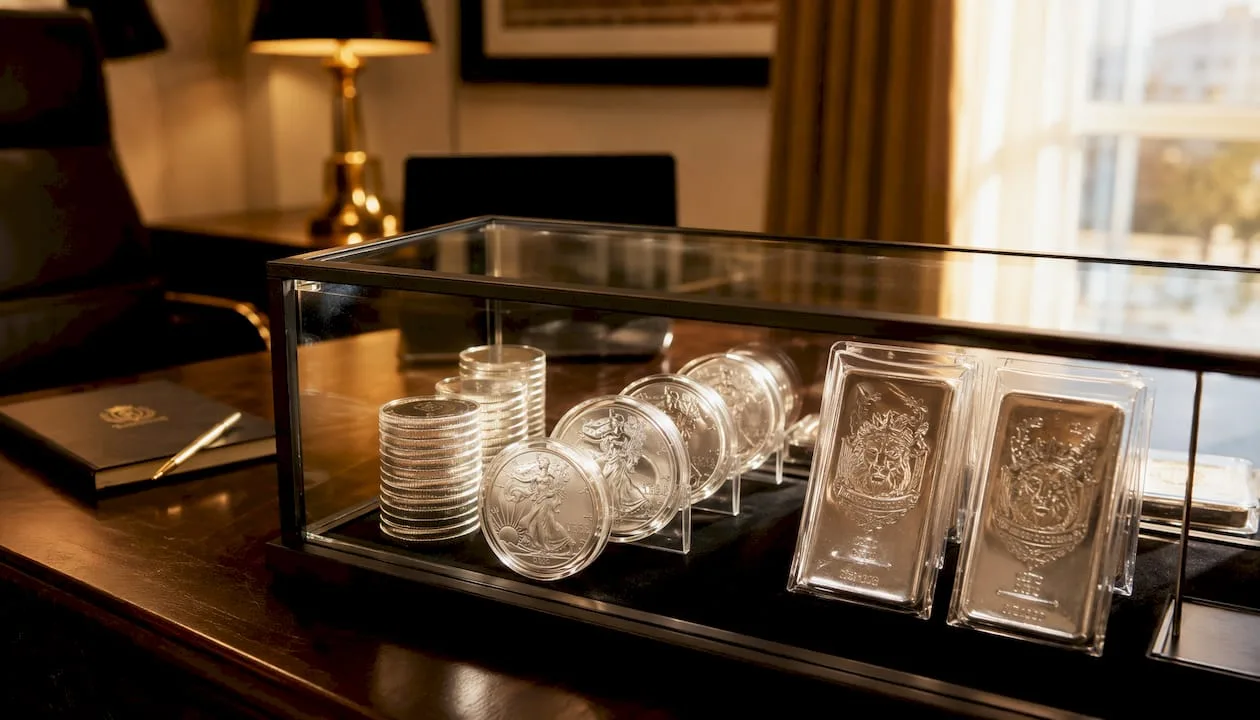
The American Silver Eagle, produced by the U.S. Mint, is the most recognized silver coin in the U.S. market. Every dealer knows it, every buyer recognizes it, and it sells quickly at fair prices. The Canadian Maple Leaf occupies a similar position internationally. That sovereign backing is worth something real: when you need to sell fast, a coin a dealer can identify in two seconds commands a tighter spread than something obscure.
The trade-off is premium. Government coins typically carry a premium over spot depending on demand, which is materially higher than rounds or bars. You’re paying for liquidity, and for most first-time buyers, that’s money well spent.
Private-mint rounds
Rounds look like coins but carry no face value and no government backing. A private mint stamps them to 0.999 fine silver, and they typically trade at a low premium over spot, the lowest premium tier. The catch: resale spreads are wider. Dealers buy them back at a steeper discount because they have to verify them more carefully and find buyers who aren’t expecting a sovereign coin.
Rounds work well once you understand the market. For a first purchase, they’re a reasonable choice if cost per ounce matters more to you than instant liquidity.
Silver bars
Bars come in 10 oz, 100 oz, and 1,000 oz sizes. The 10 oz bar is the sweet spot for most individual buyers: low enough in price to be accessible, high enough in weight to bring the per-ounce premium down to a moderate level above spot. A 100 oz bar drops the premium further but costs several thousand dollars and is harder to sell in pieces.

The resale reality with bars: a 10 oz bar from a recognized refiner (PAMP Suisse, Sunshine Minting, Engelhard) sells more easily than a generic poured bar with no serial number. Stick to named refiners.
Comparison: coins vs. rounds vs. bars
| Format | Typical premium over spot | Liquidity | Best for |
|---|---|---|---|
| American Silver Eagle (1 oz) | 7–15% over spot | Highest | First buyers, easy resale |
| Private-mint round (1 oz) | 3–5% over spot | Moderate | Cost-conscious buyers |
| Silver bar (10 oz) | 4–7% over spot | Good | Building a position |
| Silver bar (100 oz+) | Lower premium per unit (closer to spot) | Lower per unit | Larger, experienced buyers |
Pro Tip: Mix formats once you’re past your first purchase. Hold a core of American Silver Eagles for liquidity and fill the rest of your stack with 10 oz bars from named refiners to keep your average cost per ounce lower.
Where can you actually buy silver in the U.S.?
You have more options than most beginners realize, and each channel has a different cost structure, experience, and risk profile.
- Online bullion dealers post live premiums tied to the spot price, ship insured in discreet unmarked packaging, and often offer free shipping above a set threshold (commonly $199). Price transparency is generally better online than at local shops, which helps you learn what fair premiums look like quickly.
- Local coin shops let you inspect metal before you buy, which is genuinely valuable for a first purchase. Premiums tend to run higher, but you can negotiate on larger quantities, and you walk out with your silver the same day.
- Broker networks connect buyers to wholesale dealer networks. This route is less common for retail buyers and typically makes more sense for larger institutional-style purchases.
- Silver ETFs (exchange-traded funds) track the silver price and trade like stocks through any brokerage account. You get price exposure without storage costs or premiums, but you don’t own physical metal. For investors who want silver in a retirement account without the complexity of a self-directed IRA, an ETF is the simpler path.
- Self-directed precious metals IRAs let you hold IRS-approved physical silver inside a tax-advantaged retirement account. The structure requires a qualified custodian, an approved depository for storage, and additional paperwork, but it adds real tax advantages for long-term holdings. GoldRock Metal Exchange’s dedicated IRA department handles the custodian coordination and transfer paperwork, which is where most buyers get stuck.
For a first physical purchase, a reputable online dealer or a direct consultation with GoldRock Metal Exchange gives you documented pricing, insured shipping, and a clear paper trail from order to delivery.
How does silver pricing actually work?
Spot price is the baseline: the current market price for one troy ounce of silver traded on commodity exchanges. Retail buyers never pay spot. Every purchase adds a premium on top.
What makes up the premium
The premium covers fabrication and minting costs, the dealer’s operating margin, insurance during transit, and market demand for that specific product. When silver demand spikes, premiums on popular coins like the American Silver Eagle can jump well above their typical range. When demand softens, premiums compress.
Sample cost calculation
Assume spot silver is at $30.00 per troy ounce.
| Item | 1 oz American Silver Eagle | 10 oz silver bar |
|---|---|---|
| Spot price | $30.00 | $300.00 |
| Premium (7–15% coin / 4–7% bar) | $2.10–$4.50 | $12–$21 |
| Subtotal | $32.10–$34.50 | $312–$321 |
| Shipping (if below free threshold) | more than $8 | — |
| Total cost | $40.10–$42.50 (with shipping) | $320–$329 |
That shipping charge on a single coin adds more than $8 to your effective premium. Hitting a dealer’s free-shipping threshold by consolidating your order is one of the fastest ways to reduce your per-ounce cost.
Buyback spreads
When you sell, dealers buy back at a discount to spot. Typical dealer buyback ranges run 2–8% below spot depending on product type and market conditions. Sovereign coins like the American Silver Eagle tend to reclaim their premiums better than generic rounds, which is another reason to hold at least some recognizable product.
To track live spot prices before placing any order, GoldRock Metal Exchange publishes a live prices page you can use to compare dealer quotes in real time.
How do you choose a reputable silver dealer?
A dealer’s reputation is the single most important variable in your buying experience. Price differences between reputable dealers are usually small. The difference between a reputable dealer and a bad one can cost you your entire purchase.
Dealer checklist before you place an order:
- Published premiums and live pricing — the dealer’s website should show current buy and sell prices tied to spot, not vague “call for pricing” language
- BBB rating and industry association membership — check the Better Business Bureau and look for membership in recognized industry groups
- Clear buyback policy — a reputable dealer publishes what they’ll pay for your silver before you buy; if you can’t find it, that’s a problem
- Physical address and phone support — a real business has a real address and a phone number you can call; test it before you wire money
- Insured shipping with tracking — standard practice is discreet, unmarked packaging with full transit insurance; confirm this before checkout
- Written return and refund policy — know the window and conditions before you commit
Red flags to walk away from:
- Pricing that seems too far below market (it usually means counterfeit or misrepresented product)
- Pressure tactics or artificial urgency (“prices go up in 2 hours”)
- No verifiable physical address or only a P.O. box
- No published buyback prices
- Requests for payment via wire to an unverified account without a phone confirmation
Before wiring money to any dealer, call the published phone number and verbally confirm the wire instructions. Wire fraud in precious metals is real, and a two-minute phone call is the most effective protection you have.
How much silver should you buy as a first-time buyer?
There’s no universal right answer, but there are sensible starting points based on what each budget actually buys.
-
$100–$300 (starter position): Buys 3–9 oz of silver depending on spot price and premiums. At this level, shipping costs and card surcharges hit hardest relative to your purchase. Consider buying a single 10 oz bar to hit a free-shipping threshold rather than multiple small coins. The goal here is learning the process, not building a significant position.
-
$400–$800 (meaningful first stack): This range lets you buy 5–10 oz of American Silver Eagles or a 10 oz bar plus a few coins. You’ll likely clear most dealers’ free-shipping thresholds, and the per-ounce cost becomes more competitive. This is where most first-time buyers land.
-
$1,000+ (portfolio building): At this level, you can mix formats strategically: a 10 oz bar for cost efficiency and several 1 oz Eagles for liquidity. You’re also in the range where a self-directed IRA starts making sense if this is retirement money. GoldRock Metal Exchange’s silver investment guidance covers how younger investors are sizing their initial positions.
Buying consistently over time beats trying to time the spot market. Regular purchasing smooths out your average cost and removes the psychological pressure of trying to call a bottom. Pick a cadence you can sustain, whether monthly or quarterly, and stick to it.
What payment method should you use when buying silver?
Payment choice affects both your total cost and how quickly your order ships. Most dealers accept bank wire, personal check, money order, and credit or debit card. Each comes with different trade-offs.
- Bank wire: Typically the cheapest option for larger orders. Your bank may charge a wire fee ($15–$30 is common), but on a $500+ purchase that’s almost always less than a credit card surcharge. Dealers usually ship within one business day of wire confirmation.
- Personal check or money order: No surcharge from the dealer, but clearance takes 5–7 business days at most dealers before they ship. Good for buyers who aren’t in a hurry and want to avoid wire fees entirely.
- Credit or debit card: Convenient for small purchases, but dealers typically add a 3–4% surcharge. On an $800 order, that surcharge runs $24–$32, which can exceed your bank wire fee by a factor of two or more. Most dealers post a lower “wire/check price” and a higher “card price” side by side.
- Cash (in-person only): Works at local coin shops. No fees, immediate transaction, but no paper trail and no recourse if something goes wrong.
Security tip: Before wiring funds, call the dealer’s published phone number and read back the wire routing and account numbers you were given. Fraudsters intercept email confirmations and substitute their own banking details. A phone call to a number you found independently, not one in the email, is the only reliable check.
How do you verify silver authenticity after delivery?
Packages arrive discreet and unmarked. Before you sign off on delivery or open anything, check the outer packaging for damage and photograph it. Then work through these checks systematically.
- Weight check: A 1 oz silver coin should weigh exactly one troy ounce (31.1 grams). Use a digital scale accurate to 0.1 grams. Any meaningful deviation is a red flag.
- Dimensional check: Known coins and bars have published dimensions. A genuine American Silver Eagle is 40.6 mm in diameter and 2.98 mm thick. Measure with digital calipers.
- Magnet test: Silver is not magnetic. A strong rare-earth magnet should slide slowly down a tilted silver surface (due to eddy currents), not stick. If it sticks, the piece is not solid silver.
- Hallmark and serial number check: Bars from reputable refiners carry stamped purity markings (e.g., “.999 Fine Silver”), a weight, and often a serial number. Cross-reference the serial with the assay certificate if one was included.
- Visual inspection: Look for consistent die strikes on coins, clean edges, and no obvious casting seams on bars. Counterfeits often show rough surfaces or inconsistent lettering.
For authenticity verification on higher-value bars, third-party assay services and professional grading (PCGS, NGC for coins) are available. If anything looks wrong, photograph it immediately and contact the dealer within their stated return window. Don’t wait.
GoldRock Metal Exchange’s delivery guide covers what to expect from insured transit and how to handle any discrepancies on arrival.
Where should you store physical silver and how do you insure it?
Storage is the decision most first-time buyers put off until after delivery. That’s backwards. Know where your silver is going before it ships.
Three main storage options
Home safe: Immediate access, no ongoing fees, and complete privacy. The upfront cost of a quality bolted safe runs several hundred dollars. The insurance gap is the real issue: standard homeowner policies typically cap precious metals coverage at $1,000–$2,500. You’ll need a scheduled personal property rider to cover your actual stack value.
Bank safe deposit box: More physically secure than most home setups, and relatively inexpensive (often $50–$150 per year). The limitations are real though: no access outside banking hours, no FDIC insurance on the contents, and the bank itself is not liable if the box is broken into. You still need a separate insurance policy.
Third-party vault: Professional precious metals depositories offer insured custody, regular audits, and segregated storage. Fees typically run a fraction of a percent of the stored value annually. This is the standard storage solution for IRA-held silver, and it’s worth considering for any stack above a few thousand dollars.
| Storage option | Typical cost | Accessibility | Insurance included | Best for |
|---|---|---|---|---|
| Home safe | One-time purchase | 24/7 | No (rider needed) | Small stacks, frequent access |
| Bank safe deposit box | $50–$150/year | Banking hours only | No (separate policy needed) | Medium stacks, low access needs |
| Third-party vault | a fraction of a percent of value per year | Business days | Yes (typically) | Large stacks, IRA holdings |
Insurance checklist:
- Check your homeowner or renter policy for precious metals sublimits
- Ask your insurer about a scheduled personal property rider for bullion
- Confirm that third-party vault fees include transit insurance for deposits and withdrawals
- Keep a photographic inventory with weights and serial numbers stored separately from the metal
For a detailed comparison of storage options, GoldRock Metal Exchange covers home, bank, and vault solutions with cost breakdowns.
What are the tax rules when you sell physical silver?
The IRS classifies physical silver as a collectible. Long-term capital gains on collectibles are taxed at a maximum federal rate of 28%, compared to the 20% maximum that applies to most other long-term capital assets. Short-term gains (held under one year) are taxed as ordinary income at your marginal rate. Consult a tax advisor for your specific situation, since state taxes and individual circumstances vary.
Practical selling steps:
- Compare buyback offers: Get quotes from at least two dealers before selling. Online dealers often post live buyback prices; local shops may negotiate.
- Understand the spread by product: Sovereign coins like the American Silver Eagle typically command better buyback prices than generic rounds or obscure bars.
- Know the reporting thresholds: Dealers are required to file a 1099-B for certain transactions. The specific thresholds depend on product type and quantity. Keep your purchase receipts, assay certificates, and serial numbers so you can document your cost basis accurately.
- Private sales: Selling to a private buyer avoids dealer spreads but requires you to handle your own reporting and accept more counterparty risk.
Documents to keep permanently:
- Original purchase receipts with date, price, and product description
- Assay certificates and serial numbers for bars
- Photographs of each piece taken at delivery
- Any correspondence with the dealer about the transaction
This article is general information, not tax or financial advice. Confirm current IRS rules and your own tax situation with a qualified professional.
What mistakes do first-time silver buyers most often make?
Most costly errors in the silver buying process come from moving too fast or not reading the fine print.
- Buying jewelry as an investment: Sterling silver jewelry is 92.5% pure and carries enormous fabrication markups. It does not trade like bullion and has no place in a silver investment strategy.
- Paying numismatic premiums without understanding them: Rare or graded coins carry premiums based on collector value, not silver content. Unless you understand coin grading, stick to bullion.
- Ignoring shipping costs on small orders: A $25 shipping fee on a $100 order adds 25% to your effective cost. Consolidate orders to hit free-shipping thresholds.
- Using a credit card on large purchases: The 3–4% surcharge compounds with premiums and shipping to make your cost per ounce significantly higher than the listed price.
- Skipping storage planning: Buying silver and then figuring out storage is how metal ends up in a sock drawer. Decide before you order.
- Choosing a dealer based on price alone: The cheapest listed price often comes with hidden fees, slow shipping, or no buyback policy. Reputation and documented processes matter more than saving $2 per ounce.
- Not keeping records: Without purchase receipts and serial numbers, you can’t prove your cost basis when you sell, which creates tax headaches and makes authentication disputes harder to resolve.
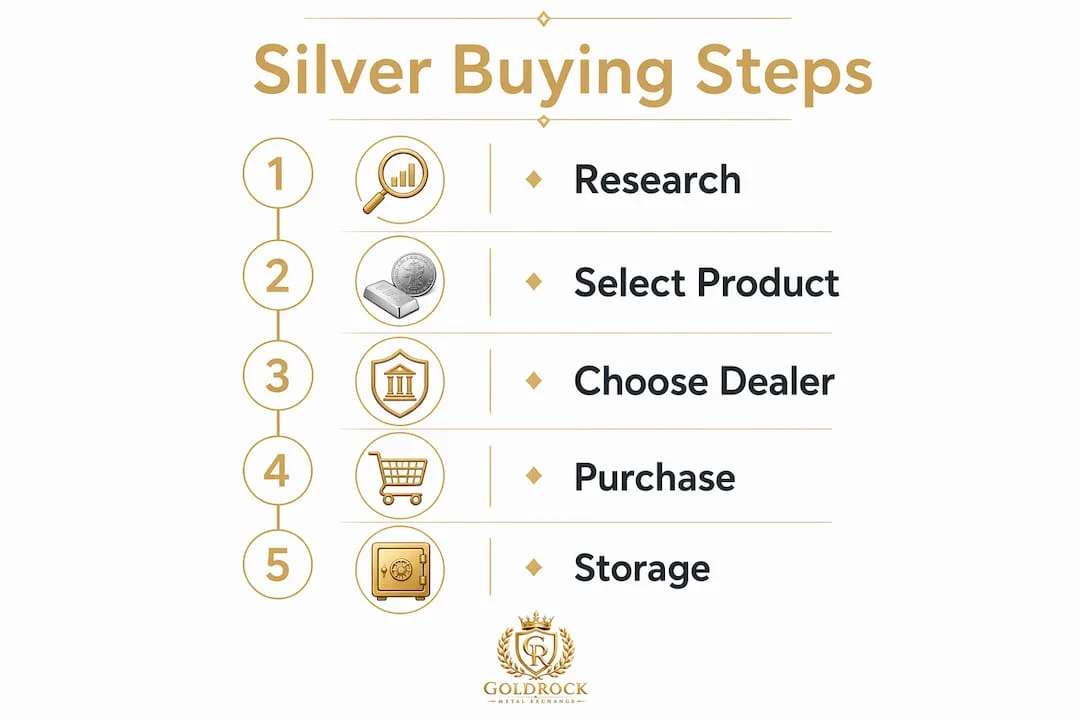
Step-by-step: the complete silver buying process from start to storage
Here’s the full sequence, in order, with realistic timing for each step.
- Set your budget (Day 1): Decide your dollar amount before you look at products. Factor in premiums, shipping, and payment method costs.
- Choose your product (Day 1): 1 oz American Silver Eagles for liquidity, a 10 oz bar for cost efficiency, or a mix of both if your budget allows.
- Compare dealers (Day 1–2): Check BBB ratings, read customer reviews, confirm published buyback policies and insured shipping terms. Get quotes from at least two sources.
- Choose your payment method (Day 2): Wire or check for orders over $300 to avoid card surcharges. Confirm wire instructions by phone before transferring funds.
- Place your order (Day 2): Screenshot your order confirmation, the listed price, and the dealer’s shipping and return policy at the time of purchase.
- Wait for payment clearing (Day 2–9): Wire transfers typically clear in 1 business day; personal checks take 5–7 business days. Orders ship after clearing.
- Track your shipment (Day 3–12): Packages ship discreet and insured. Track the shipment and be available for delivery if a signature is required.
- Verify on delivery (Delivery day): Photograph packaging before opening. Weigh, measure, and inspect each piece. Compare against your order invoice.
- Store and insure (Delivery day): Move silver to your pre-arranged storage immediately. Confirm insurance coverage is in place.
- Document your purchase (Delivery day): Log weights, serial numbers, and purchase price. Store digital copies of receipts and photos separately from the metal.
What to record and where to keep it:
- Digital copies of receipts and order confirmations: encrypted cloud storage or a password-protected folder
- Serial numbers and weight logs: a simple spreadsheet works
- Physical copies: a fireproof document safe, separate from the metal itself
How GoldRock Metal Exchange supports buyers at every stage
GoldRock Metal Exchange is a full-service precious metals dealer built around personal guidance, not just a product catalog. The practical difference shows up at the stages where most buyers get stuck.
- Product selection: GoldRock carries American Silver Eagles, silver bars, and rounds, with live pricing tied to spot. Buyers can compare formats and premiums without navigating multiple dealer sites.
- Secure checkout and payment: Transparent pricing with clear payment options. Wire and check pricing is posted separately from card pricing so you see your actual cost before committing.
- Insured private delivery: Every shipment goes out insured and in discreet, unmarked packaging. Transit coverage is documented, not assumed.
- Storage guidance: GoldRock’s team can walk you through home, bank, and third-party vault options based on your stack size and access needs.
- IRA transfers: The in-house IRA department handles custodian coordination, account transfers, and the paperwork that typically stalls buyers trying to move retirement funds into physical silver. The self-directed IRA process is managed end to end.
- Ongoing consultation: Buyers aren’t handed off after the first purchase. GoldRock offers continued guidance on building a position, managing storage, and planning eventual liquidation.
To get started, review GoldRock’s current product offerings and verify live premiums before placing your first order.
Key Takeaways
Buying physical silver safely comes down to three decisions made in the right order: choose a liquid product, verify your dealer, and lock down storage before your package ships.
| Point | Details |
|---|---|
| Start with liquid products | American Silver Eagles and 10 oz bars from named refiners offer the best balance of cost and resale ease. |
| Avoid card surcharges on larger orders | Credit card fees of 3–4% add up fast; bank wire or check is cheaper on any purchase over $300. |
| Verify dealer reputation before ordering | Check BBB ratings, published buyback policies, and insured shipping terms before you send payment. |
| Plan storage before delivery | Decide between home safe, bank safe deposit box, or third-party vault before your silver ships, not after. |
| GoldRock Metal Exchange | Offers full-service buying support, insured private delivery, and an in-house IRA department for retirement account transfers. |
The part of the silver buying process most guides skip
Most silver buying guides spend their energy on premiums and spot prices. Those matter, but they’re not where first-time buyers actually go wrong.
The real friction points are sequencing and documentation. Buyers who get into trouble almost always did one of two things: they bought before they had a storage plan, or they didn’t keep records. The first creates a scramble on delivery day. The second creates a tax problem years later when they try to sell and can’t prove what they paid.
The other thing worth saying plainly: liquidity is worth paying for on your first purchase. A 1 oz American Silver Eagle costs more per ounce than a generic round, and that premium feels like a waste when you’re staring at a spreadsheet. But when you need to sell quickly, or when you’re trying to get a fair quote from a dealer you’ve never used before, that recognizable coin sells itself. The generic round requires explanation.
Keep the first purchase simple. One product type, one reputable dealer, one storage solution. You can optimize later once you understand how the market actually moves and what your own priorities are. The buyers who overcomplicate their first order are usually the ones who end up with a mix of formats they don’t fully understand and storage they haven’t thought through.
GoldRock Metal Exchange makes the first purchase straightforward
Physical silver ownership gives you a tangible asset outside the financial system, and the buying process doesn’t have to be complicated. GoldRock Metal Exchange handles the parts that trip up most first-time buyers: product selection with live spot-linked pricing, insured private delivery in discreet packaging, and a dedicated IRA team for buyers moving retirement funds into physical silver.

Whether you’re buying your first 1 oz American Silver Eagle or transferring an existing retirement account into a self-directed precious metals IRA, GoldRock’s team provides personalized guidance through every step. Browse current silver products and live premiums at GoldRock’s product catalog and reach out directly to speak with a specialist before you place your first order.
Useful sources and further reading
- U.S. Mint Authorized Purchasers: The official list of authorized American Silver Eagle dealers; a reliable starting point for verifying dealer legitimacy.
- GoldRock Metal Exchange Live Prices: Real-time spot-linked pricing for silver products; use this to benchmark dealer quotes before ordering.
- GoldRock Precious Metals IRA: Detailed explanation of how self-directed IRA transfers work and what GoldRock’s in-house IRA department handles.
- GoldRock Storage Options Guide: Covers home, bank, and third-party vault storage with cost and accessibility comparisons.
- How to Buy Physical Silver (Bullion News): Covers dealer selection, authenticity checks, and buyback spread expectations in practical terms.
- Silver for Beginners (Minted Metal): Explains payment method cost differences and the case for buying consistently over time.
- Heirloom Jewelry Appraisal Process: Useful context on professional appraisal workflows for buyers considering estate silver or jewelry alongside bullion.