

Gold is defined as a strategic diversification asset in retirement planning, valued for its ability to protect purchasing power, reduce portfolio volatility, and preserve wealth when stocks and bonds fall together. The role of gold in a retirement portfolio goes beyond speculation. Financial experts recommend a 5% to 10% allocation for retirees seeking meaningful diversification without sacrificing income stability. Gold’s low correlation to equities and its track record as a safe-haven asset during geopolitical crises make it a serious tool for retirement security, not just a hedge for pessimists.
What percentage of a retirement portfolio should go to gold?
Financial experts commonly recommend keeping gold between 5% and 10% of your total retirement portfolio. That range gives you real diversification benefits without tying up so much capital that income generation suffers.
The math is straightforward. A $500,000 retirement portfolio would hold $25,000 to $50,000 in gold or gold-related assets. That level of exposure is enough to cushion a sharp equity sell-off without creating a liquidity problem during retirement withdrawals.

Some planners apply a modified inverse-age rule: subtract your age from 100 to get your equity allocation, then carve 10% of that equity slice into gold. A 65-year-old with 35% in equities might hold 3.5% in gold under this model. That approach keeps gold exposure proportional to overall risk tolerance as you age.
Your income needs set the ceiling. If you rely heavily on portfolio withdrawals to cover living expenses, gold above 10% creates a drag because gold produces no yield. Retirees with pension income or Social Security covering most expenses can afford to push closer to 10%.
| Portfolio size | 5% gold allocation | 10% gold allocation |
|---|---|---|
| $250,000 | $12,500 | $25,000 |
| $500,000 | $25,000 | $50,000 |
| $750,000 | $37,500 | $75,000 |
| $1,000,000 | $50,000 | $100,000 |
- Keep gold below 10% if withdrawals fund most of your monthly expenses.
- Increase toward 10% if you have guaranteed income from pensions or Social Security.
- Review your allocation annually, not just when gold prices move.
- Factor in storage and management costs when calculating your net exposure.
Pro Tip: If you are unsure where to start, anchor to 5% and adjust upward only after you have confirmed your liquidity cushion covers at least one year of expenses.
How does gold hedge against inflation and market volatility?
Gold’s protective power comes from two distinct mechanisms: its response to inflation and its behavior during market stress. Understanding both helps you set realistic expectations.
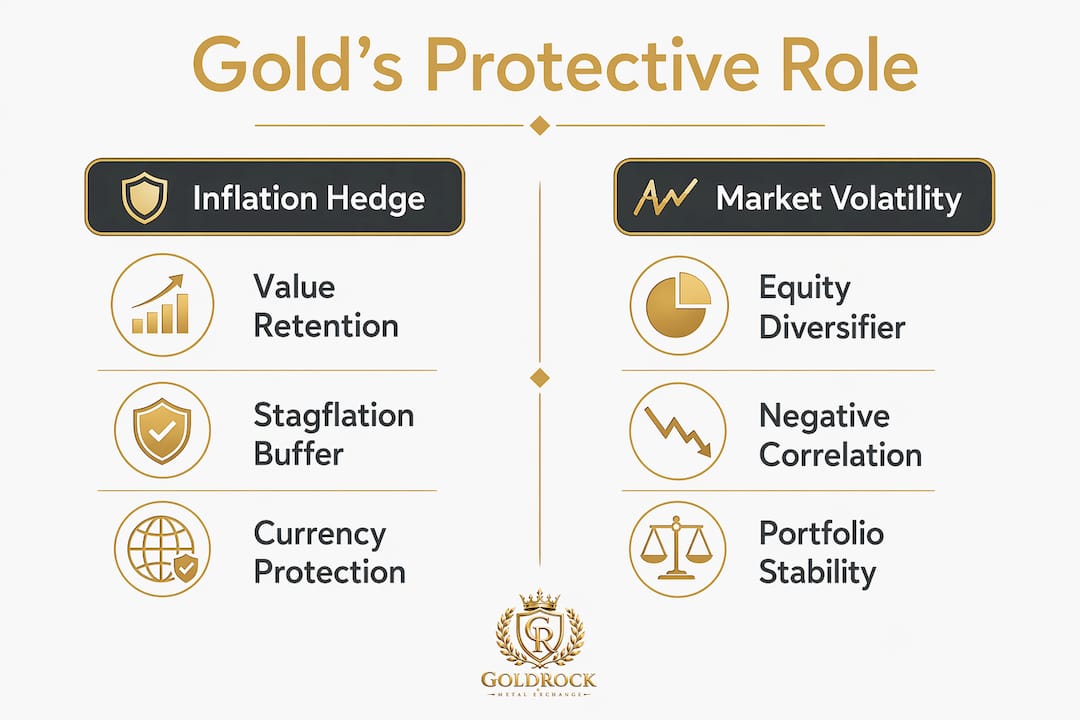
Gold has risen an average of 4% in the month following major geopolitical risk events since 1990, across 12 analyzed crises. That consistent response confirms gold’s reputation as a crisis asset, not just a long-term store of value.
Gold’s performance is most compelling during stagflation, as seen in the 1970s, but less consistent across other inflationary environments. That distinction matters. Gold is not a guaranteed inflation shield in every cycle. It works best when inflation combines with weak economic growth and falling real interest rates.
Gold’s near-zero correlation to the S&P 500 (approximately 0.00) and its 0.09 correlation to the Bloomberg US Aggregate Bond Index since the 1970s means gold moves independently of your other major holdings. That independence is the core of its diversification value.
Gold also carries an inverse relationship to the U.S. dollar, which provides a natural buffer against currency depreciation. When the dollar weakens, gold priced in dollars typically rises, protecting your real purchasing power.
| Asset | Behavior during equity sell-off | Inflation hedge | Yield |
|---|---|---|---|
| Gold | Often rises or holds | Strong in stagflation | None |
| U.S. Treasury bonds | Often rises | Weak in high inflation | Yes |
| Equities | Falls | Partial, long-term | Yes (dividends) |
| Cash | Stable | Negative (loses real value) | Minimal |
Gold is not a bond substitute. Gold’s realized volatility has been roughly twice that of U.S. government bonds over the last decade. Bonds provide predictable income and lower price swings. Gold provides crisis protection and currency defense. They serve different functions in a retirement portfolio, and treating them as interchangeable is a costly mistake.
Timing also matters more in retirement than in accumulation. Gold allocations reduce the likelihood of portfolio impairment by acting as a shock absorber during equity downturns. A sharp loss early in retirement, when you are drawing down assets, does permanent damage that later gains cannot fully repair. Gold’s role as a crisis safe-haven is most valuable precisely at that moment.
What investment methods exist for owning gold in retirement portfolios?
The method you choose to own gold shapes your allocation size, your costs, and your tax treatment. Each approach carries a different risk and benefit profile.
Physical gold eliminates counterparty risk entirely. Coins and bars carry no issuer default risk, no fund manager risk, and no brokerage dependency. Physical gold also offers privacy advantages and cross-border mobility that paper assets cannot match. The tradeoff is storage cost and the need for secure custody. Goldrockmetalexchange offers insured private delivery and guidance on safe physical gold storage for retirees who want tangible assets without logistical headaches.
The global gold market trades more than $362 billion daily, roughly $91 trillion annually. That liquidity means gold ETFs and mutual funds can be bought and sold instantly through any brokerage account. For retirees who need flexibility, paper gold products offer tactical convenience that physical bars cannot match.
- Physical gold coins and bars. Best for counterparty risk elimination, estate planning, and long-term wealth preservation. Requires secure storage and insurance.
- Gold ETFs. Best for liquidity and low transaction costs. Traded like stocks, with no storage burden. Suitable for taxable and IRA accounts.
- Gold mutual funds. Actively managed exposure to gold and gold mining companies. Higher fees than ETFs but may outperform in specific market cycles.
- Gold mining stocks. Amplified exposure to gold price movements. Higher volatility than physical gold or ETFs. Better suited to growth-oriented allocations than pure capital preservation.
- Self-directed precious metals IRA. Allows physical gold, silver, platinum, and palladium inside a tax-advantaged retirement account. Goldrockmetalexchange specializes in this structure through its dedicated in-house IRA department.
The method you choose affects how much gold makes sense. Physical gold held in a self-directed IRA may warrant a slightly higher allocation because it carries no counterparty risk. Mining stocks, with their amplified volatility, typically warrant a smaller slice of the overall gold allocation.
Pro Tip: Explore gold investment products across multiple formats before committing. Mixing physical gold with a small ETF position gives you both crisis protection and liquidity.
How to incorporate gold effectively for retirement security
Adding gold to a retirement portfolio requires sequencing. Getting the order wrong creates problems that the gold itself cannot solve.
Retirees should secure 1–3 years of living expenses in liquid assets before allocating to gold. Gold is not a cash equivalent. If a market downturn forces you to sell gold at a low price to cover expenses, the diversification benefit disappears at the worst possible moment. Liquidity comes first.
- Build your cash and short-term bond cushion before buying gold.
- Set your target allocation in writing and rebalance annually, not reactively.
- Combine gold with other inflation hedges such as Treasury Inflation-Protected Securities (TIPS) and real estate investment trusts (REITs) for broader coverage.
- Avoid concentrating more than 10% in gold unless your income needs are fully covered by guaranteed sources.
- Review your gold allocation whenever your income situation changes, not just when gold prices spike.
Vanguard and financial planners consistently warn against treating gold as guaranteed portfolio insurance. Gold is a probabilistic diversifier. It improves average outcomes over time, but it does not guarantee protection in every downturn. Retirees who treat gold as a certainty tend to over-allocate and then panic-sell when gold underperforms during a specific crisis.
Gold enhances both short-term risk management and long-term capital appreciation in multi-asset portfolios. That dual function makes it worth holding consistently, not just during periods of fear. The retirees who benefit most from gold are those who set a target, stick to it through price swings, and rebalance mechanically rather than emotionally.
Pro Tip: Pair your gold allocation with a written investment policy statement. Knowing in advance what percentage you hold and when you rebalance removes the temptation to make emotional decisions when gold prices move sharply.
Key Takeaways
Gold’s most reliable role in retirement is as a disciplined, limited allocation that reduces portfolio volatility, hedges against currency depreciation, and provides crisis protection when equities fall.
| Point | Details |
|---|---|
| Target allocation range | Hold 5%–10% of your retirement portfolio in gold for meaningful diversification without sacrificing income. |
| Liquidity first | Secure 1–3 years of living expenses in liquid assets before committing capital to gold. |
| Not a bond substitute | Gold’s volatility is roughly twice that of U.S. government bonds, so it serves a different function than fixed income. |
| Method shapes allocation | Physical gold, ETFs, and mining stocks each carry different risk profiles that affect how much you should hold. |
| Probabilistic, not guaranteed | Gold improves average outcomes over time but does not protect against every downturn, so avoid over-relying on it. |
Gold’s role in modern retirement planning: my honest assessment
I have watched retirees make the same two mistakes with gold for years. The first is ignoring it entirely because it pays no dividend. The second is over-allocating to it after a market scare and then selling at a loss when it underperforms the next quarter.
Gold’s value in a retirement portfolio is real, but it is structural, not tactical. The retirees I have seen benefit most from gold are those who set their allocation before a crisis, not during one. Buying gold when fear is already priced in means paying a premium for protection you needed six months earlier.
The geopolitical and economic environment of 2026 makes gold more relevant than it was a decade ago. Dollar credibility questions, persistent inflation risks, and equity valuations that leave little margin for error all strengthen the case for a disciplined gold position. But “more relevant” does not mean “more than 10%.” The discipline is the point.
My practical advice: treat gold like a seatbelt, not an airbag. You put it on before the accident, you keep it on consistently, and you do not expect it to make the crash painless. A 5%–10% allocation, reviewed annually and held through volatility, does exactly what it is supposed to do. That is the version of gold investing that actually works in retirement.
— Blake
How Goldrockmetalexchange supports your retirement gold strategy
Goldrockmetalexchange works with retirement investors who want physical gold, silver, platinum, and palladium inside a tax-advantaged account. The company’s dedicated in-house IRA department handles the transfer of existing retirement accounts into a self-directed precious metals IRA, removing the paperwork burden that stops most retirees from acting.

You can track live gold prices directly on the Goldrockmetalexchange platform and access educational resources through Goldrock Education to make informed allocation decisions. Every purchase comes with insured private delivery, so your physical assets arrive securely. If you are ready to add gold to your retirement plan, Goldrockmetalexchange provides the products, the guidance, and the IRA infrastructure to do it correctly.
FAQ
What is the recommended gold allocation for retirement?
Financial experts recommend holding 5%–10% of your retirement portfolio in gold. A $500,000 portfolio would hold $25,000–$50,000 in gold or gold-related assets at that range.
Can I hold physical gold in a retirement account?
Yes. A self-directed IRA allows you to hold physical gold, silver, platinum, and palladium. The IRS requires that qualifying metals meet specific purity standards and be held by an approved custodian.
Is gold a good hedge against inflation?
Gold is a strong inflation hedge during stagflation periods, as seen in the 1970s, but its performance is less consistent across all inflationary environments. Combining gold with TIPS and REITs provides broader inflation protection.
How does gold correlate with stocks and bonds?
Gold carries a near-zero correlation to the S&P 500 and a 0.09 correlation to the Bloomberg US Aggregate Bond Index since the 1970s. That independence is what makes gold effective as a diversifier in a retirement portfolio.
What precious metals are allowed in a 401k or IRA?
The IRS permits gold, silver, platinum, and palladium in self-directed IRAs, provided the metals meet minimum purity requirements. Standard 401k plans typically do not allow physical metals, but a rollover to a self-directed IRA makes it possible.