
Investors who want quick, low-cost exposure to gold prices typically lean toward a gold ETF, while those who want physical metal held inside a tax-advantaged retirement account typically choose a gold IRA. The right choice depends on your time horizon, your tolerance for fees, and whether you need daily liquidity or long-term tangible ownership. Each path carries different tax treatment, cost structures, and custody rules under U.S. regulations, which we unpack below.
TL;DR:
- Taxable brokerage holdings in physically backed gold ETFs may face collectibles rates on long term gains, while grantor trust investors typically receive Form 1099.
- Gold IRA costs commonly run $200 to $800 in the first year, then $150 to $600 annually for custody and storage, excluding dealer markups.
- ETF shares trade during market hours and settle on equity timelines, while IRA metal sales require coordination that can complicate required minimum distribution deadlines.
- Gold IRA metal must remain with a qualified custodian in an approved depository, so home storage is barred; verify allocation records and insurance in writing before funding.
Table of Contents
- Gold ETF vs Gold IRA: A Quick Comparison
- Tax Treatment and Reporting Differences for U.S. Investors
- Fees and Total Cost Comparison: Expense Ratios vs IRA Setup and Storage
- Liquidity, Access, and Trading Mechanics
- Ownership, Custody, and IRS Storage Rules for U.S. Investors
- Performance, Portfolio Role, and Investor Profiles
- How to Decide Between a Gold ETF and a Gold IRA
- Setting Up a Gold IRA in the U.S.: Step-by-Step
- Fraud Warnings, Regulatory Guidance, and Practical Safeguards
- How GoldRock Metal Exchange Supports U.S. Investors Choosing a Gold IRA
- When Physical Ownership Inside an IRA Matters
- Request a Free Precious Metals Consultation
- FAQ
- Sources
Gold ETF vs Gold IRA: A Quick Comparison
Before going deeper, here’s how the two vehicles stack up on the factors that matter most to U.S. investors:
- Tax treatment: ETFs held in taxable brokerage accounts can be taxed at the collectibles rate on long-term gains, while gold IRAs defer taxes until distribution under standard IRA rules.
- Fees: ETFs carry an annual expense ratio and brokerage commissions, while gold IRAs layer setup, custodial, storage, and dealer markup fees.
- Liquidity: ETF shares trade and settle like stocks, while selling IRA-held physical metal requires coordination between a dealer, custodian, and depository.
- Ownership: ETF investors hold a beneficial interest in a trust, while gold IRA investors own allocated physical bullion stored in an IRS-approved depository.
Say an investor holds $50,000 in each vehicle for 10 years: the ETF’s lower annual expense ratio typically preserves more of that balance than a gold IRA’s layered fees, though the IRA offers physical ownership and tax deferral that the ETF does not. The sections below walk through each factor in detail.
Tax Treatment and Reporting Differences for U.S. Investors
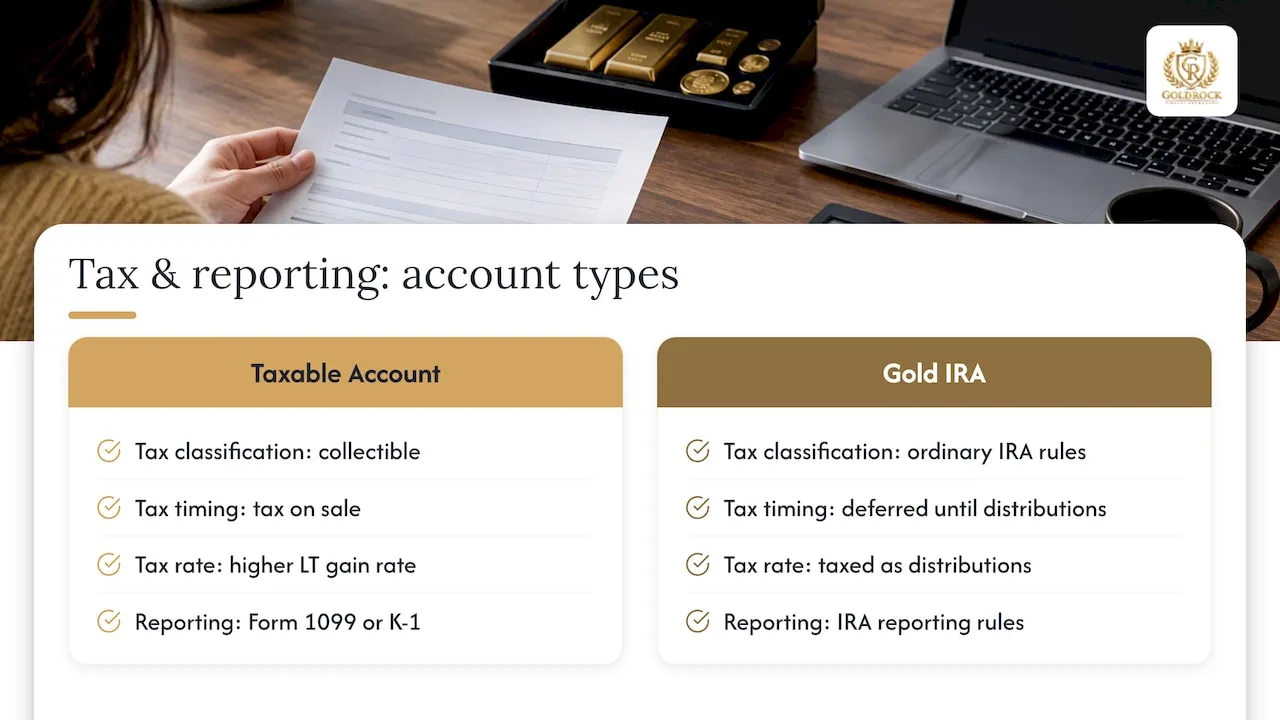
Gold held in a taxable brokerage account, including many physically backed gold ETFs, is often classified as a collectible under federal tax rules, which can mean a higher long-term capital gains rate than standard securities. A gold IRA operates under ordinary IRA rules, so taxes are typically deferred until you take distributions rather than triggered by the sale of metal inside the account.
The legal structure of an ETF also affects your paperwork. The SPDR Gold Trust is structured as a grantor trust that holds allocated gold bars, and shares represent a fractional undivided interest in that trust. Investors in this type of fund typically receive a Form 1099 rather than a Schedule K-1, which simplifies reporting compared with partnership-style structures some other commodity funds use.
Because collectibles rules, IRA distribution rules, and reporting forms vary by account type and personal circumstances, we never provide personalized tax advice, but you can find practical methods in how to reduce taxes in retirement. A qualified tax professional can confirm how these rules apply to your specific situation.
Fees and Total Cost Comparison: Expense Ratios vs IRA Setup and Storage
Gold ETFs typically charge an annual expense ratio plus ordinary brokerage commissions, a cost structure that is straightforward and visible on every statement. A gold IRA involves a different set of charges:
- Setup fee: a one-time charge to open the self-directed account.
- Annual custodial and administrative fee: paid to the IRA custodian for recordkeeping and compliance.
- Storage and insurance fee: paid to the approved depository holding your physical metal.
- Dealer markup: the spread between the metal’s spot price and what you pay to acquire it.
Self-directed IRA fee structures are often layered across setup, custodial, storage, and dealer costs, and can meaningfully reduce net returns compared with low-expense ETFs over long holding periods, according to FINRA’s guidance on self-directed IRA risk. First-year gold IRA costs commonly fall in the $200 to $800 range, with annual fees of $150 to $600 thereafter, figures worth modeling against your expected holding period before you decide.
Liquidity, Access, and Trading Mechanics
Gold ETF shares trade on public exchanges during market hours and typically settle within the standard timeframe for equity trades, giving you same-day pricing and fast access to cash. Selling physical gold held in an IRA is a longer process: you typically instruct your custodian, the custodian coordinates with the depository and a dealer to sell the metal, and proceeds are deposited into your IRA cash balance before you can withdraw them.
That difference matters most for investors approaching retirement or managing required minimum distributions, where timing cash availability against RMD deadlines requires more lead time with physical metal than with exchange-traded shares.
Ownership, Custody, and IRS Storage Rules for U.S. Investors
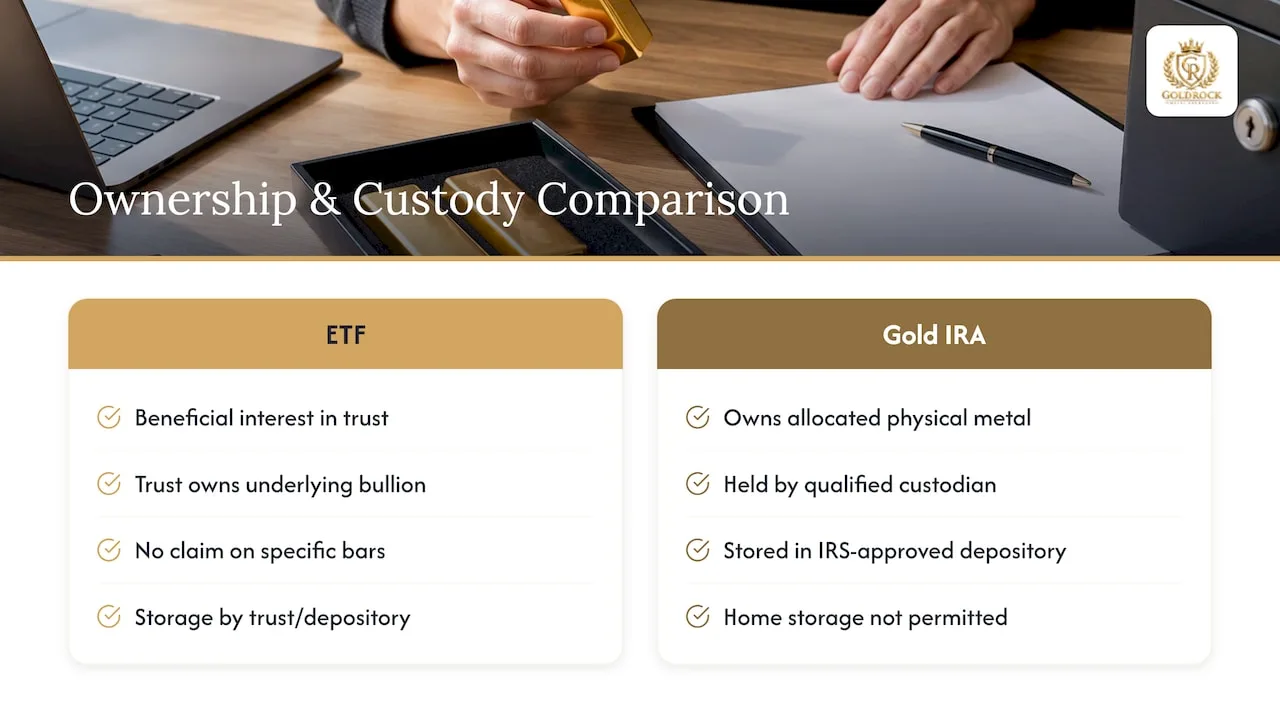
An ETF investor holds a beneficial interest in a trust that owns the underlying bullion, not a claim on specific bars. A gold IRA investor owns allocated physical metal that must be held by a qualified custodian in an IRS-approved depository; home storage of IRA-owned metal is not permitted under these rules, as Investopedia’s overview of gold IRA mechanics explains.
Before funding any account, verify how a custodian documents allocated inventory and what insurance coverage applies to stored metal. Confirming these details in writing, along with reviewing IRA-eligible coin and bar standards, helps you understand exactly what you own and where it sits.
Performance, Portfolio Role, and Investor Profiles
Both vehicles track the price of gold, but net returns diverge once fees and taxes are applied: an ETF’s lower annual cost tends to preserve more of the gross price movement, while a gold IRA’s physical ownership and tax deferral come with higher ongoing expenses. Neither structure changes the underlying metal’s price behavior, and we never promise or project specific returns from either vehicle.
Investor profiles tend to split along these lines, according to an expert comparison published by CBS News: investors who prioritize low cost and same-day liquidity typically lean toward ETFs, while investors who specifically want physical metal inside a tax-advantaged retirement account, and who accept higher fees and custodial requirements, typically lean toward a gold IRA. Your own timeline, goals, and risk tolerance determine which profile fits, and a licensed financial advisor can help you weigh that decision for your personal circumstances.
How to Decide Between a Gold ETF and a Gold IRA
A short checklist can clarify which vehicle fits your situation before you commit funds.
- Define your timeline: shorter horizons often favor ETF liquidity, while retirement-length horizons may suit a gold IRA’s structure.
- Confirm your account type: decide whether you’re investing taxable savings or retirement funds eligible for an IRA.
- Weigh ownership preference: decide whether beneficial interest in a trust or allocated physical metal matters more to you.
- Estimate fee tolerance: compare an ETF’s expense ratio against a gold IRA’s layered setup, storage, and custodial costs.
- Ask custodians and dealers directly about fee schedules, storage location, insured transport, and documentation for inventory and insurance.
Pro Tip: Request every fee schedule in writing before funding an account, and treat high-pressure sales tactics or unverifiable inventory claims as a reason to pause.
Setting Up a Gold IRA in the U.S.: Step-by-Step
Opening a self-directed gold IRA generally follows a consistent sequence. You select a qualified custodian, open the account, and transfer or roll over funds from an existing IRA or 401(k). From there, you choose IRS-eligible metals through a dealer, the custodian accepts and arranges storage at an approved depository, and the account begins ongoing custodial reporting.
Each step carries its own timeline and cost, from the first-year setup fees noted earlier to the recurring storage and administrative charges that follow. Required minimum distributions and IRS reporting apply to gold IRAs just as they do to other retirement accounts, and a tax professional should confirm how these rules affect your personal filing.
Fraud Warnings, Regulatory Guidance, and Practical Safeguards
FINRA warns that self-directed IRAs and physical precious metals carry unique risks, including fraud, higher fees, and limited liquidity, and recommends verifying custodians before funding an account. Practical safeguards include:
- Confirm a custodian’s regulatory standing independently before transferring funds.
- Request written fee schedules and periodic inventory reports.
- Walk away from any dealer using high-pressure sales tactics.
Engaging in a prohibited transaction within an IRA can jeopardize the account’s tax-advantaged status, so any unusual request from a custodian or dealer deserves scrutiny before you proceed.
How GoldRock Metal Exchange Supports U.S. Investors Choosing a Gold IRA
We have an IRA department that helps handle custodial coordination, paperwork, and storage setup described above, assisting you with dealer, custodian, and depository steps. Our services include Precious Metals IRA setup and rollovers, insured private delivery for direct purchases, and ongoing consultative support as your account moves through each stage. This article is educational and not personalized investment, tax, or legal advice.
When Physical Ownership Inside an IRA Matters
Some long-term retirement savers find real value in knowing specific, allocated metal sits in their account rather than a claim on a pooled trust. That preference is personal, tied to how each investor thinks about control and tangibility in a retirement plan, and it doesn’t make one structure objectively better than the other. Talk with a financial or tax advisor about how either vehicle fits your broader retirement strategy.
— Blake
Request a Free Precious Metals Consultation
If you’re weighing a gold IRA against other gold exposure, talking through the setup process with our in-house IRA team can save you time and guesswork. We handle custodial coordination, depository selection, and insured delivery so you can focus on the decision itself rather than the paperwork behind it.

- Precious Metals IRA setup: rollovers, custodial coordination, and storage arranged for you.
- Insured private delivery: direct purchases shipped securely to your door.
- Dedicated in-house IRA team: ongoing support through every step of the transfer.
Request a Free Precious Metals Consultation or call (888) 859-0978 to talk through your options with our team.
This article is general information, not a substitute for advice from a qualified financial advisor. Consult a qualified financial professional about your own circumstances before acting on anything here.
FAQ
Is it better to buy physical gold or open a gold IRA?
It depends on your goal: buying physical gold outright gives you immediate possession and flexibility, while a gold IRA adds tax-advantaged retirement treatment in exchange for custodial storage rules and additional fees. Investors focused on retirement planning often prefer the IRA structure specifically for its tax deferral.
Which gold ETF is backed by physical gold?
Some gold ETFs, such as those structured as grantor trusts, are designed to hold physical gold bullion directly rather than derivatives or futures contracts. The SPDR Gold Trust’s SEC filing describes this type of structure, where shares represent a fractional interest in the trust’s gold holdings.
What is the main disadvantage of gold ETFs?
Gold ETF shareholders don’t hold physical metal directly, only a beneficial interest in a trust, and in taxable accounts these funds can be subject to the collectibles capital gains rate rather than standard long-term rates. They also don’t offer the retirement-account tax deferral that a gold IRA provides.
How safe is a gold IRA from a regulatory standpoint?
Gold IRAs operate under standard IRA rules and require an IRS-approved custodian and depository, but FINRA notes that self-directed IRAs carry unique fraud and fee risks that require careful due diligence. Verifying custodians, requesting written fee schedules, and confirming insured storage are key steps toward reducing that risk.
How much does it typically cost to open a gold IRA?
First-year costs for a gold IRA commonly range from $200 to $800, with annual custodial and storage fees of $150 to $600 in subsequent years. These figures vary by custodian and the amount of metal held, so requesting a written fee schedule before funding an account is recommended.
Sources
- SPDR Gold Trust (GLD) SEC filing — Trust Indenture
- FINRA: Self-directed IRAs and risk of fraud
- Investopedia: Gold IRA
- CBS News: Gold bars vs. gold IRA vs. gold ETF — experts pick best option