

Those three steps matter more than any single “which asset wins” debate.
An economic uncertainty investment checklist works because it forces sequence: liquidity first, allocation second, opportunistic moves last. Skipping the order is how investors end up selling low and buying high.
Run through these in priority order:
- Emergency fund check (urgent): a contingency fund covering several months of expenses in a high-yield savings account or money market fund.
- Risk tolerance confirmation (urgent): does your stomach match your stated plan, or did the last downturn expose a mismatch?
- Asset allocation review (high): compare current weights to target bands and flag any drift past 5% to 10%.
- Rebalancing decision (high): trim winners, add to laggards, or hold if within bands.
- Dollar-cost averaging setup (medium): automate contributions instead of guessing entry points.
- Tax and account review (medium): check for wash-sale exposure and IRA rollover paperwork.
- Physical asset security (medium): if you own or plan to buy precious metals, confirm authentication and insured delivery.
GoldRock Metal Exchange works with investors on the last two items directly, handling self-directed IRA rollovers and insured private delivery of physical gold, silver, platinum, and palladium. If you want a second set of eyes on where metals might fit your plan, call (888) 859-0978 to request a free consultation.
Key Takeaways
A disciplined, sequenced checklist, liquidity first, allocation second, opportunistic moves last, protects long-term outcomes better than reacting to any single headline.
| Point | Details |
|---|---|
| Build liquidity first | Hold a contingency fund covering several months of expenses in a high-yield savings account before adjusting any allocation. |
| Watch drift, not headlines | Rebalance when allocation drifts more than 5% to 10% from target, not when the news gets loud. |
| Automate with DCA | Set fixed contribution schedules to remove market-timing guesswork from ongoing investing. |
| Check tax timing before trading | Confirm wash-sale windows and gather IRA rollover documentation before harvesting losses or transferring accounts. |
| Get help with metals and rollovers | GoldRock Metal Exchange offers in-house IRA support and insured private delivery for investors adding physical precious metals. |
This article is general information, not a substitute for advice from a qualified financial advisor. Consult a qualified financial professional about your own circumstances before acting on anything here.
Table of Contents
- The Full Checklist for Uncertain Markets
- Putting Each Step Into Practice Without Guessing the Market
- Tax and Account Moves That Prevent Costly Surprises
- A 30/90/180-Day Plan to Actually Follow Through
- Custody, Authentication, and Storage for Physical Metals
- Why Your Behavior Matters More Than Your Allocation
- Reading the Economic Signals Worth Watching
- Tools for Measuring Risk When the Ground Feels Unstable
- Stress Testing Your Portfolio Before the Market Does It for You
- When to Bring in a Professional
- Sources
The Full Checklist for Uncertain Markets
Each item below pairs a concrete action with the reason it matters. Work through them in order rather than jumping to whichever feels most urgent that day.
- Confirm your emergency fund covers a contingency fund covering several months of expenses. Hold it in a high-yield savings account or money market fund, not in equities. Skipping this is the single most common reason investors are forced to sell depressed assets.
- Re-check your risk tolerance against actual behavior, not the number you picked two years ago. If the last 10% market drop kept you up at night, your allocation is too aggressive for you.
- Pull your current asset allocation and compare it to your target. Most advisors treat a drift of more than 5% to 10% from target weights as a rebalancing trigger.
- Diversify with uncorrelated assets. A mix of equities, bonds, cash instruments, and a measured allocation to precious metals reduces the odds that one sector-specific shock wrecks the whole portfolio.
- Set up or confirm a dollar-cost averaging schedule. Fixed contributions on a fixed cadence remove the temptation to guess a bottom, a discipline HSBC and other major institutions recommend over market timing.
- Review debt and near-term liquidity needs. Upcoming tuition, a balloon payment, a planned home purchase. Money you need within two years has no business in volatile assets.
- Set a rebalancing cadence. Quarterly or semiannual reviews, triggered by drift bands rather than headlines, keep the process mechanical instead of emotional.
- Run a tax and account pre-check. Confirm you understand wash-sale timing before harvesting any losses, and gather documentation early if an IRA rollover is on your radar.
- If you hold or plan to buy physical metals, verify authentication and delivery security. Insured, trackable transit is not optional for anything shipped to your door.
Pro Tip: Set a recurring 15-minute calendar block, weekly or biweekly, to glance at net worth, budget leaks, and allocation drift. A short regular review habit catches small problems before they become reactive, expensive mistakes.
Putting Each Step Into Practice Without Guessing the Market
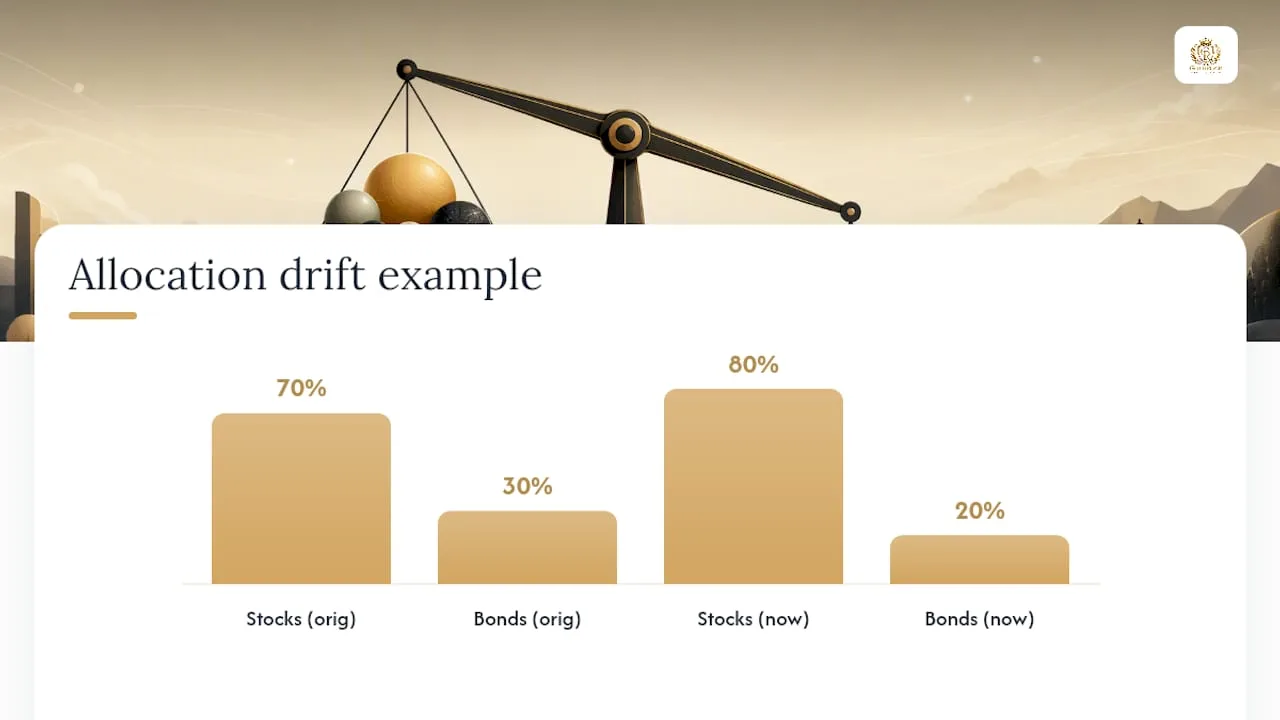
Testing allocation alignment starts with a simple question: does your current mix still match the goal it was built for? A 70/30 stock-to-bond split set five years ago may have drifted to 80/20 purely from stock appreciation, quietly raising your risk exposure without any decision on your part.
Dollar-cost averaging works across taxable brokerage accounts, 401(k)s, and IRAs, but the mechanics differ slightly. In a 401(k), it happens automatically through payroll deduction. In a taxable account or IRA, you have to schedule it yourself, and the most common pitfall is abandoning the schedule the moment markets drop, which defeats the entire purpose.
A defensive tilt makes sense operationally when your own liquidity timeline shortens, not when a headline spikes your anxiety. If you’ll need funds within 24 months, that’s a signal grounded in your plan. A scary news cycle is not.
For the diversification layer itself:
- Short-term Treasury bills and money-market instruments provide stability and current yield with minimal credit risk.
- Investment-grade bonds add ballast that tends to move differently than equities during stress.
- A measured allocation to precious metals adds a noncorrelated element, pairing defensive holdings with growth assets in what Standard Chartered calls a barbell strategy (pairing defensive assets with growth assets).
Investopedia notes that investors commonly shift toward government bonds, money-market funds, and precious metals during heightened uncertainty, precisely because these assets respond to different drivers than growth stocks.
Tax and Account Moves That Prevent Costly Surprises
Tax mistakes made during a rebalance are avoidable, but only if you check the rules before you trade, not after.
- Watch the wash-sale window. The IRS disallows a loss if you repurchase a “substantially identical” security within 30 days before or after the sale, a trap that catches investors harvesting losses while rebalancing into a similar fund.
- Document everything for an IRA rollover. If you’re moving retirement funds into a self-directed precious metals IRA, your custodian will need transfer paperwork, account statements, and timing records; missing documentation is the top cause of rollover delays.
- Confirm the rollover method with your custodian before initiating. A direct trustee-to-trustee transfer avoids the 60-day rule complications that come with an indirect rollover.
- Check IRS guidance directly rather than relying on a dealer’s summary, and loop in a tax professional for anything account-specific. This article is educational, not personalized tax or legal advice.
A 30/90/180-Day Plan to Actually Follow Through
Checklists fail when there’s no deadline attached. Here’s a schedule that turns the list above into scheduled actions instead of good intentions.
- Days 1 to 30: Confirm your emergency fund balance and credit availability. Pause any impulsive trading. Set or confirm auto-contributions so you’re not making daily decisions.
- Days 31 to 90: Rebalance to target allocation bands. Lock in your dollar-cost averaging schedule across relevant accounts. If a precious metals IRA rollover is on the table, start the custodian conversation now, since paperwork often takes several weeks.
- Days 91 to 180: Review performance against your original objectives, not against the market’s headlines. Update your documentation. Decide whether to expand or scale back any pilot allocation based on how it performed against your plan, not against luck.
If you’re testing a precious metals allocation for the first time, stagger the purchases rather than buying all at once.
Pro Tip: Treat the 90-day mark as your hard deadline for a rebalancing decision. Investors who let “I’ll get to it” stretch past one quarter almost always end up reacting to a headline instead of a plan.
Custody, Authentication, and Storage for Physical Metals
Buying metal is the easy part. Getting it home safely, or into a retirement account correctly, is where investors most often get careless.
- Demand authentication documentation at delivery, including assay certification and serial numbers for bars, before signing off on receipt.
- Insured private delivery removes the liability gap that exists when metal ships through standard, uninsured mail.
- Allocated vault storage through a qualified depository keeps your specific metal segregated and insured, an option many custodians require for IRA-held metals.
- Home storage avoids ongoing fees but carries insurance and theft risk that a vault does not.
A self-directed precious metals IRA has to follow IRS custodial rules, meaning the metal typically sits with an approved depository rather than in a home safe. Getting the custody chain right the first time avoids costly corrections later.
GoldRock Metal Exchange runs an in-house IRA department specifically to walk investors through custodian paperwork and timing, and every purchase ships through insured private delivery with full authentication support.
This article is educational and general in nature. It is not personalized tax, legal, or investment advice; consult a qualified professional about your specific situation.
Why Your Behavior Matters More Than Your Allocation
Portfolios don’t fail during uncertainty nearly as often as investors’ nerve does. The most common mistake isn’t picking the wrong asset mix. It’s abandoning a reasonable mix at the worst possible moment because a headline made the plan feel wrong.
Psychological preparedness starts with expecting volatility rather than reacting to it. If you know in advance that a 15% drawdown is a normal, recurring feature of markets rather than a sign something is broken, you’re less likely to sell into it. Write down, in advance, what would actually change your plan, a job loss, a shortened timeline, a genuine shift in goals, and separate that list from “the news made me nervous.” Only the first list should trigger action.
A short recurring review habit helps here too. Checking your numbers on a fixed schedule, rather than every time you see a market headline, keeps decisions tied to your data instead of your mood. Advisors who specialize in wealth preservation consistently point back to the client’s original financial plan as the anchor, arguing that strategy should follow long-term goals rather than short-term headlines.
Loss aversion is well documented: people feel the pain of a loss roughly twice as intensely as the pleasure of an equivalent gain. That asymmetry is exactly why a written checklist beats a gut decision when markets get loud. The checklist doesn’t have feelings. You do.
Reading the Economic Signals Worth Watching
Not every economic indicator deserves your attention, and chasing all of them is its own kind of distraction. A handful actually move markets in ways relevant to portfolio decisions.
Inflation data (the Consumer Price Index, released monthly by the Bureau of Labor Statistics) shapes interest rate expectations, which ripple through bond yields and equity valuations. Employment reports signal consumer spending power and recession risk. The yield curve, particularly the spread between short-term and long-term Treasury yields, has historically preceded recessions when it inverts, though the timing has varied widely across cycles. Federal Reserve statements on interest rate policy move markets faster than almost anything else on the calendar.
The mistake most investors make isn’t ignoring these signals. It’s treating any single one as a trading trigger. Advisors focused on wealth preservation during uncertainty recommend reading indicators collectively rather than reacting to any one data point in isolation, since a single soft jobs report or a single inflation print rarely tells the whole story.
Treat these releases as context for your quarterly rebalancing review, not as standalone buy or sell signals. If your allocation is already within target bands, an inflation surprise doesn’t require you to do anything. If it pushes an indicator you were already watching past a threshold you set in advance, that’s when it earns a second look.
Tools for Measuring Risk When the Ground Feels Unstable
Standard risk assessment gets harder when volatility itself is elevated, because historical averages stop predicting near-term behavior as reliably. A few practical tools help anyway.
Standard deviation and historical drawdown data show how far a given asset class has fallen in past downturns, giving you a realistic range rather than a hopeful guess. If an asset dropped 35% in 2008 and you can’t tolerate that outcome today, it’s oversized in your current mix regardless of its long-term average return.
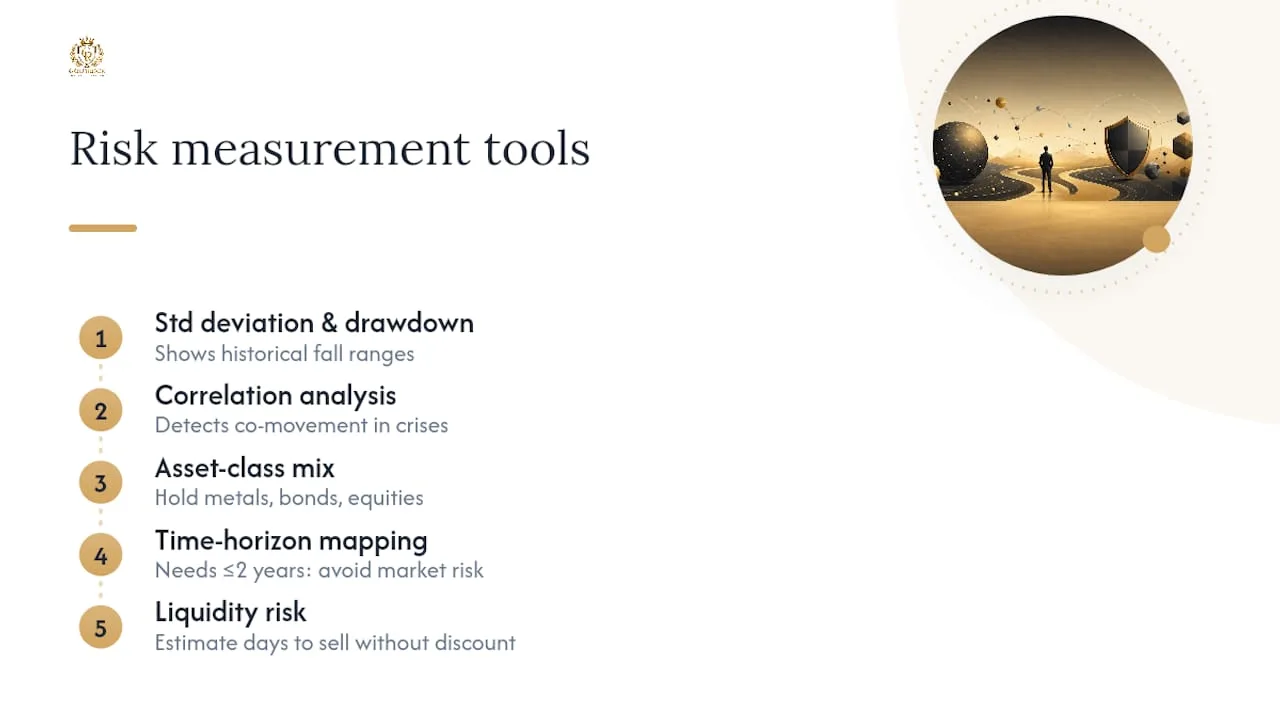
Correlation analysis matters more than most investors realize. Two assets that look diversified on paper can move together during a genuine crisis, which is exactly when diversification is supposed to help. Precious metals, government bonds, and equities each tend to respond to different economic drivers, which is the practical case for holding all three rather than assuming any single “safe” asset will do the job alone.
Time horizon mapping is the simplest tool and the most skipped. List every near-term financial need, tuition, a home purchase, retirement withdrawals, against a timeline. Money needed within two years shouldn’t carry meaningful market risk, full stop, regardless of how confident you feel about any particular asset.
Liquidity risk deserves its own line item. An asset that’s hard to sell quickly at a fair price, whether that’s a thinly traded stock or an illiquid alternative investment, adds risk that standard deviation numbers don’t capture. Ask yourself how many days it would actually take to convert each major holding to cash without taking a discount.
Stress Testing Your Portfolio Before the Market Does It for You
Scenario planning means asking, in a calm moment, “what happens to my plan if X occurs?” before X actually occurs and panic sets in for real.
For each one, work out what your emergency fund covers, whether your allocation would need forced selling to meet expenses, and how long recovery would realistically take given historical precedent.
This exercise isn’t about predicting which scenario happens. It’s about discovering, ahead of time, whether your current plan can absorb a shock without forcing a bad decision at the worst moment.
Rebalancing bands do double duty as a built-in stress test.
When to Bring in a Professional
A checklist handles most routine decisions. Certain situations warrant a conversation with a financial or tax professional instead of a solo decision.
Bring in a professional when you’re rolling over a retirement account, since custodian rules and timing windows carry real penalties if handled incorrectly. Bring one in when a major life event, a job loss, an inheritance, a divorce, changes your financial picture enough that your old plan no longer fits. And bring one in when you’re genuinely unsure whether a tax move, like harvesting a loss near the wash-sale window, will produce the outcome you expect.
A one-time consultation isn’t an admission that you can’t manage your own money. It’s a checkpoint, the same way you’d get a second opinion on a major medical decision, not because you doubt yourself but because the stakes justify a second set of eyes.
A Discipline Checklist Beats a Gut Decision
The single biggest mistake I see in how people talk about uncertain markets is treating it as a forecasting problem. It isn’t. It’s a discipline problem. Nobody consistently predicts recessions or rallies, but almost anyone can follow a checklist that prioritizes liquidity and goal alignment before opportunistic buying.
That ordering matters more than which specific assets you choose. Get liquidity and alignment right first, and the rest becomes a series of small, reversible decisions instead of one large, anxious bet.
— Blake
How GoldRock Metal Exchange Fits Into Your Checklist
Once your liquidity, allocation, and rebalancing steps are set, the physical metals and IRA pieces of this checklist are where most investors want a second set of hands. GoldRock Metal Exchange runs an in-house IRA department that handles custodian paperwork, rollover timing, and account setup directly, so you’re not piecing together the process from scattered instructions. Every order also ships through insured private delivery with authentication support, closing the custody gap that trips up investors who buy metal without a plan for getting it home safely or into a compliant retirement account.
If you’re ready to see current pricing before making a decision, check live precious metals prices or browse available products. If a retirement account rollover is part of your plan, request a free precious metals consultation and call (888) 859-0978 to talk through your specific situation with GoldRock’s team before you commit to anything.
Sources
- Stability in chaos – the ‘barbell strategy’ guide | Standard Chartered
- What is dollar-cost averaging? | HSBC
- How to Invest in Uncertain Times | Investopedia
- Investment Strategies During Market Volatility | Morgan Stanley