

TL;DR:
- Medium-risk investors benefit most from allocating 4% to 6% of their portfolio to silver, which often exceeds the minimal exposure in institutional holdings.
- Silver’s industrial demand, especially for solar and electric vehicle manufacturing, drives its price movements and adds cyclical risk beyond its role as a store of value.
- Choosing between physical silver, ETFs, or mining stocks depends on your liquidity needs, storage preferences, and willingness to manage custodial or tax complexities.
- Implementing staged purchases and setting strict rebalancing rules help mitigate volatility risks and prevent overconcentration in silver holdings.
- Costs for holding silver include premiums, storage, insurance, and tax treatment differences, with physical and paper forms bearing unique advantages and drawbacks.
Table of Contents
- What Is the Right Silver Allocation in Portfolio Terms?
- Why Does Silver Behave Differently Than Gold?
- What Are the Best Ways to Hold Silver?
- How Do You Actually Build a Silver Position?
- What Costs and Mistakes Should You Watch For?
- When Should You Add or Trim Silver in Your Portfolio?
- Build Your Silver Position With GoldRock Metal Exchange
- Sources
- FAQ
What Is the Right Silver Allocation in Portfolio Terms?
The right number depends on how much volatility you can tolerate and what job you want silver to do. A conservative investor building a defensive sleeve behaves differently than someone using silver tactically to chase industrial demand cycles.
Here’s how the ranges break down by profile:
- Conservative: 2% to 4% of total portfolio, usually paired with a larger gold position.
- Moderate: 4% to 6% of total portfolio.
- Aggressive: 10% to 15%, reserved for investors comfortable with sharp price swings and who understand silver’s industrial exposure adds cyclical risk on top of its role as a store of value.
Statistic Callout: Portfolio-optimization research from the Silver Institute found that medium-risk investors historically benefited from a dedicated silver allocation generally between 4% and 6% of the total portfolio over rolling five-year windows from 1999 to 2022 and in forward-looking scenarios. This allocation is considerably higher than the average exposure institutional portfolios actually carry, which is typically minimal.
Financial advisors generally frame these numbers differently depending on whether they’re talking about “total portfolio” or “metals sleeve.” If you’re already holding gold, silver often becomes the smaller half of that sleeve. A balanced investor in their peak earning years might land at 5%, matching the Silver Institute’s medium-risk finding almost exactly. You can read more on the exact mechanics of a 4% to 6% silver allocation if you want to see the math applied to different account sizes.
Why Does Silver Behave Differently Than Gold?
Silver and gold get lumped together as “precious metals,” but they respond to different forces. Gold trades mostly as a monetary asset and a hedge against currency and economic stress. Silver carries that same monetary character, but it also functions as an industrial commodity, which changes its behavior in ways that matter for allocation decisions.
Industrial demand for silver hit a record 680.5 million ounces in 2024, driven heavily by solar panel manufacturing, electric vehicle components, and electronics. That industrial footprint means silver prices move with manufacturing cycles and clean energy buildout, not just with fear-driven demand for safe havens.
That dual identity creates a few practical differences worth knowing:
- Volatility: Silver typically swings harder than gold in both directions, so employing effective options strategies for volatile markets can help manage risk when industrial orders and investment demand shift.
- Correlation: Silver tends to move with gold during broad monetary stress but can decouple during industrial growth or contraction phases, which is part of what makes it a genuine diversifier rather than a gold substitute.
- The gold-to-silver ratio: Many investors watch this ratio (the number of silver ounces it takes to equal the price of one gold ounce) as a way to gauge relative value. It’s a useful context tool, not a timing signal, and treating it as a trading rule tends to backfire when industrial demand shifts the relationship for reasons that have nothing to do with historical averages.
This is also why advisors rarely recommend replacing gold with silver outright. Silver’s role in hedging against inflation works best as a complement to gold’s more stable monetary behavior, not a substitute for it.
What Are the Best Ways to Hold Silver?
The method you choose determines your costs, your liquidity, and how much hands-on management the position requires. None of these options is universally “best.” Each fits a different objective.
- Physical bars and coins. You own the metal outright, with no counterparty risk. The trade-off is premiums over spot price, storage logistics, and the fact that small lots often sell at a wider spread than bulk bars. This suits investors who want direct, tangible ownership tied to a long-term holding period.
- Vaulted or allocated storage with insured private delivery. This removes the home-storage burden while still keeping the metal specifically allocated to you rather than pooled. Storage and insurance fees apply, but for many investors that cost is worth not having to manage a home safe.
- Silver ETFs. These offer stock-market liquidity and low friction for buying and selling, but most don’t allow physical redemption, and tax treatment can differ from owning the metal directly.
- Mining stocks and funds. These add leverage to silver price moves along with company-specific risk (management decisions, production costs, geopolitical exposure at mine sites) that has nothing to do with the metal itself.
- Futures and leveraged products. These are appropriate only for sophisticated traders who understand margin requirements and contract-roll risk. A retail investor building a long-term diversification position generally has no business here.
Physical silver tends to suit long-term holders, while ETFs and other liquid instruments fit investors prioritizing quick entry and exit, a distinction backed by financial experts who recommend matching the purchase method to the metal’s role in the portfolio rather than picking one format for every situation.
Pro Tip: If you’re deciding between physical and paper exposure, ask yourself whether you’d ever want to actually take delivery of the metal. If the answer is no, an ETF probably serves you better. If the answer is yes, even occasionally, physical ownership with insured storage is worth the added cost.
How Do You Actually Build a Silver Position?
Implementation matters as much as the target percentage. A correct allocation number executed poorly still produces a bad outcome.
Step 1: Define the role silver plays. Decide whether you’re using it as a long-term diversifier or a tactical position tied to industrial demand cycles. This decision determines whether you set your target as a percent of the total portfolio or as a percent of a dedicated metals sleeve.
Step 2: Choose lump-sum or staged buying. Silver’s volatility makes timing a single large purchase risky. Dollar-cost averaging into a position over several tranches, say monthly or quarterly purchases over six to twelve months, smooths out entry price and reduces the odds of buying entirely at a peak.
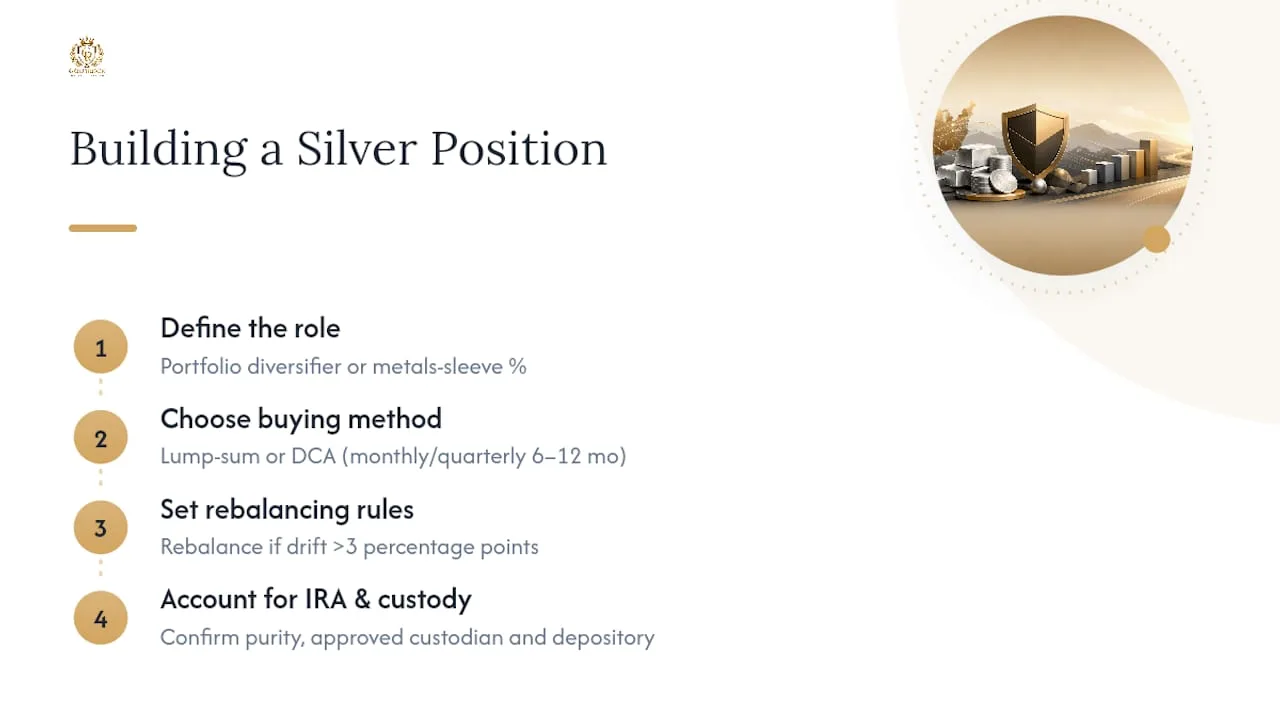
Step 3: Set rebalancing rules in advance. A common guardrail is rebalancing when your silver position drifts more than 3 percentage points from its target weight. Without a preset rule, most investors either let winners run too long or panic-sell during a dip.
Step 4: Account for IRA and custody rules if using retirement funds. Not every silver product qualifies for a self-directed IRA. The IRS sets minimum purity standards and requires an approved custodian and depository, and not all bullion types are IRA-eligible. This is where working with a dedicated IRA desk saves real time compared to figuring out custodial rules alone.
Statistic Callout: Advisory guidance summarized by Morgan Stanley puts total precious-metals exposure at roughly 5% to 15% of a portfolio, with gold typically making up the larger share of that sleeve and silver serving as the complementary position.
What Costs and Mistakes Should You Watch For?
Silver’s costs run deeper than the sticker price, and the mistakes tend to be behavioral more than analytical.
The real cost stack includes the premium over spot price, the buy-sell spread you absorb when you eventually sell, storage and insurance fees for physical holdings, and tax treatment that can differ meaningfully between physical metal and ETF shares. Worth noting: physical silver stored in a home safety deposit box isn’t covered by FDIC deposit insurance, a detail many first-time buyers overlook entirely.
Common mistakes investors make with silver allocations:
- Chasing price rallies instead of sticking to a staged buying plan.
- Skipping rebalancing once silver’s price swings push the position far above or below target.
- Overconcentrating in a single form (all physical, or all ETF) instead of mixing custody types for liquidity flexibility.
- Assuming physical silver and ETF silver carry identical tax treatment when they often don’t.
Pro Tip: Keep a small portion of your silver position in a more liquid form, even if most of it is physical. That way, a short-term cash need doesn’t force you to sell your entire long-term holding at whatever price the market happens to offer that week.
When Should You Add or Trim Silver in Your Portfolio?
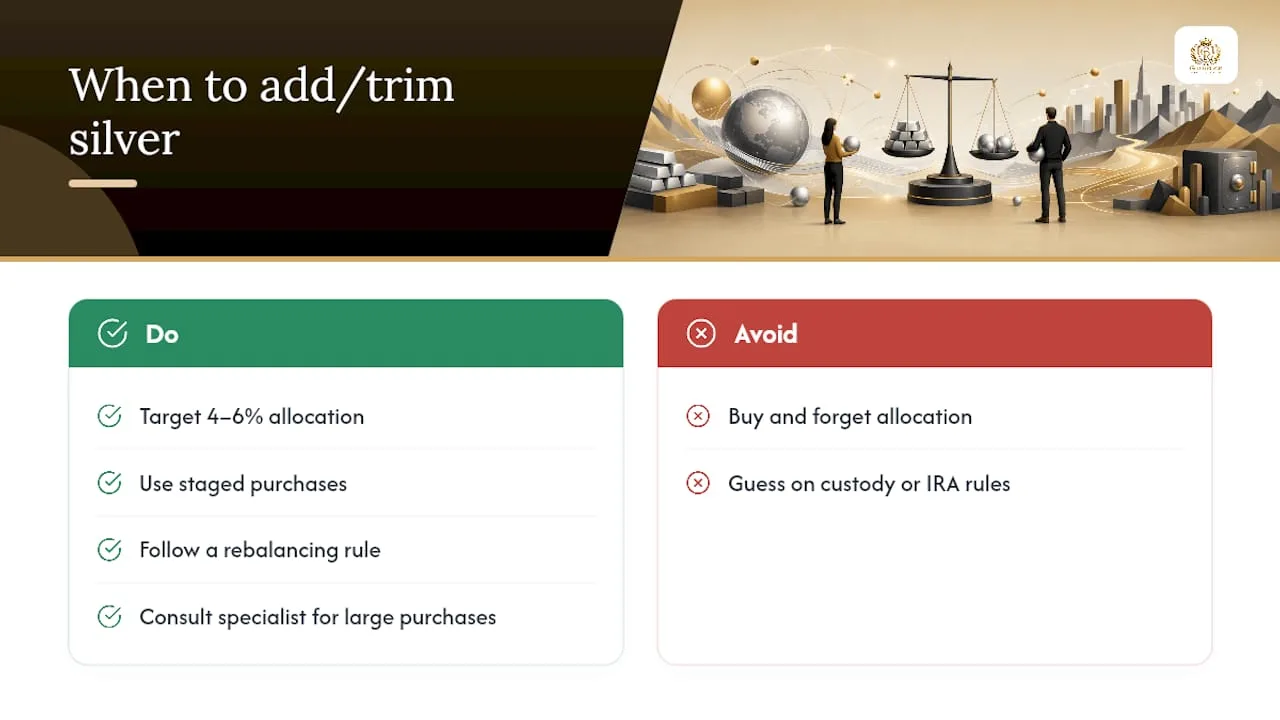
The evidence points toward 4% to 6% for most medium-risk investors, and I don’t think that number needs to be treated as fixed. It’s a starting point, not a ceiling. If industrial demand trends (solar, EV production) keep climbing, a tactically inclined investor has a real argument for leaning toward the higher end of that range.
What I’d push back on is buying the allocation and forgetting it. The percentage only means anything if it’s paired with staged purchases and a rebalancing rule you actually follow. For larger physical purchases or an IRA rollover, talk to a specialist before you move; the custody rules aren’t the place to guess.
— Blake
Build Your Silver Position With GoldRock Metal Exchange
GoldRock Metal Exchange gives you a direct path from allocation target to actual ownership, without the runaround of piecing together custody, storage, and IRA paperwork on your own.

Once you’ve settled on a target percentage, the harder question is usually execution: where do you buy, how do you store it, and what happens if you want it inside a retirement account? Our in-house IRA department handles self-directed rollovers for gold, silver, platinum, and palladium, providing guidance on IRS purity rules and approved custodians. If you’d rather hold physical metal outside a retirement account, we offer insured private delivery options, so your silver can arrive directly and securely. Whether you’re staging a dollar-cost-averaging plan or moving a larger lump sum, you can check current live silver and gold prices before placing an order, or browse available silver bars and coins directly. For IRA rollovers specifically, GoldRock’s self-directed Precious Metals IRA page outlines the setup process. Ready to talk through your allocation with someone who handles this daily? Request a Free Precious Metals Consultation or call (888) 859-0978.
Sources
- The relevance of silver in a global multi-asset portfolio — Silver Institute
- How to capitalize on silver’s price growth, according to experts — CBS News
- Investing in gold and silver: A decision guide — Morgan Stanley
- How to buy silver — Fidelity
This article is for educational purposes only and does not constitute personalized investment, tax, or legal advice. Consult a qualified financial, tax, or legal professional before making decisions about your portfolio or retirement accounts.
FAQ
What Does Warren Buffett Say About Silver?
Buffett’s Berkshire Hathaway made a large silver purchase but has not been a consistent silver advocate since; his public commentary on precious metals has generally favored productive assets over metals as a long-term strategy.
What Is the 80/50 Rule for Silver?
There’s no standardized, widely recognized rule for silver allocation in financial literature; treat any source citing a specific rule with caution and rely instead on the evidence-based ranges from portfolio-optimization research.
Could Silver Hit $500 an Ounce?
No credible primary source or portfolio-optimization research supports a specific price target like this, and price forecasting isn’t something GoldRock Metal Exchange or this article attempts; allocation decisions should be based on your risk profile and goals, not speculative price targets.
Should I Hold Silver Inside an IRA or Outside One?
That depends on whether the funds are already in a retirement account and what role you want silver to play; a self-directed Precious Metals IRA lets you use existing retirement funds while physical ownership outside an IRA offers more flexibility for private delivery and direct access.