
Retirement portfolio diversification is defined as spreading your investments across multiple asset classes, geographic regions, and account types to reduce the risk that any single investment can derail your retirement income. The industry term for this practice is asset allocation, and diversification is the strategy that makes it work. Done well, it means a stock market crash does not force you to sell your home, and a bond market slump does not cut off your monthly income. This article covers the core asset classes, the retirement-specific risks diversification addresses, the role of tax planning, and the practical steps to build a portfolio that lasts as long as you do.
What types of assets make up a diversified retirement portfolio?
Broad diversification blends asset classes, geographic regions, and market capitalizations to reduce the risk of catastrophic losses from any single sector. That definition matters because many retirees think owning 20 stocks counts as diversification. It does not. True diversification means your portfolio holds assets that do not all fall at the same time.
The major asset classes in a retirement portfolio each serve a distinct role:
- U.S. stocks provide long-term growth but carry the highest short-term volatility. Large-cap index funds like those tracking the S&P 500 are the most common vehicle.
- International stocks add geographic diversification. When U.S. markets underperform, developed markets in Europe or emerging markets in Asia may not follow the same path.
- Bonds generate income and act as a cushion during equity downturns. Short-term and intermediate-term bonds carry less interest rate risk than long-term bonds.
- Cash and cash equivalents such as money market funds and Treasury bills provide liquidity for near-term expenses without requiring you to sell equities.
- Real estate through REITs (Real Estate Investment Trusts) adds income and inflation sensitivity without requiring direct property ownership.
- Precious metals such as gold, silver, platinum, and palladium act as crisis hedges and inflation protection. Physical metals hold value independent of any company’s earnings or a government’s monetary policy.
| Asset class | Primary role | Risk level |
|---|---|---|
| U.S. stocks | Long-term growth | High |
| International stocks | Geographic diversification | High |
| Bonds | Income and stability | Low to medium |
| Cash equivalents | Liquidity buffer | Very low |
| REITs | Income and inflation hedge | Medium |
| Precious metals | Crisis hedge and inflation protection | Medium |
The right mix depends on your age, income needs, and risk tolerance. A 45-year-old planning for early retirement needs a different allocation than a 68-year-old already drawing income. The principle stays the same: no single asset class should have the power to end your retirement.

How does diversification manage sequence-of-returns risk?
Sequence-of-returns risk is the danger that a major market decline in the first few years of retirement permanently damages your portfolio, even if markets recover later. A retiree who withdraws 4% annually during a 30% market drop in year one sells shares at the worst possible price. Those shares never recover their full contribution to the portfolio.
The most direct defense is a liquidity buffer. Holding 3–5 years of living expenses in non-equity assets like cash or short-term bonds shields retirees from selling stocks during early bear markets. That buffer buys time for equities to recover before you need to draw from them.
The three-bucket strategy formalizes this approach:
- Bucket 1 (0–3 years): Cash and money market funds for immediate income needs.
- Bucket 2 (3–7 years): Short and intermediate bonds, dividend-paying stocks, and REITs for medium-term income.
- Bucket 3 (7+ years): Growth-oriented equities and alternatives for long-term compounding.
Withdrawal strategies using distinct time-horizon buckets avoid selling depreciated assets by drawing from stable buckets during downturns. That separation is the mechanical reason bucket strategies work.
Longevity risk adds another layer. Retirees who live 30 or 50 years past their last paycheck face a very different math problem than those planning for 15 years. Experts recommend lowering safe withdrawal rates to 3.0–3.5% for 50-year retirement horizons, compared to the traditional 4% rule. A more conservative withdrawal rate preserves capital long enough to survive extended market cycles.
Pro Tip: Rebalance your portfolio using threshold rules, not calendar dates. When any asset class drifts more than 5% from its target allocation, rebalance. This keeps your risk level consistent without requiring you to predict market movements.
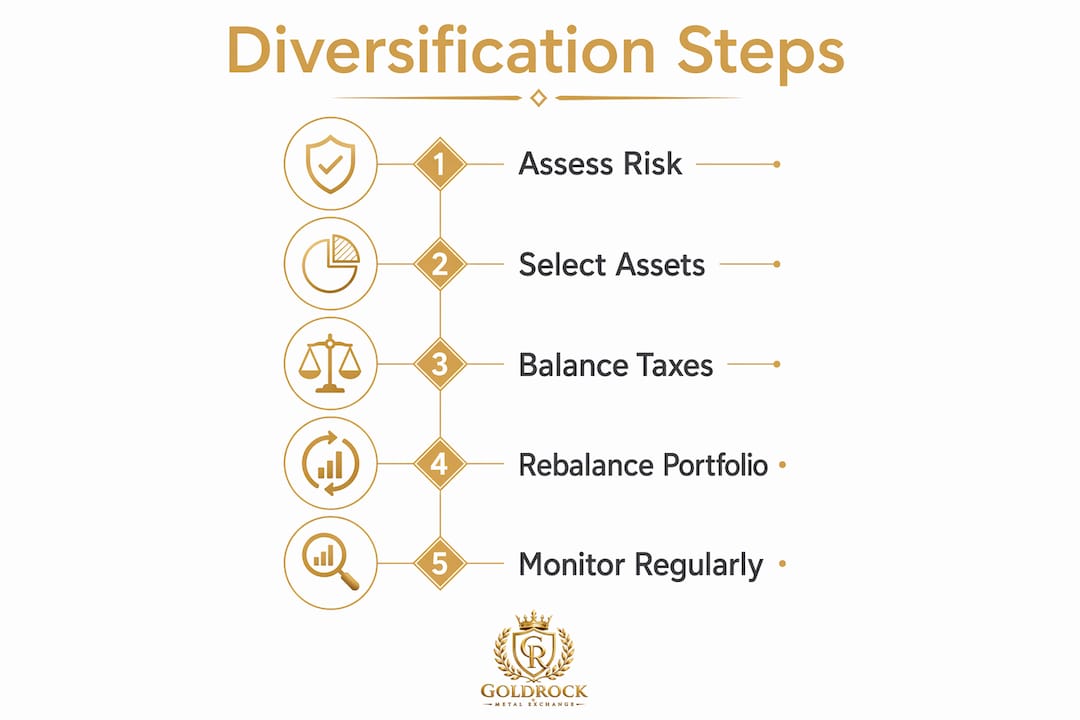
Portfolio rebalancing driven by threshold rules rather than market predictions maintains risk and income objectives consistently. Rebalancing also forces you to sell high and buy low, which is the opposite of what most emotional investors do.
Why does tax diversification matter as much as asset diversification?
Tax diversification is the practice of holding retirement assets across accounts with different tax treatments. Most retirees focus entirely on what they own. The smarter question is where they own it.
Retirees should hold funds across taxable, pre-tax, Roth, and HSA accounts to control their adjusted gross income (AGI) each year. AGI directly affects Medicare Part B and D premiums, ACA subsidy eligibility, and the taxation of Social Security benefits. A retiree who draws entirely from a traditional IRA has no flexibility. A retiree with all four account types can engineer their income.
The four tax buckets work like this:
- Taxable accounts (brokerage accounts): Gains taxed at capital gains rates. Useful for tax-loss harvesting and flexible withdrawals.
- Pre-tax accounts (traditional IRA, 401(k)): Contributions were tax-deductible; withdrawals are taxed as ordinary income. Required Minimum Distributions (RMDs) begin at age 73.
- Roth accounts (Roth IRA, Roth 401(k)): Contributions were after-tax; qualified withdrawals are tax-free. No RMDs during the owner’s lifetime.
- HSA accounts: Triple tax advantage. Contributions are pre-tax, growth is tax-free, and withdrawals for qualified medical expenses are tax-free.
For early retirees, two tools unlock pre-59½ access without the 10% penalty. The Roth conversion ladder and 72(t) SEPP are the primary methods, but both require multi-year planning and careful income management. A Roth ladder requires converting funds five years before you need them. A 72(t) SEPP locks you into fixed withdrawals for five years or until age 59½, whichever is longer.
The coordination of tax planning with asset allocation is what separates a good retirement plan from a great one. Placing high-growth assets in Roth accounts and income-generating bonds in pre-tax accounts maximizes after-tax returns without changing a single investment.
How do you build and maintain a diversified retirement portfolio?
Building a diversified retirement portfolio starts with three questions: How much income do you need each month? How long do you expect to live? How much volatility can you tolerate without making panic-driven decisions?
Once you have answers, the process follows a clear sequence:
- Set your target allocation. A common starting point for retirees is 60% equities and 40% fixed income, adjusted based on your income needs and risk tolerance. Early retirees with 30+ year horizons often hold more equities.
- Choose your bucket structure. Assign assets to short, medium, and long-term buckets based on when you will need the money.
- Select specific investments within each bucket. Use low-cost index funds for broad market exposure, dividend-focused funds for income, and physical assets or REITs for inflation protection.
- Establish a rebalancing trigger. Set a threshold, such as a 5% drift from target allocation, that prompts a rebalance regardless of market conditions.
- Review annually and after major life events. A health change, inheritance, or shift in spending needs may require adjusting your allocation.
Dividend income can cover up to 89% of a standard 4% annual withdrawal, enabling retirees to preserve core share holdings and maintain compounding growth. That figure shows why dividend-focused strategies reduce the need to sell shares during downturns.
One critical mistake to avoid: failing to replenish safe assets like cash or bonds during market upswings forces retirees to sell growth assets at losses during downturns. Refilling Bucket 1 during bull markets is not optional. It is the maintenance that keeps the whole system working.
Pro Tip: When markets rise, use gains from Bucket 3 to refill Bucket 1 and Bucket 2. This automatic discipline prevents the most common retirement portfolio failure mode.
Retirement strategies tailored to individual income needs, legacy goals, and health considerations avoid unnecessary volatility exposure. A one-size-fits-all allocation is not diversification. It is guesswork dressed up as a plan.
What role do precious metals and alternative investments play?
Precious metals occupy a unique position in a diversified retirement portfolio. Gold, silver, platinum, and palladium do not correlate tightly with stock or bond markets. When equities fall sharply, metals often hold value or rise, providing a genuine offset to paper asset losses.
Gold’s role as a crisis hedge and inflation protection is well established across multiple market cycles. Silver adds industrial demand to its monetary value, making it sensitive to both economic growth and inflation. Platinum and palladium carry additional exposure to industrial and automotive demand.
Physical metals offer something paper assets cannot: tangible ownership outside the banking system. A self-directed IRA holding physical gold or silver through a dealer like Goldrockmetalexchange gives retirees IRS-compliant precious metals exposure within a tax-advantaged account. Goldrockmetalexchange’s in-house IRA department handles the transfer process and provides insured private delivery for physical assets.
When adding alternatives to a retirement portfolio, three factors matter most:
- Liquidity: Physical metals and private real estate are less liquid than stocks. Size these positions so you never need to sell them in an emergency.
- Correlation: The value of an alternative asset comes from its low correlation to your existing holdings. Adding a second asset that moves with your equities adds concentration, not diversification.
- Allocation size: Most financial planners suggest keeping alternatives, including precious metals, to 5–15% of a retirement portfolio. Enough to matter during a crisis, not so much that it dominates your income plan.
For a deeper look at building a recession-proof physical asset portfolio, the principles of liquidity management and asset correlation apply directly to how metals fit alongside stocks and bonds.
Key Takeaways
A well-diversified retirement portfolio combines asset class diversification, tax account diversification, and a structured withdrawal strategy to manage both market risk and longevity risk simultaneously.
| Point | Details |
|---|---|
| Asset class mix | Spread across stocks, bonds, cash, REITs, and precious metals to reduce single-sector risk. |
| Sequence-of-returns buffer | Hold 3–5 years of expenses in non-equity assets to avoid selling stocks during early downturns. |
| Tax account diversification | Use taxable, pre-tax, Roth, and HSA accounts to control AGI and reduce healthcare costs. |
| Threshold-based rebalancing | Rebalance when allocations drift 5% from target, not on a fixed calendar schedule. |
| Replenish safe buckets | Refill cash and bond buckets during market upswings to prevent forced selling during downturns. |
Why most retirees diversify too late and too little
Most retirees I talk to have diversified their investments but not their strategy. They own stocks, bonds, and maybe a REIT fund. What they have not done is think about sequence risk, tax bucket management, or what happens to their income if markets drop 35% in year two of retirement.
The uncomfortable truth is that diversification is not a one-time allocation decision. It is an ongoing discipline that requires you to refill safe buckets when markets are up, convert to Roth accounts when your income is low, and hold assets that feel boring when equities are surging. The retirees who struggle are usually the ones who chased returns in the accumulation phase and never shifted their thinking to income preservation.
Precious metals are the clearest example of this gap. Most retirees have never held physical gold or silver. They think of it as speculative. The reality is that metals are one of the few assets that genuinely behave differently from stocks during financial crises. Adding even a modest allocation through a self-directed precious metals IRA changes the character of a portfolio in ways that adding a fifth equity fund never will.
The best retirement portfolios are not the ones with the highest returns. They are the ones that survive the worst years without forcing you to make decisions you will regret.
— Blake
Goldrockmetalexchange: add precious metals to your retirement plan
Diversifying retirement investments beyond stocks and bonds is one of the most effective ways to reduce portfolio vulnerability during market stress.

Goldrockmetalexchange specializes in helping retirees add physical gold, silver, platinum, and palladium to their portfolios through self-directed precious metals IRAs. The company’s in-house IRA department handles account transfers and provides insured private delivery for all physical assets. Whether you are starting a new precious metals position or rolling over an existing retirement account, Goldrockmetalexchange offers personalized guidance at every step. Browse the full range of IRS-approved gold and silver products to find the right fit for your retirement allocation.
FAQ
What is retirement portfolio diversification?
Retirement portfolio diversification is the practice of allocating investments across multiple asset classes, geographic regions, and account types to reduce risk and protect income during retirement. The goal is to prevent any single market event from depleting your retirement savings.
How many years of expenses should retirees hold in safe assets?
Retirees should hold 3–5 years of living expenses in non-equity assets like cash or short-term bonds to avoid selling stocks during market downturns early in retirement.
What is the safe withdrawal rate for a long retirement?
Experts recommend a withdrawal rate of 3.0–3.5% for retirement horizons of 50 years, compared to the traditional 4% rule used for shorter retirements.
What is tax diversification in retirement?
Tax diversification means holding assets across taxable, pre-tax, Roth, and HSA accounts to control your adjusted gross income each year. This flexibility reduces Medicare premiums, preserves ACA subsidies, and lowers your overall tax burden.
How do precious metals fit into a diversified retirement portfolio?
Gold, silver, platinum, and palladium have low correlation to stocks and bonds, making them effective crisis hedges and inflation protection tools. Most financial planners suggest allocating 5–15% of a retirement portfolio to precious metals.