
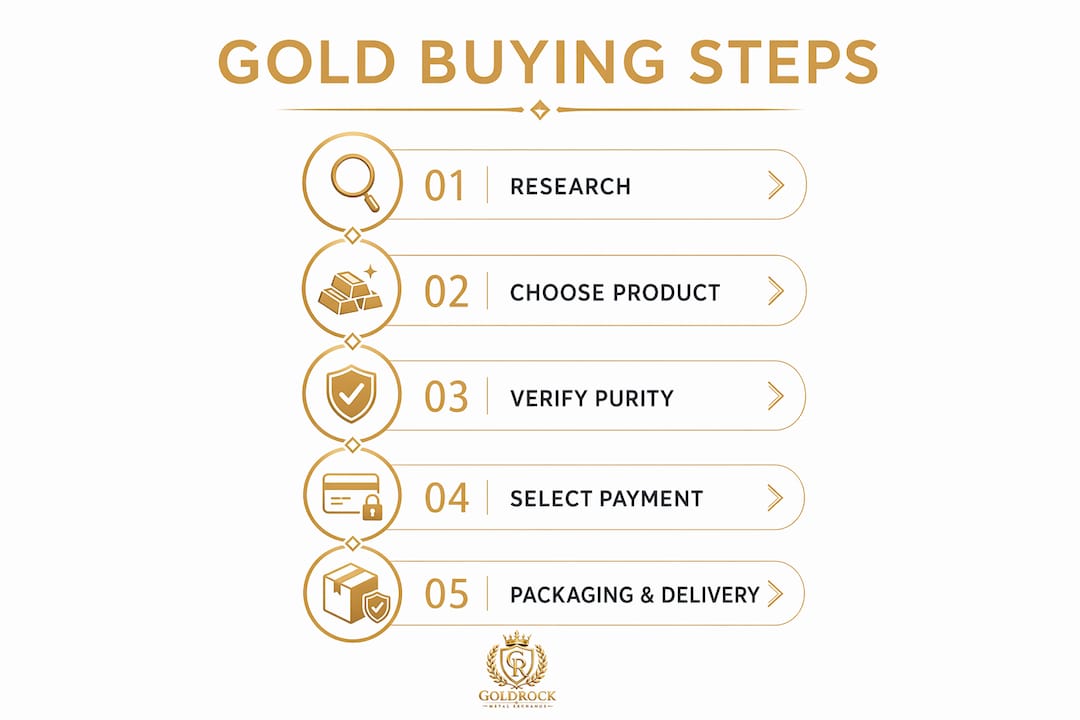
Buying gold comes down to nine steps: set your goal and budget, understand spot price and premiums, choose between physical and financial gold, pick a reputable dealer, check your state’s sales tax, place your order, select a payment method, verify your delivery, and arrange secure storage. That sequence works whether you’re buying your first coin or funding a self-directed IRA. The details inside each step are where most beginners lose money or confidence, so here’s what actually matters at each stage.
The gold buying process at a glance:
- Step 1: Define your goal (wealth preservation, growth, hedging) and set a realistic budget
- Step 2: Learn how spot price and premiums determine what you actually pay
- Step 3: Decide between physical gold (coins, bars) or financial gold (ETFs, futures, IRAs)
- Step 4: Choose a dealer with verified credentials and transparent buyback terms
- Step 5: Check your state’s sales tax rules before placing any order
- Step 6: Place your order and lock the price quickly during checkout
- Step 7: Pay by wire transfer when possible to avoid card surcharges
- Step 8: Inspect your delivery before signing and verify authenticity
- Step 9: Store your gold in a rated safe or professional vault
Table of Contents
- How the gold buying process works for physical bullion
- What are your options for investing in financial gold?
- How do you choose the right gold investment for your situation?
- What drives gold’s price and how do US taxes affect your purchase?
- GoldRock Metal Exchange makes the process straightforward for new buyers
- Key Takeaways
How the gold buying process works for physical bullion
Physical gold means you own the metal directly: coins, bars, or rounds that you can hold, store, and sell. It’s the most straightforward form of gold ownership, but the buying process has more moving parts than most beginners expect.
Choosing your product type
The three main physical formats are coins, bars, and rounds. Government-minted coins like the American Gold Eagle, the Canadian Gold Maple Leaf, and the South African Krugerrand are the most liquid option. Any dealer in the country will buy them back without hesitation. Gold bars from accredited refiners carry slightly lower premiums at larger sizes but get more scrutiny at resale. Rounds are privately minted and generally carry the lowest premiums, though they lack the sovereign guarantee that makes coins easy to sell quickly.

For a first purchase, a 1 oz government-minted coin is the standard recommendation. You get the best premium-per-ounce ratio, the widest resale market, and the simplest math. Fractional coins (1/4 oz, 1/10 oz) cost more per ounce in premium terms. A 1/10 oz American Gold Eagle, for example, typically carries a premium of 10% or higher above spot. That’s a real gap to close before your gold starts working for you. You can explore specific popular gold coin options to compare formats before committing.
Authentication and purity verification
Gold purity is measured in karats or fineness. Standard investment-grade bullion runs .999 or .9999 fine (24 karat). American Gold Eagles are 22 karat (.9167 fine) but contain a full troy ounce of gold alloyed with copper and silver for durability. When your order arrives, check the weight with a calibrated scale and use a basic acid test or electronic tester if you have any doubt. Reputable dealers ship with assay cards or certificates of authenticity for bars. If a bar arrives without a recognized refiner stamp, that’s a problem worth addressing immediately.

State sales tax and payment methods
Sales tax on gold varies by state. Many U.S. states exempt investment-grade bullion from sales tax, though some still impose it depending on product type or purchase size. Tax is calculated on the ship-to address, not the dealer’s location, so check your state’s rules before you order.
Payment method affects your total cost more than most buyers realize. Wire transfers typically receive the best pricing from dealers because there are no processing fees to pass on. Credit card payments add surcharges that can erode the premium advantage you found. If you’re buying at a tight premium, paying by card can wipe out that savings entirely. For tax planning around your gold purchases, a resource like Lotus tax planning can help you understand state-specific obligations before you buy.
Packaging, delivery, and storage
| Consideration | What to know |
|---|---|
| Shipping | Reputable dealers ship in discreet, unmarked packaging with full insurance |
| Signature requirements | Orders typically require signature confirmation at delivery |
| Inspection | Refuse a visibly damaged or tampered package before signing |
| Home storage | Use a fire-rated safe bolted to the floor or wall; a basic lockbox is not sufficient |
| Professional storage | Third-party vaults offer higher security and insurance for larger holdings |
GoldRock Metal Exchange provides insured private delivery and secure storage guidance, so buyers know exactly what to expect from the moment an order ships to the moment it’s secured.
What are your options for investing in financial gold?
Financial gold lets you gain exposure to gold prices without taking physical possession. The main vehicles are exchange-traded funds (ETFs), futures contracts, and gold-backed IRAs. Each serves a different investor profile.
Gold ETFs trade on stock exchanges like the NYSE. The SPDR Gold Shares ETF (ticker: GLD) is the most widely held, tracking the spot price of gold. ETFs offer high liquidity. You can buy and sell shares in seconds through any brokerage account. The trade-off is that you don’t own physical metal. You own a share in a fund that holds gold on your behalf, which introduces counterparty risk that physical ownership eliminates.
Gold futures contracts trade on COMEX, the Commodity Exchange Inc. that operates as part of the New York Mercantile Exchange. COMEX is the largest gold futures market by trading volume globally. Standard contracts represent 100 troy ounces, making them impractical for most retail buyers. Futures are primarily tools for hedging and speculation, and only 1–2% of contracts result in actual physical delivery.
Gold-backed IRAs are self-directed individual retirement accounts that hold physical gold instead of paper assets. The IRS requires that gold in an IRA meet minimum purity standards (.995 fine for bars) and be stored at an approved depository. You cannot store IRA gold at home. The tax advantages can be significant for long-term holders, particularly those in higher brackets, but setup fees, annual maintenance costs, and storage fees add to the total cost of ownership.
Key differences between physical and financial gold:
- Physical gold eliminates counterparty risk; financial gold products depend on the solvency of a fund, exchange, or custodian
- ETFs offer same-day liquidity; physical gold typically takes days to sell and settle
- Futures require margin accounts and active management; they’re not a passive holding
- Gold IRAs combine physical ownership with tax-deferred or tax-free growth, depending on account type
- Regulatory reporting requirements apply to certain large transactions in all formats
GoldRock Metal Exchange operates a dedicated in-house IRA department that handles the transfer of existing retirement accounts into precious metals. For buyers considering this route, the self-directed IRA options page covers account types, eligible metals, and the setup process in detail.
How do you choose the right gold investment for your situation?
The right gold product depends on four factors: your investment goal, your budget, your liquidity needs, and your tolerance for complexity. Getting clear on these before you browse any product page saves time and prevents expensive mistakes.
Start with your goal. Wealth preservation favors physical coins or bars held long-term. Portfolio hedging against inflation or currency risk can be served by ETFs or a gold IRA. Growth-oriented buyers sometimes use futures, though that requires active management and a higher risk tolerance. If your goal is retirement security, a gold-backed retirement portfolio approach through a self-directed IRA may offer the best tax structure.
Compare premiums and buyback spreads together. The premium is what you pay above spot to buy. The buyback spread is what you give up when you sell. A dealer advertising a 2% premium but offering only 95% of spot on buyback costs you more over a full round trip than a dealer charging 3% with a 98% buyback. Trustworthy dealers maintain visible credentials and transparent buyback terms. Always ask about buyback policy before placing your first order.
Verify dealer credentials. Look for US Mint Authorized Purchaser status for American Gold Eagles, Better Business Bureau ratings, and membership in the Professional Numismatists Guild (PNG) or the National Coin and Bullion Association (NCBA). A quick check of the BBB website and the CFTC enforcement actions database eliminates nearly all fraud risk before you wire a dollar.
Pro Tip: Never choose a dealer based solely on the advertised premium. Factor in shipping costs, payment method surcharges, and buyback terms to calculate your true all-in cost. A dealer with a 3% premium and free insured shipping often beats one with a 2% premium and a $25 shipping fee.
On timing: gold prices update continuously during market hours, and trying to catch the exact low is a losing game for most buyers. Dollar-cost averaging spreads purchases over time, smoothing your average cost and removing the emotional pressure of timing every buy. For larger purchases, staggered buying across multiple price points reduces the risk of deploying all your capital at a spike high.
What drives gold’s price and how do US taxes affect your purchase?
Understanding gold pricing mechanics is the difference between paying a fair premium and overpaying without knowing it.
How spot price is determined
The spot price is the benchmark market rate for raw gold, set through two primary mechanisms. The London Bullion Market Association (LBMA) runs a twice-daily price auction at 10:30 AM and 3:00 PM London time, with fifteen direct participants including Bank of China, HSBC, and JPMorgan Chase submitting buy and sell orders by volume. When the net difference between buying and selling interest falls within 20,000 ounces, the auction concludes and that price becomes the official LBMA Gold Price, published in US dollars and 16 other currencies. COMEX in New York handles the continuous real-time price discovery between those auctions, accounting for roughly 80% of global gold futures trading volume.
Physical gold always trades above spot. The spot price reflects institutional wholesale trades of large bars, not retail coins or bars. When you buy a 1 oz coin, you pay spot plus a premium that covers minting, distribution, dealer margin, and market demand.
Premium components and typical ranges
| Product type | Typical premium above spot |
|---|---|
| 1 oz government-minted coin (Eagle, Maple Leaf) | 3–8% |
| 1 oz gold bar (accredited refiner) | 2–5% |
| 1/4 oz fractional coin | 5–10% |
| 1/10 oz fractional coin | 10%+ |
| Historic fractional sovereign coins | 2–5% |
Premiums widen during periods of high demand or market stress. During a price spike, checkout timing matters: most dealers lock your price for only 5–10 minutes after you confirm an order. If you don’t complete payment within that window, the price can reset. Have your payment method ready before you add anything to your cart.
US sales tax and regulatory compliance
Many states exempt investment-grade gold from sales tax, but rules vary by product type and purchase size. Some exempt coins but tax bars; others have minimum purchase thresholds before exemptions apply. Always verify your state’s current rules before ordering.
Dealers must also comply with Anti-Money Laundering (AML) and Know Your Customer (KYC) regulations. For large gold purchases, you should expect to provide identity documentation as part of the transaction. This is standard practice across the industry and a sign of a compliant, legitimate dealer. You can monitor live spot prices and premiums at GoldRock Metal Exchange to track current market conditions before placing an order.
GoldRock Metal Exchange makes the process straightforward for new buyers
Most gold dealers hand you a product catalog and leave the rest to you. GoldRock Metal Exchange takes a different approach: personalized guidance from a team that handles everything from product selection to IRA transfers to insured delivery.
For buyers coming from this guide, the practical difference is this. GoldRock’s in-house IRA department simplifies the transfer of existing retirement accounts into physical gold, silver, platinum, or palladium, without the back-and-forth that typically slows the process at other dealers. For direct purchases, insured private delivery means your metal ships discreetly and arrives protected. You’re not navigating storage logistics alone after the fact.
GoldRock Metal Exchange suits buyers who want a full-service experience: someone to talk to, a clear explanation of costs, and a dealer who stays involved after the sale. Browse the full product catalog to see current offerings, or check live spot prices to understand what you’d pay today. If a gold IRA is on your radar, the self-directed IRA page walks through the setup process step by step.
Key Takeaways
Buying gold successfully requires understanding spot price mechanics, total all-in costs, and dealer credentials before placing any order.
| Point | Details |
|---|---|
| Spot price is a reference, not your price | Physical gold always trades above spot; premiums cover minting, distribution, and dealer margin. |
| Payment method affects total cost | Wire transfers typically get the best pricing; credit card surcharges can erase a low-premium advantage. |
| State sales tax varies | Many states exempt investment-grade bullion, but rules differ by product type and purchase size. |
| Buyback spread matters as much as premium | Calculate the full round-trip cost, not just the upfront premium, to find the true cost of ownership. |
| GoldRock Metal Exchange | Offers personalized guidance, insured private delivery, and an in-house IRA department for full-service gold buying. |