

Most retirement portfolios can reasonably hold a small to moderate portion in gold, with the exact amount depending on income needs, the holding vehicle you choose, and how much price volatility you can stomach without selling in a panic. Gold’s job in retirement is to diversify and cushion against shocks to stocks and bonds, not to generate income or guaranteed growth. The right range for you comes down to how the sizing and vehicle choices below line up with your withdrawal plan.
TL;DR:
- Gold should be allocated between 2% and 12% of a retirement portfolio, depending on risk tolerance, inflation concerns, and income needs.
- The vehicle choice affects taxes, liquidity, and costs, with physical bullion incurring premiums and collectibles taxes, while ETFs and IRAs have different storage and tax rules.
- Avoid buying gold after rallies out of fear and rebalance periodically to prevent fee erosion and emotional trading.
- Fees, including premiums, bid-ask spreads, custodial charges, and insurance, can significantly impact net returns over time.
- GoldRock Metal Exchange offers streamlined services for IRA rollovers, physical delivery, and storage, facilitating adherence to IRS rules and minimizing transaction hassle.
Table of Contents
- Gold Allocation In Retirement: What The Ranges Actually Mean
- How To Size Gold For Your Retirement Needs
- Physical Gold, ETFs, And Gold IRAs: Custody And Tax Differences
- What Gold Actually Costs You Over Time
- How GoldRock Metal Exchange Helps Retirees Implement An Allocation
- Where Retirees Go Wrong With Gold Allocation
- Ready To Set Your Allocation? Here’s Where GoldRock Fits In
- Sources
- FAQ
Gold Allocation In Retirement: What The Ranges Actually Mean
There’s no single official number for gold allocation in retirement, but the guidance from financial outlets clusters into three bands that map to different risk appetites and goals.
- Conservative allocations for retirees who want diversification exposure without meaningfully affecting portfolio income or growth.
- A commonly cited range for investors over 50 balancing gold’s diversification benefit against the income it doesn’t produce, according to CBS News.
- Tactical positions for retirees specifically worried about inflation or currency risk, usually held for defined periods rather than as permanent fixtures.
Pro Tip: Some advisors use an inverse-age approach, where the older you get, the smaller your gold allocation becomes, reflecting changing income needs and time horizons.
Here’s what such ranges translate to in dollars on a retirement portfolio. Allocations in the lower to mid single-digit percentages correspond to meaningful sums invested in a non-income-producing asset, which is why J.P. Morgan Private Bank describes gold as a strategic diversifier rather than a growth engine. Its value shows up in how it behaves when equities and bonds move together in the wrong direction, not in the returns it generates on its own.
How To Size Gold For Your Retirement Needs
Picking a percentage from a rule of thumb is the easy part. Sizing gold correctly means running it through your specific income and liquidity situation first.
- Map your liquidity needs. Before allocating anything to gold, confirm you have enough cash and liquid bonds to cover your withdrawal rate for at least 12 to 24 months.
- Define gold’s job. Decide whether it’s there as portfolio insurance, an inflation hedge, or a small tactical position. This determines whether you treat it as a long-term holding or something you’d trim after a big rally.
- Pick a target percentage. Choose a number within the 2% to 10% range based on your risk tolerance and time horizon.
- Run the 30% drawdown test. Ask yourself honestly: if gold dropped 30% next year, would you hold or panic-sell? If the honest answer is “sell,” your target allocation is too high.
- Set a ceiling. Decide the maximum percentage you’ll let gold drift to before rebalancing back down, and write it down now, not during a rally.
Three quick profiles show how this plays out differently. An income-first retiree drawing 4% annually from a $1 million portfolio might cap gold at 5%, prioritizing liquid, income-producing assets. A preservation-first retiree with a pension covering most expenses might comfortably sit at 10%, since they need less liquidity from the rest of the portfolio. An inflation-hedge retiree worried about currency erosion over a 20-year horizon might run 10% to 12%, understood explicitly as a tactical position rather than a permanent one.
Physical Gold, ETFs, And Gold IRAs: Custody And Tax Differences
The vehicle you choose changes your tax treatment, your liquidity, and how much friction is involved in buying and selling.
- Physical bullion: You hold coins or bars directly, either through private delivery to your home or via secure third-party storage. This route offers direct control and no counterparty risk, but it comes with dealer premiums over spot price, insurance costs, and more effort to sell than a brokerage trade.
- Bullion-backed ETFs: These trade like stocks, offering same-day liquidity and no storage logistics. The trade-off is that many bullion ETFs are taxed as collectibles, just like physical metal.
- Self-directed Gold IRAs: These let you hold IRS-approved physical gold inside a tax-advantaged retirement account, but the IRS requires an approved custodian and storage in an approved depository. You cannot store IRA-held gold at home, and required minimum distributions apply once you reach the applicable age, just as they do with any traditional IRA.
On taxes, this is where a lot of retirees get caught off guard. Physical bullion and many bullion-backed ETFs are taxed as collectibles, meaning long-term gains are taxed at your ordinary income rate, capped at 28%, rather than the lower long-term capital gains rates that apply to stocks. That 28% ceiling can meaningfully change your net return on a large gain, which is worth modeling before you commit a significant sum. Our guide to Gold IRA rules breaks down the custody and purity requirements in more detail.
What Gold Actually Costs You Over Time
The percentage you allocate matters less than the fee structure you allocate it through. Two retirees holding identical 7% gold positions can end up with very different net outcomes depending on costs.
- Dealer premiums: The markup over spot price, which varies by product type and typically runs higher on smaller coins than on larger bars.
- Bid-ask spreads: The gap between what you pay to buy and what you receive when you sell, which eats into returns on short holding periods.
- Custodian and storage fees: Annual charges for Gold IRA custodians and approved depositories, usually a flat fee or a small percentage of assets.
- Insurance and delivery charges: Costs tied to insured private delivery or secure storage of physical metal outside a retirement account.
Pro Tip: Ask any dealer for a full written fee schedule before you buy, covering premium, storage, and custodian costs as separate line items. If a quote bundles everything into one number, that’s a sign to ask more questions, not fewer.
Watch for red flags, too: vague fee schedules, promises of guaranteed appreciation, high-pressure timelines, or claims that gold offers special tax shelters it doesn’t actually have. None of those hold up against a transparent process. For a closer look at how rebalancing discipline protects you from these cost drags over time, the analysis at Oracle Investments on portfolio drift is worth a read.
How GoldRock Metal Exchange Helps Retirees Implement An Allocation
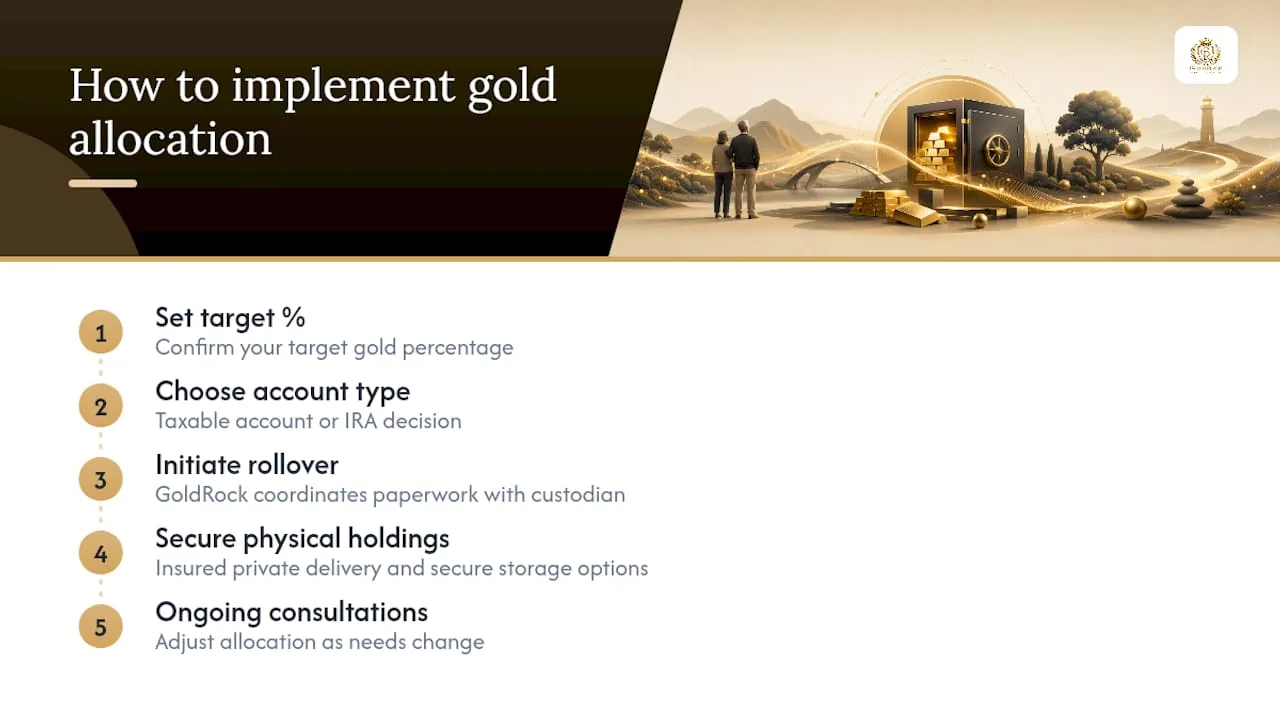
Once you’ve settled on a target range and a vehicle, execution is where most of the friction actually happens. GoldRock Metal Exchange’s in-house IRA department coordinates the paperwork for self-directed Gold IRA rollovers, working directly with your custodian so the transfer stays compliant with IRS rules. For retirees holding metal outside a retirement account, GoldRock offers insured private delivery and secure storage options, plus ongoing consultations as your allocation needs change.
None of this is personalized investment, tax, or legal advice. Talk to a fiduciary financial advisor or tax professional about how gold fits your specific situation before you act.
A simple next step: confirm your target percentage, decide between a taxable account and an IRA, and request a free consultation to walk through custodian and delivery options.
Where Retirees Go Wrong With Gold Allocation
The most common mistake isn’t picking the wrong percentage. It’s buying after a big rally out of fear of missing out, then panic-selling on the next dip because there was never a real plan. Rebalancing on a set schedule, rather than reacting to headlines, avoids most of this. The second-biggest error is ignoring fees until they’ve quietly eaten a chunk of the gain. Rebalancing rules that predefine your funding source for purchases, whether that’s cash or selling another asset, keep you from being forced into a bad trade at a bad time.
— Blake
Ready To Set Your Allocation? Here’s Where GoldRock Fits In
If you’ve settled on a target range and want a straightforward way to act on it, GoldRock Metal Exchange gives you a direct path: one team handling both the IRA rollover paperwork and the physical metal purchase, instead of juggling a custodian, a dealer, and a storage provider separately.

Getting started is simple. Request a consultation, decide whether a taxable account or a self-directed IRA fits your plan, and choose physical delivery or approved depository storage. GoldRock’s team coordinates the IRA rollover process directly with your custodian, and you can browse current gold and silver products or check live prices before you commit to a number. Request a Free Precious Metals Consultation, or call (888) 859-0978 to speak with someone directly.
Sources
Core references include the IRS, Investopedia’s Gold IRA primer, CBS News, J.P. Morgan Private Bank, and World Gold Council price data.
This article is general information, not a substitute for advice from a qualified financial advisor. Consult a qualified financial professional about your own circumstances before acting on anything here.
- How much gold should you own in retirement? Rules of thumb for investors over 50 – CBS News
- Is it a golden era for gold? – J.P. Morgan Private Bank
- Gold Allocation in a Retirement Portfolio? – Madison Partners
FAQ
How much of my retirement portfolio should be in gold?
Most guidance suggests a modest to moderate percentage allocation to gold for investors over 50, with conservative allocations toward the lower end and tactical positions possibly reaching higher percentages depending on individual goals and time horizon.
What does Warren Buffett say about gold?
Buffett has long favored productive assets like businesses and stocks over gold, arguing that gold doesn’t generate earnings or dividends the way a company does, which lines up with the view that gold works as a diversifier rather than a growth engine.
What percent of Americans have $1,000,000 in retirement savings?
This figure varies by year and data source and isn’t something this article’s research covers directly, so check a current retirement savings survey from a source like the Federal Reserve for an up-to-date number.
Is gold held in an IRA taxed differently than physical gold I store myself?
Yes.