
A dealer buyback policy is the written set of terms a precious metals dealer uses to repurchase bullion or coins it previously sold you, including how it prices the offer, what condition rules apply, and how fast you get paid. The single most important thing to check before you ever buy is how that buy price gets calculated relative to spot, whether that’s a stated formula (spot minus a percentage or flat dollar amount) or a published spread. Neutral guidance from FINRA and IRS rules under IRC §408(m) both matter here, and GoldRock Metal Exchange is one dealer readers can contact directly to ask these questions before committing.
TL;DR:
- Dealers typically buy back bullion at 2% to 8% below spot, with tighter spreads for sovereign coins and broader ones for generic or silver products.
- IRA held metals require coordination with approved custodians and depositories, which extends sale timelines and involves stricter compliance steps.
- Protect your resale value by obtaining written buyback formulas, packaging requirements, and serial number tracking before purchasing.
- Disputes over condition or authenticity benefit from documented evidence like photos and written dealer explanations, with recourse through consumer protection agencies.
- Most dealers now publish buyback formulas and lock-in windows, but spreads widen during market volatility, especially for smaller or off-brand items.
Table of Contents
- What Dealer Buyback Policies Actually Cover
- Spot, Spread, and What Buyback Prices Actually Look Like
- How IRA Buybacks Work: Custodians, Depositories, and Timing
- The Pre-Purchase Checklist: What to Get in Writing
- The Sellback Process, Step by Step
- Red Flags That Signal a Weak Buyback Policy
- Legal and Regulatory Considerations Behind Buyback Terms
- How Buyback Terms Have Shifted Over Time
- Dealer Buybacks Versus Other Ways to Sell
- Tax Implications When You Sell Back to a Dealer
- Your Rights When a Buyback Dispute Comes Up
- GoldRock’s Approach to Transparent Buyback Terms
- Ready to Ask the Right Questions Before You Buy?
- Where to Verify These Rules Yourself
- Sources
What Dealer Buyback Policies Actually Cover
A buyback policy spells out which products the dealer will repurchase and under what conditions. Most policies draw a hard line between investment-grade bullion (government-minted coins, branded bars) and numismatic or “collectible” pieces, which trade on rarity rather than metal content and are often excluded entirely or priced separately.
Beyond eligibility, look for four recurring terms:
- Condition requirements: scratched, cleaned, or damaged pieces frequently get a reduced offer or outright rejection.
- Packaging and documentation: original mint packaging, assay cards, or certificates of authenticity can affect the quoted price.
- Minimum quantities: some dealers won’t process a buyback below a certain dollar or ounce threshold.
- Quote lock windows and payment methods: how long a quoted price stays valid, and whether payment arrives by check, wire, or ACH.
None of these terms are universal across the industry, which is exactly why asking for a dealer’s written policy before purchase, rather than assuming one, protects you later.
Spot, Spread, and What Buyback Prices Actually Look Like
Spot price is the current market value of the raw metal. Bid is what a buyer will pay for it right now; ask is what a seller wants for it. The gap between those two, the spread, is where a dealer makes its margin on both the sale and the eventual repurchase.
Buyback offers are pegged to spot at the time of the transaction, and most dealers price their repurchases 2% to 8% below spot for common bullion products. Where you land in that range depends on the product:
- Sovereign coins (American Eagles, Canadian Maple Leafs): tightest spreads, highest liquidity.
- Branded bars from major refiners: close behind coins, still broadly accepted.
- Generic rounds or off-brand bars: wider spreads, less consistent demand.
- Silver products generally: proportionally wider spreads than gold due to storage and handling costs relative to value.
Pro Tip: Ask what the dealer would pay you back for the exact same item six months from today. A dealer that hedges with a vague answer is telling you something.
Volatility widens spreads industry-wide, and dealer scale matters too. Larger, higher-volume dealers can often hold tighter spreads because they turn inventory faster and don’t need as wide a cushion to manage risk. You can track how spot itself has moved using historical gold price data to get a feel for how much swings in the underlying market amplify swings in buyback offers.
How IRA Buybacks Work: Custodians, Depositories, and Timing
Selling metals held inside a self-directed Precious Metals IRA works differently than selling coins you hold personally, because IRS rules govern custody, not just eligibility. IRC §408(m) sets fineness and product standards for IRA-held gold, silver, platinum, and palladium, and it requires that those assets sit with an approved custodian and depository rather than in your possession.
That structure changes the sellback workflow:
- You (or your dealer) initiate the sale request through your IRA custodian, not directly with the depository.
- The custodian coordinates with the depository to verify the specific metals and confirm they meet IRA-eligible standards.
- The dealer provides a buyback quote against those verified holdings.
- Once the sale is approved, proceeds land back in your IRA as cash, not in your personal bank account.
- The custodian updates your account records to reflect the sale.
This extra layer of coordination means IRA sellbacks generally take longer than a personal bullion sale, and the paperwork trail is thicker. Anyone using an IRA to hold physical metals should expect that timing difference going in, rather than being surprised by it when they need liquidity.
The Pre-Purchase Checklist: What to Get in Writing
The best time to protect your future resale value is before you buy, not after. A handful of documents and confirmations at purchase time make an enormous difference when you eventually decide to sell.
- Get the dealer’s buyback formula in writing, ideally with a sample quote for the exact product SKU you’re buying.
- If the purchase is for an IRA, confirm which custodian and depository will hold the metal and what its own sellback process requires.
- Confirm packaging, serial number tracking, and any assay certificate requirements the dealer expects intact at resale.
- Keep your own paper trail: dated receipts, photos of the product and packaging, and serial numbers recorded separately from the physical items.
Pro Tip: Photograph sealed packaging and tamper-evident seals the day you receive your order. If a dispute ever comes up over “condition,” dated photos are your strongest evidence.
Reviewing a dealer’s overall transparency, not just its buyback math, is worth doing before you commit any funds; a look at dealer selection best practices is a useful starting point.
The Sellback Process, Step by Step
Selling back to a dealer follows a fairly consistent sequence across the industry, even though specific windows and requirements vary by company.
- Request a quote based on current spot and the dealer’s published formula.
- Lock the quote, typically valid for 24 to 72 hours.
- Ship the metal using the dealer’s specified insured carrier, or arrange in-person drop-off or custodial transfer for IRA holdings.
- The dealer inspects and verifies the shipment against your locked quote.
- Payment is issued, usually within one to seven business days after verification.
A few practical notes make this smoother:
- Missing a quote’s lock window almost always voids it, forcing a re-quote at the new spot price.
- Use insured, trackable shipping methods like Registered Mail or a bonded courier; standard parcel insurance frequently excludes bullion and coins in the fine print.
- If a dispute arises over condition or authenticity at inspection, ask for photographic evidence and a written explanation before accepting a reduced offer.
Red Flags That Signal a Weak Buyback Policy
Some policy language should make you pause before buying. Vague phrases like “we buy back at market price” without a stated formula tell you nothing about the actual spread you’ll face at exit.
- No published formula or spread, just a promise to “offer a fair price” at the time of sale.
- Heavy promotion of graded or numismatic coins, which usually carry wider spreads and a smaller pool of buyers than standard bullion.
- Long, one-sided quote lock windows that favor the dealer, or fees buried in the fine print that reduce your net proceeds.
- Shipping requirements that shift liability entirely onto you without clear insurance guidance.
Legal and Regulatory Considerations Behind Buyback Terms
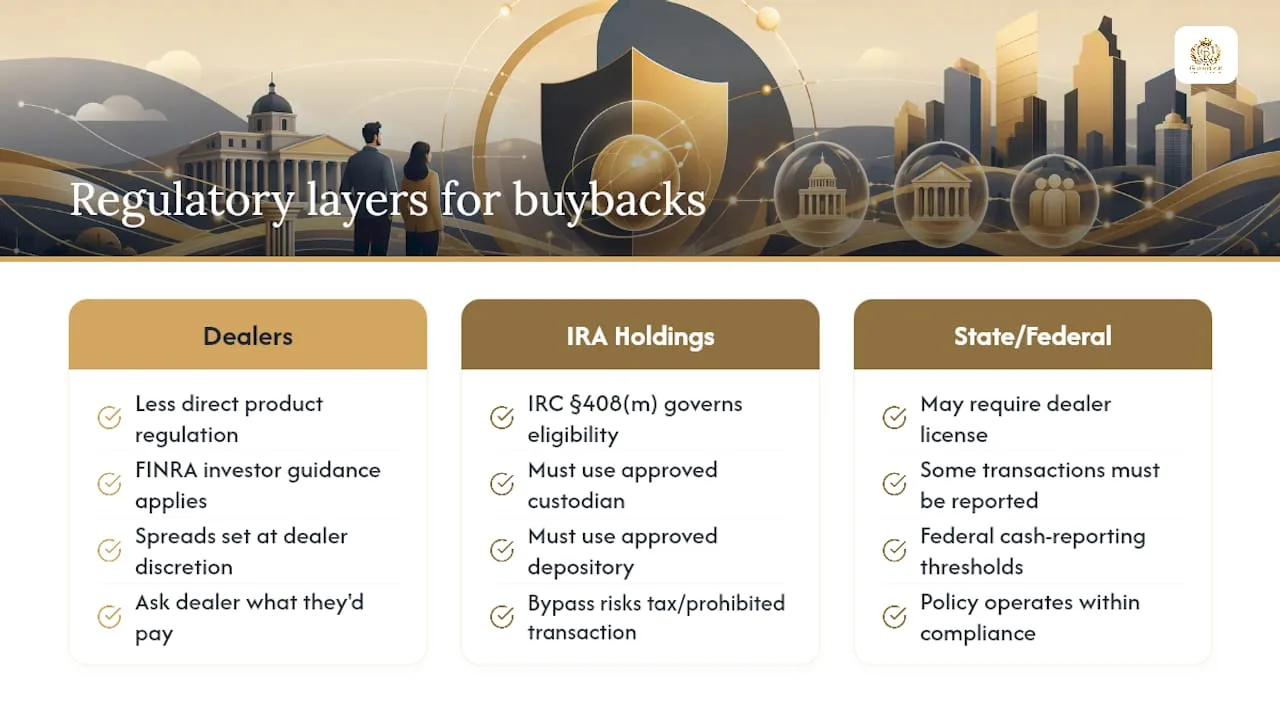
Precious metals dealers operate with less direct product regulation than, say, securities brokers, which is exactly why investor-protection guidance from bodies like FINRA matters even though metals dealers themselves aren’t FINRA members. FINRA’s own investor bulletin recommends asking a dealer directly what it would pay you back for a product, precisely because spreads are set at the dealer’s discretion and aren’t standardized across the industry.
For IRA holdings, the regulatory layer is more concrete. IRC §408(m) isn’t a suggestion, it’s the legal boundary for what metals qualify for IRA custody, and it mandates that those assets sit with an approved custodian and depository rather than at home. A buyback that doesn’t route through that custodial chain for IRA-held metals risks creating a taxable distribution or a prohibited transaction, which is a separate and more serious problem than simply getting a mediocre price.
State-level rules also come into play for personal (non-IRA) sales. Some states require dealers to hold a secondhand dealer license or report certain transactions, and reporting thresholds for cash transactions exist at the federal level as well. None of this is exotic, but it means the “policy” you’re handed isn’t just a marketing document, it operates inside a real compliance framework, and a dealer that treats it casually is worth a second look.
None of this constitutes personalized legal or tax advice. Rules vary by state and by account structure, and anyone with a complex situation should talk to a qualified tax or legal professional before acting.
How Buyback Terms Have Shifted Over Time
Buyback policies used to be far less standardized than they are now. A couple of decades ago, it was common for dealers to quote buyback prices verbally, with no published formula and no obligation to honor a number once market conditions moved. Investors often discovered the real spread only at the moment they tried to sell.
The rise of online bullion dealers changed that dynamic considerably. Competition pushed more dealers toward publishing at least a general buyback formula on their websites, and quote-lock windows, once rare, became a near-standard feature of the online sellback process. That shift didn’t eliminate spread variability, but it made the variability visible upfront rather than a surprise at the point of sale.
Volatility events have also reshaped policy behavior repeatedly. During sharp market swings, dealers across the industry widen their spreads temporarily to manage inventory risk, then narrow them again once prices stabilize. Investors who bought during a calm period and tried to sell during a volatile one have sometimes been surprised by a wider gap between their purchase price and their buyback offer, not because the policy changed, but because the market conditions underneath it did.
The IRA side of the market has matured too. As self-directed IRAs holding physical metals became more common, custodians and depositories built more standardized processes for verifying and processing sellbacks, which reduced (though didn’t eliminate) the friction that once made IRA-held metal harder to liquidate than personally held bullion.
Dealer Buybacks Versus Other Ways to Sell
A dealer buyback isn’t the only path to converting metal back into cash, and it helps to understand how it stacks up against the alternatives.
Selling to a local coin shop or pawn broker in person often gets you cash the same day, but pricing tends to be less transparent, and you’re relying entirely on that single buyer’s judgment of condition and value with no written formula to check it against. Private sales, listing bullion yourself to another individual, can occasionally net a better price since you’re cutting out a dealer’s spread entirely, but you take on the full burden of verifying the buyer, handling secure payment, and arranging safe transfer yourself, with none of the built-in verification a dealer buyback provides.

Auction houses are typically better suited to genuinely rare or numismatic pieces than standard bullion, and they charge seller’s commissions that can offset any price premium a rare item might command.
Against all of these, a dealer buyback policy, especially one with a published formula and an insured shipping process, offers the most predictable, documented path to liquidity. You know roughly what you’ll get before you ship anything, you have a paper trail, and you’re not personally vetting a stranger’s payment method. The tradeoff is that a dealer’s spread means you generally won’t get quite as much as a well-executed private sale might yield.
Tax Implications When You Sell Back to a Dealer
Selling precious metals back to a dealer is a taxable event, and the rules differ depending on how you held the metal. For personally held bullion outside an IRA, the IRS generally treats physical gold, silver, platinum, and palladium as collectibles, which can carry a different capital gains treatment than typical investment assets depending on your holding period. Dealers may also be required to file certain reporting forms for larger cash transactions, a compliance step separate from your own tax filing obligation.
For metals held inside a self-directed IRA, the tax picture shifts entirely. Because the custodian holds and processes the sale, proceeds return to the IRA as cash rather than as a personal payment to you, and the transaction itself typically isn’t a taxable event at the time of sale. Tax exposure instead depends on how and when you eventually take distributions from the IRA, following the same rules that govern any other IRA distribution.
Given how much these outcomes depend on your specific holding period, account type, and personal tax situation, this is an area where generic guidance only goes so far. A tax professional familiar with collectibles and self-directed IRAs can walk through your specific numbers in a way a general article can’t. Understanding gold’s role in a retirement portfolio alongside those tax mechanics helps frame the decision of whether to hold metal personally or inside an IRA in the first place.
Your Rights When a Buyback Dispute Comes Up
If a dealer’s inspection turns up a disagreement over condition, authenticity, or the quoted price, you have real options before accepting a reduced offer. Start by requesting the dealer’s specific written justification, ideally with photographic evidence of the issue they’re citing. A reputable dealer will document a condition dispute rather than simply lowering the number and expecting you to accept it.
Beyond the dealer itself, a few avenues of recourse exist. State consumer protection offices and attorneys general handle complaints against secondhand dealers and precious metals sellers. The Better Business Bureau maintains complaint histories that can be useful both before you buy and if a dispute drags on. For transactions that feel like they crossed into fraud or clearly deceptive advertising, the Federal Trade Commission accepts complaints as well.
Keeping your own documentation, receipts, photos, correspondence, is what makes any of these dispute paths actually work. A verbal disagreement with no paper trail rarely resolves in the seller’s favor.
GoldRock’s Approach to Transparent Buyback Terms
GoldRock Metal Exchange built its buyback process around the same principle this article has walked through: a written formula, not a verbal promise. Every client working with GoldRock’s in-house IRA department gets a dedicated point of contact for custodial coordination, and every insured private delivery follows documented chain-of-custody procedures from shipment through receipt.
If you want a straight answer about how a specific product’s buyback pricing works before you commit any funds, request a Free Precious Metals Consultation or call (888) 859-0978 to talk through your situation directly.
— Blake
Ready to Ask the Right Questions Before You Buy?
Most of the frustration investors run into with buybacks traces back to one thing: nobody handed them a written formula before they bought. GoldRock Metal Exchange puts that formula in front of you upfront, backed by an in-house IRA department that manages the custodian and depository coordination for you instead of leaving you to figure it out at sale time.

Whether you’re buying your first coin or rolling a retirement account into physical metal, the same rule applies: get the terms in writing before you pay. Browse GoldRock’s current gold, silver, platinum, and palladium inventory, check live spot pricing before you place an order, or review how insured private delivery works so you know exactly what protects your shipment both ways. If you’re holding metal in a retirement account or considering a rollover, GoldRock’s self-directed Precious Metals IRA team can walk you through custody and eligibility before you commit.
Keep every receipt, photo, and serial number from the day your order arrives. Then request a Free Precious Metals Consultation or call (888) 859-0978, and ask GoldRock for its published buyback terms before you buy anything.
Where to Verify These Rules Yourself
For the underlying rules on IRA-eligible metals and custodial requirements, IRC §408(m) is the governing standard, summarized clearly in this breakdown of IRS rules for self-directed IRAs. FINRA’s investor bulletin on buying physical metals covers the questions to ask any dealer about pricing and spreads. For a closer look at typical sellback logistics, including shipping and payment timing, the Minted Metal selling guide walks through the mechanics in more detail. The U.S. Mint’s own site remains the reference point for verifying specifications on government-issued bullion coins before you buy or sell.
This article provides general educational information about precious metals dealer practices and is not personalized investment, tax, or legal advice. Consult a qualified professional regarding your specific situation.
This article is general information, not a substitute for advice from a qualified financial advisor. Consult a qualified financial professional about your own circumstances before acting on anything here.
Sources
- Finra
- Gold buyback programs overview | USA Today
- Complete Guide to Selling Precious Metals | Minted Metal
- Precious metals in a self-directed IRA: Complete 2026 IRS rules – IRA Guidelines