


Personalized investment guidance aligns your strategy to your specific goals, risk tolerance, tax situation, and life stage, and the benefits of personalized investment guidance go well beyond better returns. Vanguard’s Emotional & Time Value of Advice survey found that 86% of advised investors reported greater peace of mind, and that the median time saved for advised clients was about two hours per week — more than 100 hours a year.
At a glance:
- Personalized guidance matches your portfolio to your actual goals, not a generic template
- Advised investors report measurably better emotional outcomes and significant time savings
- Specialist guidance matters most at inflection points: retirement, IRA rollovers, and physical metals allocation
Ready to see what tailored guidance looks like for precious metals? Request a Free Precious Metals Consultation — details below.
Key Takeaways
Personalized investment guidance delivers measurable value across financial, tax, behavioral, and time dimensions — and specialist guidance matters most when physical assets or IRA rollovers are involved.
| Point | Details |
|---|---|
| Peace of mind is measurable | 86% of advised investors reported greater peace of mind in Vanguard’s survey. |
| Time savings add up fast | Advised investors save a median of two hours per week — over 100 hours annually. |
| Verify credentials before committing | Check SEC adviserinfo for Form ADV and FINRA BrokerCheck for broker history. |
| Metals IRA needs a specialist | Self-directed Precious Metals IRAs involve IRS rules and custodian logistics that general advisors rarely handle. |
| GoldRock Metal Exchange | Offers a free consultation covering IRA rollovers, metal selection, and insured private delivery. |
This article is general information, not a substitute for advice from a qualified financial advisor. Consult a qualified financial professional about your own circumstances before acting on anything here.
Table of Contents
- What “personalized investment guidance” actually means
- 8 concrete benefits of personalized investment guidance
- What the research actually shows
- How personalized guidance is built and kept current
- Fee structures, costs, and how to verify an advisor
- Who benefits most from personalized guidance
- How to get started: questions to ask and steps to take
- Risks, limitations, and what to watch for
- How GoldRock Metal Exchange delivers personalized guidance
- GoldRock Metal Exchange offers a free consultation to get you started
- Sources
What “personalized investment guidance” actually means
The phrase gets used loosely, so the distinction matters. At the shallow end, “personalized” often means a risk questionnaire drops you into one of five model portfolios. That is template-based allocation, not true personalization.
Deep personalization is different in kind, not just degree:
- Shallow personalization: risk band assigned, target allocation set, periodic rebalancing back to that mix
- Deep personalization: asset-level decisions driven by your tax bracket, account types, concentrated positions, liquidity needs, and life events — with rules that are specific to you, not a cohort
InvestmentNews reports that many platforms’ offerings stop at risk-banding, and that true personalization requires portfolio construction driven by client intent with automated, client-specific rules. The other critical point: real personalization is ongoing. A one-time plan that sits in a drawer is not guidance — it is a document. Genuine guidance includes monitoring, rebalancing triggers, and updates as your life changes.
8 concrete benefits of personalized investment guidance
1. Strategy aligned to your actual goals
Generic portfolios optimize for a hypothetical average investor. A personalized plan starts with your specific targets — retirement at 62, a business exit, a Precious Metals IRA rollover — and builds backward from there. The asset mix, time horizon, and withdrawal sequence all follow from your goals, not from a model designed for someone else.

2. Tax efficiency through asset location
Placing tax-inefficient assets (bonds, REITs, actively traded funds) inside tax-advantaged accounts while keeping tax-efficient assets in taxable accounts can produce measurable after-tax gains. Wharton Pension Research Council research documents that this asset-location discipline generates real tax-alpha — gains that show up in after-tax wealth, not just pre-tax returns. Physical gold held inside a self-directed IRA, for example, defers taxes on appreciation in a way that holding the same metal in a taxable account does not.
3. Risk management matched to your comfort level
Risk tolerance is not a single number on a questionnaire. It includes your capacity to absorb losses without changing behavior, your concentration in any single position, and your liquidity needs over the next 12–24 months. A personalized plan addresses all three. If you hold a concentrated stock position or a large allocation to a single asset class, a tailored strategy can map out how to reduce that concentration without triggering unnecessary tax events.
4. Behavioral coaching that prevents costly mistakes
Vanguard’s research frames advice as a “behavioral partnership” — the advisor’s role during a market shock is as much about preventing panic-selling as it is about picking securities. Personalized guidance reduces impulsive reactions because the plan already accounts for volatility. You are not reacting to headlines; you are following a strategy built for your situation. This behavioral dimension often matters more than any small security-selection advantage.
5. Peace of mind — measurable, not just anecdotal
86% of advised investors in Vanguard’s survey reported greater peace of mind about their finances. That is not a soft metric — it reflects reduced anxiety, better sleep, and fewer reactive decisions during downturns. For investors holding physical metals or navigating an IRA rollover, knowing that custody, delivery, and tax treatment are handled correctly is a specific source of that relief.
6. Time savings that compound over years
The median advised investor saves about two hours per week compared to self-directed investors — over 100 hours a year. That time comes back from not monitoring markets daily, not researching every product decision, and not troubleshooting IRA paperwork. For a busy professional, that reclaimed time has real value independent of any portfolio improvement.
7. Flexibility as your life changes
A personalized plan is not static. Marriage, inheritance, a job change, or a shift toward retirement all alter the optimal strategy. Ongoing guidance means the plan updates when your circumstances do — rebalancing triggers fire when your allocation drifts, and life-event reviews happen before a major decision rather than after. This is the ongoing nature of real personalization that one-time financial plans cannot provide.
8. Measurable portfolio value across three dimensions
Vanguard’s whitepaper on the value of advice reviews studies estimating that personalized advice can add roughly 2–3% in value per year in certain samples, before fees, across portfolio construction, financial planning, and emotional outcomes. No single source of that value dominates — the gains come from better asset location, reduced behavioral drag, and smarter planning decisions working together.
What the research actually shows
The evidence base for personalized financial advice is stronger than most investors realize, and it covers more than portfolio returns.
Key findings:
- Peace of mind: Vanguard’s survey of advised investors found 86% reported greater peace of mind — a consistent, repeatable finding across the sample
- Time savings: The median time saved was about a couple of hours per week, which compounds to a considerable amount annually.
- Portfolio and planning value: Vanguard’s review of multiple studies estimates roughly 2–3% additional annual value in certain samples before fees, spread across portfolio construction, tax planning, and behavioral coaching
- The personalization gap: InvestmentNews documents that most platforms’ “personalized” offerings stop at risk-banding — which means investors who believe they have personalized guidance may actually have template-based allocation
The practical implication: the value of advice is not primarily about stock-picking. It comes from tax efficiency, behavioral discipline, and planning decisions that a generic portfolio simply cannot replicate.
Pro Tip: When evaluating any advisory service, ask specifically how the portfolio differs from their standard model allocation for someone with your tax bracket and account types. If the answer is vague, the personalization is probably shallow.
How personalized guidance is built and kept current
The process follows four stages, and understanding them helps you know what to expect and what to prepare.
-
Discovery: Document your goals, current holdings, account types (taxable, IRA, 401(k)), risk tolerance, tax filing status, and any concentrated positions or liquidity needs. Bring your last two tax returns, recent account statements, and a list of any single positions exceeding 10% of your portfolio.
-
Design: The advisor builds an asset-location strategy — placing tax-inefficient assets in tax-advantaged accounts, setting rules for concentrated positions, and mapping a withdrawal sequence. For precious metals investors, this stage includes deciding whether physical metals belong in a self-directed IRA or in a taxable account, and what custody or delivery arrangement fits your situation.
-
Implementation: Trades execute, IRA rollovers initiate, and physical metals purchases or transfers complete. For a Precious Metals IRA, this means coordinating with a custodian, selecting IRS-approved metals, and arranging insured delivery or custodian storage.
-
Monitoring and updates: Rebalancing triggers fire when allocations drift beyond set thresholds. Life-event reviews happen at major transitions. The plan evolves as your circumstances change — this is what separates ongoing guidance from a one-time financial plan.
Pro Tip: Speed up the discovery stage by preparing a one-page summary: total investable assets by account type, your target retirement date, and any assets you cannot or will not sell. Advisors can design a better plan faster when that information is ready on day one.
Fee structures, costs, and how to verify an advisor
Understanding what you pay — and what you get — is the practical core of evaluating any advisory relationship.
Common fee formats:
- AUM percentage: typically ranges from 0.25% to 1.5% annually, depending on account size and service depth
- Flat planning fee: a fixed annual or one-time fee for a financial plan, regardless of assets managed
- Hourly: charged per consultation hour, useful for narrow, specific questions
- Commission/transaction-based: the advisor earns a fee when you buy or sell a product — a structure that creates potential conflicts of interest
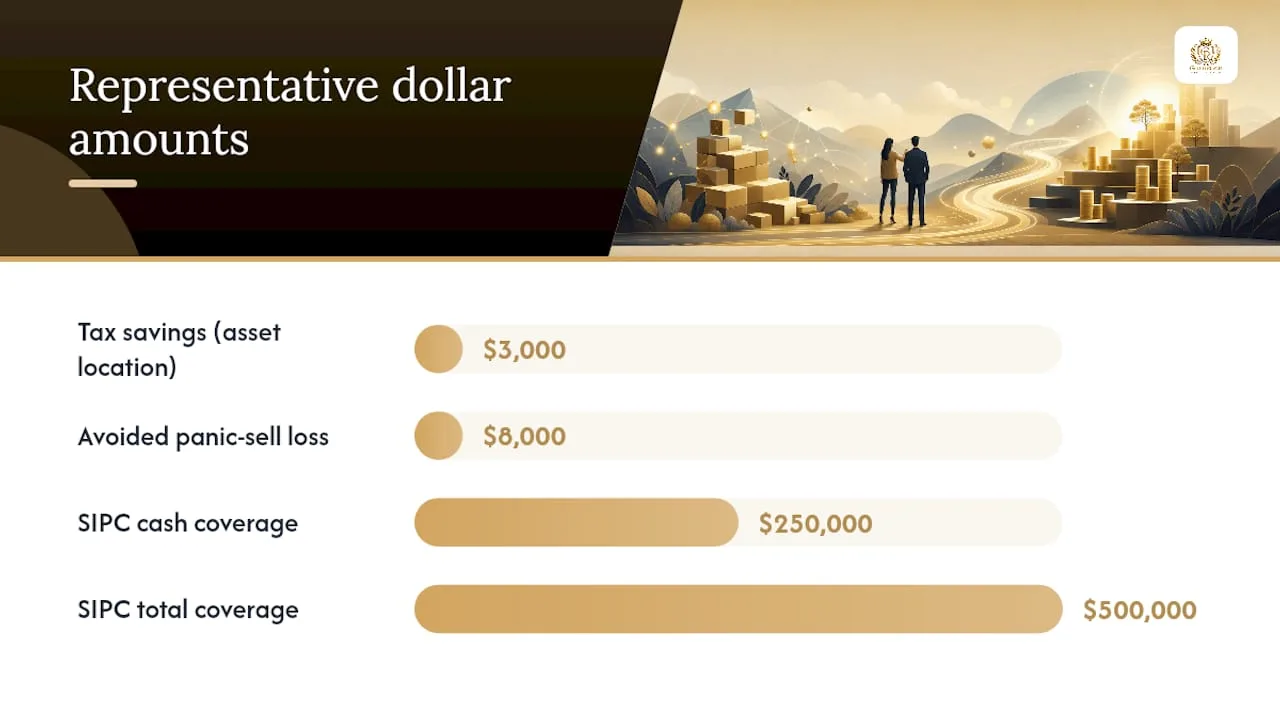
How to evaluate value against cost: Compare the fee to measurable benefits — projected tax savings from asset location, time reclaimed (two hours per week has a real dollar value), and the cost of a behavioral mistake avoided. If better asset location saves $3,000 in taxes and avoiding one panic-sell saves $8,000 in realized losses, the math favors the fee.
Trust signals to verify before you commit:
- CFP credential: Certified Financial Planner designation, verifiable through the CFP Board
- RIA/SEC registration: Registered Investment Advisers must file Form ADV disclosures; check SEC adviserinfo for registration status, services offered, and any disciplinary history
- BrokerCheck: FINRA’s BrokerCheck covers brokers and their representatives — employment history, licenses, and public disclosures
- Fiduciary duty: Ask directly whether the advisor is a fiduciary at all times, not just during certain transactions
- SIPC membership: SIPC protects customers of member broker-dealers if the firm fails, up to $500,000 (including $250,000 for cash) — but SIPC does not protect against market losses, and it does not cover physical precious metals held outside a brokerage account
For macroeconomic context when assessing portfolio risk, the Federal Reserve’s FAQ pages are a reliable primary source.
Who benefits most from personalized guidance
Personalization adds the most value in specific situations. Recognizing yours helps you decide how much guidance you actually need.
- Concentrated-stock holders: If a single position represents more than 20% of your portfolio, a personalized plan for reducing that concentration without triggering a large tax bill is worth significant money
- New retirees managing withdrawals: Sequence-of-returns risk, Social Security timing, and required minimum distributions all interact in ways that generic advice handles poorly
- Investors with complex taxable accounts: Multiple account types, capital gains carryforwards, and tax-loss harvesting opportunities require asset-level decisions that template portfolios cannot make
- Precious Metals IRA candidates: Anyone considering rolling over a 401(k) or traditional IRA into a self-directed Precious Metals IRA benefits from specialist guidance on IRS-approved metals, custodian selection, and the rollover process itself
- Busy professionals: The two-hours-per-week time savings is the primary benefit — delegating monitoring and rebalancing has real value when your time is genuinely scarce
When simpler approaches may suffice: If you have a single account, a straightforward asset mix, no concentrated positions, and no near-term life events, a low-cost index portfolio with automatic rebalancing may cover your needs. The case for deep personalization grows with complexity.
How to get started: questions to ask and steps to take
Prepare before your first conversation
- Gather account statements for all investment accounts (IRA, 401(k), taxable brokerage)
- Pull your last two federal tax returns — your marginal rate and filing status matter for asset-location decisions
- List any concentrated positions (single stocks, real estate, business interests) exceeding 10% of total assets
- Write down your three most important financial goals with target dates
- Note any upcoming life events: retirement, inheritance, business sale, or major purchase
Questions to ask any advisor or service
- Are you a fiduciary at all times, and will you confirm that in writing?
- Can I see your Form ADV Part 2, and will you walk me through your fee structure?
- How do you handle concentrated positions without triggering unnecessary tax events?
- If I want physical precious metals in my IRA, which custodians do you work with, and how does the transfer process work?
- What are the custody and storage arrangements for physical metals, and is delivery insured?
- Can you show me a sample client scenario similar to my situation?
Ready to talk to a specialist?
Request a Free Precious Metals Consultation with GoldRock Metal Exchange — Call (888) 859-0978. GoldRock’s in-house IRA team walks you through rollover options, metal selection, and insured delivery logistics at no cost for the initial consultation.
Risks, limitations, and what to watch for
Personalized guidance is not without trade-offs, and some risks are specific to physical metals.
Conflicts of interest: Commission-based advisors earn more when you buy certain products. Form ADV Part 2 discloses compensation arrangements — read it before signing anything. An advisor who earns a transaction fee on every metals purchase has a different incentive structure than a flat-fee planner.
Liquidity considerations for physical metals: Physical gold, silver, platinum, and palladium are not instantly liquid. Selling requires finding a buyer, negotiating a bid/ask spread, and arranging logistics. A personalized plan that includes physical metals should account for your liquidity needs over the next 12–24 months before committing a large percentage of assets to physical holdings.
Custody and delivery risks: Insured private delivery and secure custodian arrangements matter. Verify that any delivery service carries insurance covering full replacement value, and confirm custody arrangements in writing. GoldRock’s private metals delivery service includes insured delivery — confirm the specific coverage terms for your order.
Pro Tip: Ask for the delivery insurance certificate before your metals ship. A reputable dealer provides documentation of coverage without hesitation.
Regulatory limits to understand:
- SIPC covers brokerage account assets up to $500,000 if a member firm fails — it does not cover physical metals held outside a brokerage, and it does not protect against market losses
- IRS rules govern which metals qualify for IRA inclusion, contribution limits, and rollover procedures — consult the IRS directly or a qualified tax professional for your specific situation, as this article does not constitute tax or legal advice
- Verify any advisor’s registration through SEC adviserinfo before transferring assets
How GoldRock Metal Exchange delivers personalized guidance
GoldRock Metal Exchange operates with a dedicated in-house IRA department — not a third-party referral network — which means the team handling your rollover is the same team answering your questions about metal selection and delivery.
What the onboarding process looks like:
- A discovery call to understand your current retirement accounts, goals, and timeline
- A personalized metals allocation discussion covering gold, silver, platinum, and palladium options appropriate for your situation
- IRA transfer support: GoldRock’s team coordinates directly with your existing custodian to initiate the rollover
- Product selection guidance based on IRS-approved metals and your specific IRA structure
- Insured private delivery or custodian storage setup, confirmed in writing before metals ship
Trust signals you can verify:
- Dedicated in-house IRA department with direct advisor contact
- Insured private delivery on all physical metals orders
- Educational resources available at GoldRock Education
- Ongoing consultation available after your initial purchase
For investors considering gold’s role in a retirement portfolio or reducing portfolio risk with precious metals, GoldRock’s team provides guidance specific to metals — not generic financial planning.
Request a Free Precious Metals Consultation — Call (888) 859-0978.
A perspective worth considering
Most investors underestimate how much of the value in personalized guidance is behavioral, not analytical. The research is consistent on this: the biggest gains often come not from a better asset mix, but from not selling at the bottom of a correction, not over-concentrating in a single position, and not procrastinating on a rollover until the tax window closes. For precious metals investors specifically, the complexity of IRA rules, custodian selection, and delivery logistics creates real decision friction — and that friction is exactly where specialist guidance pays for itself. A general financial plan rarely addresses the specific mechanics of a self-directed metals IRA. A specialist who handles those mechanics daily does.
GoldRock Metal Exchange offers a free consultation to get you started
Physical metals investing involves decisions that generic financial planning tools are not built for: IRS-approved metal selection, custodian coordination, insured delivery logistics, and IRA rollover sequencing. GoldRock Metal Exchange’s in-house IRA team handles all of it in one place.

What the free consultation covers:
- A review of your current retirement accounts and how a Precious Metals IRA fits your situation
- IRA transfer and rollover options, including the specific steps and timeline for your account type
- Insured private delivery logistics and custody arrangements for physical metals
Request a Free Precious Metals Consultation — Call (888) 859-0978 or browse GoldRock’s IRA services to see current options.
This article is for educational purposes only and does not constitute personalized investment, tax, or legal advice. Consult a qualified professional and verify current IRS rules before making any investment or rollover decision.
Sources
- Advice Pays in Peace of Mind and Time: Vanguard Survey Reveals Hidden Value of Financial Advice | Vanguard
- Superficial personalization is reaching its limit; advisors’ next advantage lies in portfolios that truly reflect client intent — InvestmentNews
- Federalreserve
- Adviserinfo
- Sipc